If you are searching for digital commerce vs e-commerce, you will find definitions that sound similar enough to make the distinction seem unnecessary. While the terms were often used interchangeably, their roles have become more distinct as commerce has expanded across channels, connected systems, automation, and AI.
The simplest explanation is this: eCommerce enables the transaction, while digital commerce encompasses the broader journey, from discovery and personalization to fulfillment, service, and AI-driven experiences.
Gartner projects that 20% of digital commerce transactions will run through AI platforms by 2030, highlighting how quickly AI is becoming part of the commerce ecosystem.
At Excellent Webworld, we have spent 15 years delivering ecommerce development services for startups, businesses, and enterprises worldwide. I have observed a consistent pattern: businesses obsess over storefront capabilities while the real complexity builds behind them.
That is why ecommerce vs digital commerce is ultimately an architecture question. Understanding the technology, data, integrations, automation, and AI behind your commerce operations helps determine which model fits your business.
In this blog, I break down the key differences, business considerations, architecture considerations, and the practical path to modern digital commerce.
The Evolution of the Transaction: Defining the 2026 Landscape
E-commerce and digital commerce were initially used interchangeably and gradually became distinct over the past decade. To understand the difference, we explain both terms, where they diverge, and how that split influences your technology stack.
What Is E-Commerce? The Traditional Transactional Storefront
E-commerce refers to the ability to buy and sell products or services through digital channels, such as online storefronts, marketplaces, and apps. It covers product discovery, ordering, cart management, payment, and fulfillment. Nothing more, nothing less. For example, eCommerce platforms such as Shopify or WooCommerce can handle these functions well.
A modern eCommerce platform comes with additional capabilities, such as catalogs, pricing, promotions, inventory, customer accounts, orders, and fulfillment. However, legacy e-commerce platforms can become restrictive because their capabilities are tightly coupled to a single storefront or platform.
The important point is that eCommerce is not becoming obsolete. It can remain the transaction foundation for a digital commerce ecosystem, where businesses can connect new channels, enterprise systems, real-time data, automation, and AI capabilities without major changes.
What Is Digital Commerce? The Connected, Autonomous Ecosystem
Digital commerce is a connected commerce architecture where digital channels, backend systems, commerce capabilities, data, and next-gen technologies work in sync through APIs and composable architecture. It is designed to evolve as channels, business requirements, and technologies change.
An API layer enables businesses to connect storefronts, marketplaces, mobile apps, ERP, CRM, PIM, order management systems, and payment systems without being attached to one platform. Composable architecture allows businesses to replace or expand individual commerce components without rebuilding the system from scratch.
That structure answers what a digital commerce ecosystem is in practice: connected systems that can read and write data in real time and coordinate processes. AI then supports intelligent decision-making, automation, and orchestration across connected systems.
In the end, if e-commerce is a single well-built room, digital commerce is the whole connected building, designed so a customer can walk in through any door (a search result, a social ad, a voice assistant, a marketplace listing) and get the same coherent experience.
Differences Between E-Commerce and Digital Commerce
The digital commerce vs ecommerce difference becomes clear once you compare them side by side. Let’s compare digital commerce and eCommerce in detail across some of the most essential factors.
| Factor | E-Commerce | Digital Commerce |
|---|---|---|
| Scope | Mainly allows online product browsing, purchasing, payment, and completing checkout. | Covers the connected commerce ecosystem across discovery, personalization, purchase guidance, fulfillment, service, retention, and automation, often handled with AI. |
| Channels | Websites, mobile apps, and marketplaces are the primary transaction channels. | Websites, mobile apps, marketplaces, voice search, and AI agents can research, compare, and transact for the customer without direct browsing. |
| Focus | Enhances the entire online store and transaction experience. | Optimizes the broader customer journey and business operations through connected systems. |
| Technology | Built on a monolithic, all-in-one platform where the storefront and backend are tightly coupled. | Uses API-first, composable architecture to connect commerce capabilities and enterprise systems. |
| Personalization | Relies on customer profiles, rules, and recommendation engines. | Uses real-time context, behavioral data, predictive models, and AI to personalize experiences. |
| Data | Often siloed to the storefront, with ERP and CRM data synced manually or not at all. | Unifies data across the storefront, ERP, and CRM, giving AI systems one source of truth to act on. |
| Customer Service | Primaily supports customers through conventional chat, email, phone, or self-service tools. | Connects customer service with commerce data and AI customer service agents to support contextual, automated interactions |
The Core Verdict: Why the Difference Dictates Your Tech Stack
The e-commerce vs digital commerce difference shifts from an academic to a technical decision once a business plans to expand beyond a single storefront. Choosing the right architecture gives businesses the freedom to connect enterprise systems, unify data, and introduce AI without rebuilding the commerce foundation.
| Legacy E-Commerce Approach | Digital Commerce Approach |
|---|---|
| Rigid monolith architecture with tightly coupled storefront and commerce capabilities. | API-first, composable architecture that connects channels, services, and AI capabilities as business needs evolve. |
| Single-transaction focus with limited visibility beyond the immediate purchase. | Customer lifetime value (LTV) focus, using unified customer data and AI to support personalization, retention, and intelligent engagement. |
| Data silos across the online store, ERP, and CRM systems, limiting real-time decision-making. | Connected ERP, CRM, and commerce data that supports automation, analytics, and AI-driven workflows. |
| Ideal for businesses that need an off-the-shelf eCommerce solution with minimal customization. | Suitable for businesses that need an architecture that integrates with CRM, ERP, recommendation engines, and AI agents. |
Choosing the right architecture can determine success or failure. The decision can go wrong in both directions: over-investing in enterprise digital commerce infrastructure when a solid storefront is all that is needed wastes the budget. On the contrary, integrating AI personalization and omnichannel support into legacy approaches can result in a fragile stack that breaks with every update.
E-commerce can remain the transaction engine, but digital commerce requires an architecture built for connected systems, continuous modernization, and AI-ready operations.
How Digital Commerce Changes Across Business Models
The shift from eCommerce to digital commerce is not the same across eCommerce business models. Transaction complexity, customer experience requirements, and data needs determine which architecture works best for a business, not which one sounds more ambitious.
B2B: Complex Catalogs and Account-Based Buying
B2B commerce often requires capabilities that off-the-shelf eCommerce platforms do not handle well out of the box. These capabilities include account-specific pricing, custom catalogs, approval workflows, and multi-stakeholder buying cycles. A digital commerce approach allows businesses to manage complex customer relationships at scale, with AI progressively qualifying leads and routing approvals automatically.
B2C: Personalization at Scale
Most people associate eCommerce with B2C; however, modern eCommerce depends on more than a functional storefront. Personalized search, product recommendations, dynamic pricing, and AI-driven customer interactions depend heavily on connected data and an AI layer, capabilities that basic eCommerce platforms cannot provide natively.
C2C and Marketplace Models
C2C and two-sided marketplace models manage multi-party transactions, product discovery, trust, payments, and interactions between buyers and sellers. A digital commerce architecture helps connect these capabilities, similar to how we approached it for a multi-vendor super app marketplace, while AI can strengthen areas such as fraud detection, product discovery, matching, and content moderation.
The Business Case: Benefits and Risks of Going Digital First
Going digital first opens a new world of possibilities; however, it comes with different operational and technological risks. The right digital commerce strategy strikes the right balance between scalability and efficiency, including security, advancement, and differentiation.
| Benefits | Risks |
|---|---|
| Lower Operational Overhead: Automation reduces repetitive work and infrastructure costs per channel, allowing businesses to operate efficiently at scale. | Great Security Exposure: More connected systems and more digital touchpoints create greater security exposure, as AI agents access live data across the digital commerce ecosystem. |
| Faster Scaling: Connected API-first systems allow you to introduce new channels, products, services, and AI capabilities without rebuilding the entire tech stack. | Implementation Complexity: Adding new data, systems, and AI capabilities needs better control, architecture, and execution. Businesses should consider AI implementation challenges before scaling these capabilities. |
| Better Visibility and Decision Making: A unified digital data strategy boosts SEO and AEO, as content, product operations, and customer experience function simultaneously, while AI helps businesses make efficient, data-backed decisions. | Weak Differentiation: Technology has little inherent advantage. Any business can replicate your online storefront. What wins now is how businesses use AI, data, and connected experiences to deliver value beyond competitors. |
The Catalyst of Modern Digital Commerce: The AI Imperative
AI is no longer limited to digital commerce. It transforms the way customers browse, make purchase decisions, complete transactions, and how businesses manage day-to-day operations.
The real shift is from isolated AI features towards systems that can analyze intent, execute actions, and constantly optimize eCommerce operations.
From Basic Chatbots to Agentic AI
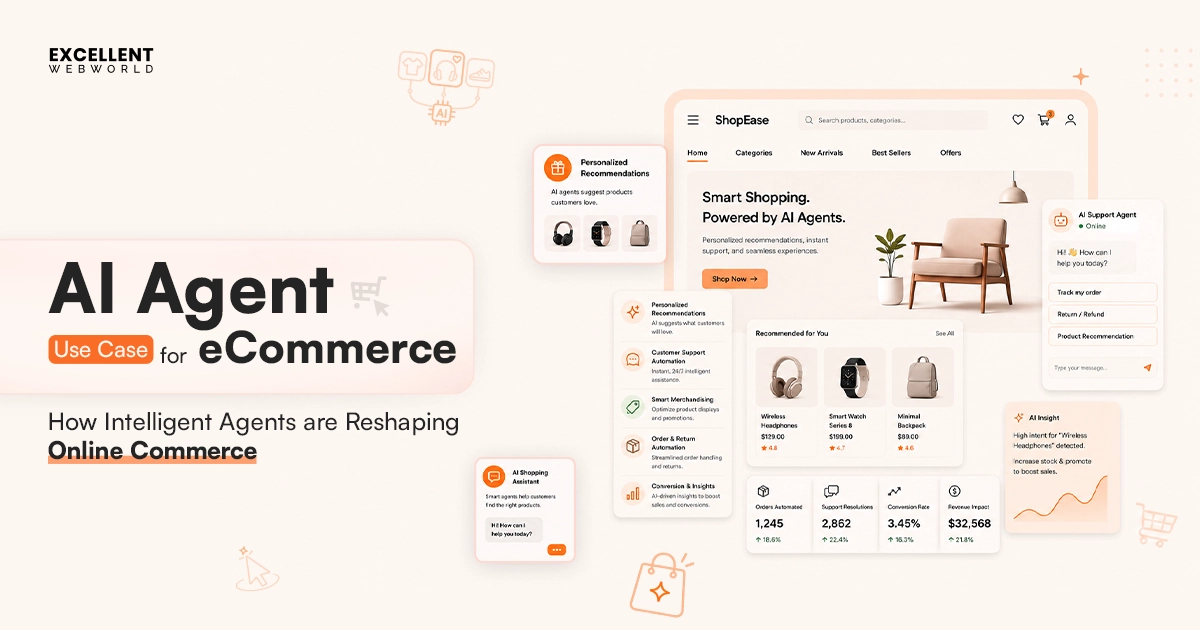
Most businesses initially started AI in eCommerce by using rule-based customer service chatbots for answering FAQs and handling rule-based queries. That ceiling is completely broken by AI agents. Today, AI agents move beyond basic conversation and handle multi-step tasks, such as researching products, comparing options, applying business rules, and coordinating actions across systems.
Agentic commerce is where AI agents can research and transact on behalf of customers, showcasing the major shift in digital commerce. This shifts the role of AI from customer support technology to an essential element in a customer's buying journey. Businesses need commerce systems that can securely connect AI agents with product data, inventory, pricing, payments, and fulfillment.
Hyper-Personalization Models
Hyper-personalization has reached a level beyond “customers who also bought” recommendations. The latest AI models can anticipate real-time intent, customer browsing patterns, product conversations, and contextual signals to provide relevant search results, recommendations, and digital experiences.
Instead of relying solely on past data, AI constantly evolves and delivers the best customer experience during the session. This ensures that personalization is highly responsive and suitable across varied online channels. In the end, digital commerce feels less like a store and more like a conversation.
Smart Supply Chains
AI has a positive impact on the operational side of digital commerce. Demand forecasting, inventory optimization, and dynamic pricing allow businesses to respond to evolving market trends with enhanced accuracy.
The value becomes greater when these capabilities integrate well with the advanced eCommerce ecosystem. AI-powered operations enable businesses to align inventory, pricing, and demand signals, while reducing manual intervention and supporting data-based decision-making.
Beyond AI: Other Technologies Reshaping Digital Commerce in 2026
AI is not only a primary catalyst but also a technology that reshapes digital commerce. Some of the best eCommerce trends are expanding the way customers browse, evaluate, and interact with products.
Voice Commerce and Conversational Shopping
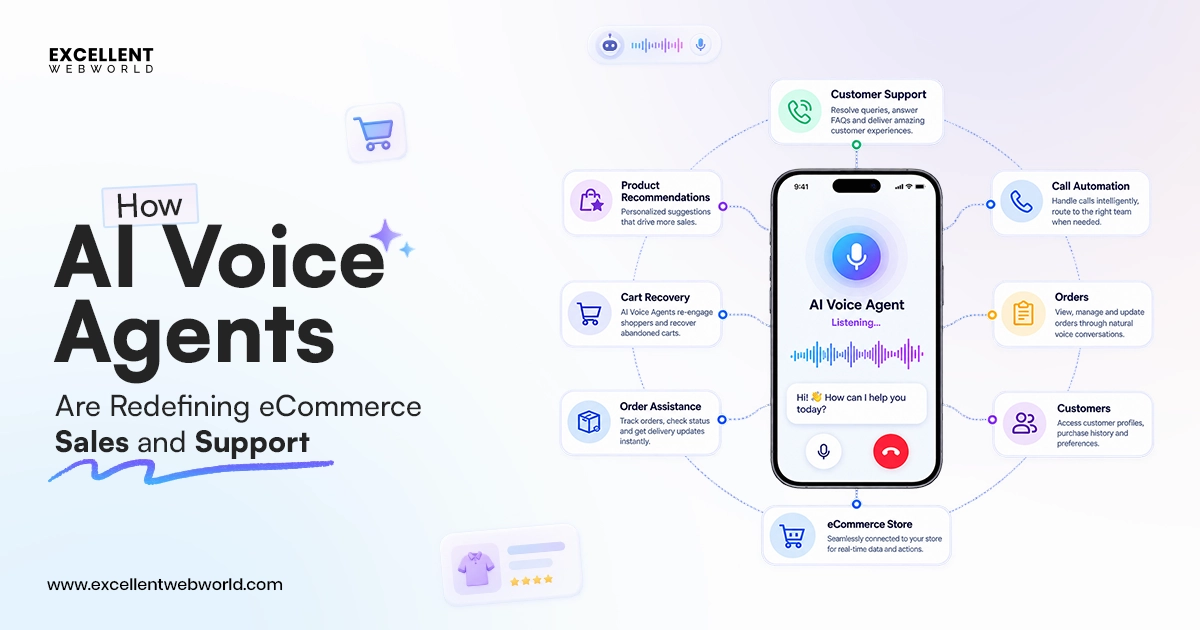
Voice interfaces through smart speakers and in-app voice assistants allow hands-free product discovery and conversational shopping, which provides additional ways for customers to discover and engage with online stores.
AR/VR and Immersive Product Experiences
Augmented and virtual reality in eCommerce work on the principle of “try before you buy.” Hence, virtual try-ons, 3D product reviews, and in-space visualization allow customers to evaluate products before buying, which matters when fit, size, and appearance are the core factors behind purchasing decisions.
The Architecture Behind a 2026 Digital Commerce Ecosystem
The architecture behind a modern digital commerce ecosystem combines headless commerce, AI middleware, and security controls to connect channels, enterprise systems, data, and intelligent automation.
The Role of Headless Commerce in Delivering Omnichannel Experiences
Headless commerce decouples the customer-facing frontend from the backend eCommerce capabilities that manage inventory, pricing, and order logic. APIs ensure that one backend can support a website, a mobile app, a voice assistant, and an in-store kiosk simultaneously, while keeping them in sync.
This flexibility is essential as customer journeys move swiftly between digital and physical touchpoints. Enterprises can launch next-gen experiences without rebuilding the core commerce infrastructure for every channel.
Building Custom AI Middleware: Connecting Legacy Data to Intelligent LLMs
Most enterprises don’t have to remove or replace their ERP, CRM, inventory, and commerce systems to go AI-native. Rather than replacing existing platforms, enterprises need a middleware layer that connects legacy data to intelligent LLMs without unnecessarily exposing or compromising that data.
This approach makes digital commerce migration more practical by introducing new capabilities progressively. Businesses building this layer can also explore how to build an AI agent that securely accesses approved enterprise data and systems.
Security and Compliance in the Age of Automated Digital Transactions
Automated transactions, connected systems, and autonomous AI actions can increase the risk of security breaches and cyberattacks, which is why enterprise AI security needs to be built in from the start. They also raise new questions around authorization controls, audit trails, data governance, and fraud monitoring.
In 2026 and beyond, enterprises should not consider security and compliance to be post-launch requirements. They must define how AI systems access data, perform actions, and remain accountable before launch.
Which Model Fits Your Business Right Now?
The selection of the right business model varies based on the operational needs, growth plans, and ability to deliver advanced commerce experiences.
| Signs Legacy Still Works | Signs You've Outgrown It |
|---|---|
| A small, stable product catalog and sales primarily through one or two established channels indicate that the existing model may still be suitable. | Business expansion across channels can make launching or managing each new channel increasingly time-consuming and resource-intensive. |
| Traffic, orders, inventory, and customer needs are handled without frequent manual intervention. | Manual reconciliation of inventory, orders, or customer data across disconnected systems has become part of regular operations. |
| Advanced personalization, automation, or AI-driven commerce experiences are not a significant requirement. | Fragmented customer data makes personalization difficult, while new AI capabilities require complex workarounds. |
| The existing platform can support foreseeable growth without major architectural limitations. | Legacy architecture is slowing integrations, automation, personalization, or the rollout of new digital experiences. |
Replatforming or Retrofitting: How to Transition Your Business
Moving from traditional eCommerce to a digital commerce model doesn't mean you need a complete replatform. The best approach is to identify the limitations of your current architecture and improve the areas that need it.
Auditing Your Current E-Commerce Limitations
Start by identifying where the existing eCommerce architecture falls short. Review data connectivity, personalization, channel expansion, performance, integrations, and manual processes to detect the real source of the problem.
Skip this step, and you might invest precious time resolving symptoms, such as a slow site, rather than the actual cause, which is the monolithic architecture behind it. An in-depth audit helps businesses avoid expensive solutions that address symptoms instead of underlying architectural limitations.
The Phased Roadmap: Infusing AI and Modular APIs into Your Existing Setup
A complete replatform is not always the correct solution. Businesses can add modular APIs, AI middleware, and new integrations gradually, then update frontend and backend components over time.
The phased approach reduces the risk of migration and keeps investment easier to manage. For example, businesses adding mobile commerce can evaluate ecommerce mobile app development cost as part of their broader modernization roadmap.
Choosing the Right Technology Partner
The right partner should discuss composable architecture, AI integration, API-led development, and data unification in detail, instead of just talking about storefront design.
They should be able to evaluate whether your business needs retrofitting, selective modernization, or a complete replatform. The main purpose here is not to include a technology just because it's new, but to build an architecture that supports future growth.
How Excellent Webworld Helps Businesses Build AI-Native Digital Commerce Platforms
Understanding the digital commerce vs eCommerce difference becomes essential when businesses want their platforms to operate on an AI-native, API-first architecture rather than function as a single storefront. A digital commerce platform should also integrate with ERP, CRM, and storefront systems to support better customer experiences and more efficient business operations.
Integrating AI into a disconnected system is not sufficient. The underlying architecture must support reliable outcomes while adapting to continuous change without adding unnecessary complexity.
At Excellent Webworld, we have 15+ years of experience, a team of 80+ eCommerce specialists, and have delivered 100+ eCommerce apps for startups, SMBs, enterprises, and Fortune 500 companies. As an AI development company, we help businesses integrate AI capabilities with commerce platforms, enterprise data, and operational workflows to build AI-ready digital commerce platforms.
Frequently Asked Questions
Shopify is primarily an eCommerce platform; however, it can support a broader digital commerce ecosystem. It can become part of the digital commerce strategy when it is connected to AI agents, ERP, and CRM data. In general, it can run the transaction layer, not the entire ecosystem.
Generative AI enables businesses to craft innovative and responsive digital commerce experiences. It can generate product descriptions, support personalized search, and increasingly, enable purchase decisions on a customer’s behalf. Its role is evolving from generating content to performing various steps in the customer journey to deliver personalized experiences.
The cost of migrating from legacy e-commerce to headless digital commerce can range from $30,000 to $300,000. However, there is no fixed cost, as the investment depends on existing architecture, integrations, data complexity, and required functionality. A basic headless migration may require less effort than rebuilding a commerce ecosystem involving ERP, CRM, PIM, multiple channels, and AI capabilities.
Agentic Commerce refers to the use of AI agents that can handle various eCommerce tasks, such as searching, comparing, and purchasing products on a customer’s or business’s behalf. Enterprises should prepare with API-first architecture, unified product and customer data, secure third-party integrations, and systems that enable AI agents to interact with commerce workflows.
An AI agent can understand customer intent, make decisions, and execute multi-step commerce tasks. Based on the use case, it can support product discovery, recommendations, customer service, order management, and other workflows end- to-end without needing a human.
Not necessarily; the decision depends on your business complexity and growth requirements. Shopify is a suitable solution for many businesses, while a custom headless architecture becomes more valuable when you require extensive integrations, next-level personalization, complex workflows, or enhanced control over the commerce experience.
AI improves backend operations by turning commerce data into faster predictions, decisions, and automated actions. Businesses can utilize AI for streamlining repetitive tasks, demand forecasting, inventory optimization, complex data analysis at scale, fraud detection, pricing, order management, and workflow automation across connected systems.

Article By


Mayur Panchal is the CTO of Excellent Webworld. With his skills and expertise, he stays updated with industry trends and utilizes his technical expertise to address problems faced by entrepreneurs and startup owners.