Building an app sounds exciting until reality hits. Deadlines pile up, budgets stretch thin, and your team is stuck maintaining two separate codebases for iOS and Android. Every bug fix takes twice the time, twice the effort, and twice the cost. This is the silent struggle most development teams face, and it’s exactly why so many businesses are asking: Is Flutter good for app development?
Flutter, Google’s open-source UI framework, has rapidly changed how modern apps are built. The benefits of Flutter app development go far beyond writing one codebase for multiple platforms. From faster development cycles to near-native performance, the benefits of Flutter are hard to ignore, especially when speed and budget both matter. Yet, many businesses still hesitate, unsure whether Flutter can truly handle their product’s complexity and long-term scalability.
That hesitation is exactly what this blog addresses. If you’re evaluating whether “Is Flutter good for app development” for your next project, this blog breaks down 13 advantages of Flutter that make it one of the most practical and powerful frameworks available today.
What Is Flutter? Is Flutter Good for App Development?
Developed by Google, Flutter is an open-source software development kit (SDK) that helps you to develop cross-platform mobile applications. It was first announced at Google I/O 2017, and the first version of Flutter 1.0 was released in December 2018. Since then, Flutter has become the most preferred cross-platform development SDK among developer communities. Flutter 3.41, released in February 2026, is the latest version of Flutter that focuses on transparency and modularity.
Apps that are built with Flutter tend to have an amazing UI. In addition, Flutter aims to provide a user experience that feels native on every platform.
So, what is the USP of Flutter?
The classic standpoint about Flutter is that we can use it to develop apps for six operating systems:
- Windows
- macOS
- Linux
- Linux-based Google Fuchsia
- Android
- iOS
By using Flutter, there is no requirement for platform-specific codebases. This technology aids in developing the app on a hybrid platform — a single codebase for iOS, Android, and Desktop apps.
Who Uses Flutter Today in 2026?
Not only consumer applications but also well-established enterprises have been developing mobile apps or using Flutter as their base technology.
Notable Flutter apps:
- Google Ads – Digital marketing ad management app
- Google Pay – Payments and financial services app
- Postmuse – Instagram photo editing app
- Watermaniac – Water consumption monitoring application
- Cryptograph – Update tracker app for global cryptocurrencies
- Hamilton Musical – Band app for karaoke and other details
- Groupon – To get deals and coupons
Is Flutter open source? Yes
Does it let you make amazing designs? Yes
Why don’t you give it a shot if you see companies with those names using the Flutter architecture and framework for their apps?
The market’s biggest players have been built on Flutter or are using it. Then why don’t you too?
Now that we have explained what Flutter is, let’s learn what programming language it uses.
13 Advantages of Using Flutter for Cross-Platform App Development
Now that you know the answer to “Is Flutter Good for App Development?” is a resounding yes, here are the 13 reasons that back this claim. Like every other technology, Flutter also has its own pros and cons. However, we’re discussing the advantages, which outweigh the disadvantages by a fair distance.
1. Open-Source Framework
Flutter’s open-source foundation means full transparency; you can inspect, customize, and trust the code powering your app. A global developer community continuously improves the framework, so your product benefits from cutting-edge innovations without extra cost. When you hire Flutter developers, they leverage this collective expertise to build faster, smarter, and more reliably.is open source, you can easily read and understand the code.
2. Cost-Effective
Flutter’s cross-platform development capabilities and faster development time can help you reduce the overall cost of app development. With Flutter, you don’t have to maintain separate codebases for Android and iOS. You can just build once and deploy that everywhere.
3. Native Advantages in a Cross-Platform Framework
Flutter is winning the hearts of developers and users at the same time because it offers the performance and feel of a native platform within a Flutter cross-platform development (hybrid) model. Also, if you’re deploying code in Flutter, you’re reducing the synchronization issues that could have occurred if you were maintaining two separate codebases for iOS and Android.
4. Reusable Code
You can reuse the Flutter codebase for Android, iOS, web, and desktop applications. Although Flutter can’t exactly reduce the development time by half, it significantly reduces the development time by eliminating the need to write platform-specific code.
5. Custom Widgets for Different OS
Flutter is a widget-based framework that allows developers to add as many plugins as they want. As the platform provides custom widgets, it helps you to create user-friendly UI designs. In addition to all these, Flutter provides an extensive widget library that helps you design a customizable UI that can be reused across different projects.
6. Strong Community Support
Flutter has a massive, rapidly growing developer community that contributes to the ecosystem by creating plugins, tools, and packages that speed up and improve the development process. Lastly, with more than 54,000 packages on pub.dev, Flutter is one of the richest cross-platform development frameworks in the market.
7. Backend-Agnostic with Excellent Cloud Integration
Flutter doesn’t come with a default or built-in backend, so it’s backend-agnostic technology. It means you can pair Flutter with any backend services. Common choices include Firebase, Supabase, AWS Amplify, custom REST APIs, and GraphQL backends. Out of these options, Firebase is the most popular one due to its official Flutter plugin and deep-level integration.
8. Google-Backed with Long-Term Commitment
As Flutter is developed and maintained by Google itself, you’re bound to get all the latest updates and long-term support. So many of the popular Google products, such as Google Pay, Google Ads, Google Earth, etc., are built with Flutter, so you can know the kind of trust Google has in this framework. This kind of commitment from a top tech company makes Flutter a reliable choice for long-term app development projects.
9. Hot Reload & Hot Restart
Flutter’s Hot Reload instantly reflects code changes in the development environment, letting developers see UI updates within seconds without losing the app’s current state. Hot Restart provides a fresh app launch when needed. Together, these features dramatically speed up development cycles.
10. Platform-Agnostic Nature
Flutter’s platform-agnostic architecture lets a single codebase run seamlessly across iOS, Android, web, and desktop, eliminating redundant development work. It means faster launches, lower costs, and consistent user experiences across every device. You get full cross-platform coverage without the overhead of maintaining separate teams for each platform.
BOX OF INFORMATION!!!
Flutter uses third-party packages and Framework packages.
Part I
The most popular third-party packages used in Flutter apps are:
- Rxdart
- cached_network_image
- SQFlite
- Font_awesome_flutter
- flutter_launcher_icons
Part II
The most popular framework packages used in Flutter apps are:
- http
- Shared_preferences
- Intl
- Meta
- Path_provider
- go_router
11. Faster Deployment
The code that you write in Flutter gets compiled into native ARM code for Android and iOS. While fixing bugs and upgrading features, hot reloading helps you to deploy updates seamlessly without recompilation. This feature enables a faster release cycle and agile development workflows, thereby answering your question of “Is Flutter Good for App Development?”
12. High Performance
With the introduction of Flutter 3.x, you have Impeller, the custom rendering engine, that bypasses native UI components and maps each and every pixel directly, thereby providing peak performance consistently. Thanks to these functionalities, there are fast, smooth animation transitions at 60 fps or 120 fps on supported hardware.
13. Compatibility with Existing Code
Flutter can be integrated with existing native code, making it a good choice for companies that want to add new features to their existing apps.
These were the benefits of Flutter for cross-platform mobile app development.
What Programming Language Does Flutter Use?
Dart is a foundational programming language of the Flutter framework. Dart not only helps you write code for Flutter applications but also helps you identify and debug bugs. The Dart virtual machines help in this process via just-in-time compilation during development and ahead-of-time compilation during production.
In March 2021, Dart null safety was introduced, and it became a fully supported feature in Flutter 2.0. As Flutter has evolved to version 3.41.7, null safety has become the norm rather than an optional feature. With null safety, you can reduce runtime errors because no variable in the code can have a null value unless it is explicitly set to null.
Flutter Developer Adoption & Satisfaction
If you go by Google Trends, Flutter still leads the chart as one of the most searched terms as far as the cross-platform app development framework is concerned.
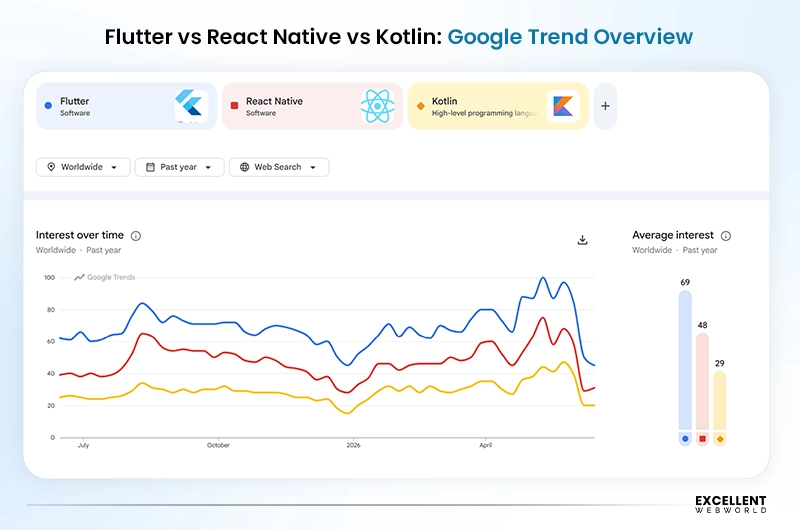
There are more than 1 million active Flutter developers, and 30% of all free iOS applications are now developed with Flutter.
According to Statista, Flutter is the most popular cross-platform development framework, with 46% of developers preferring it for modern app development projects.
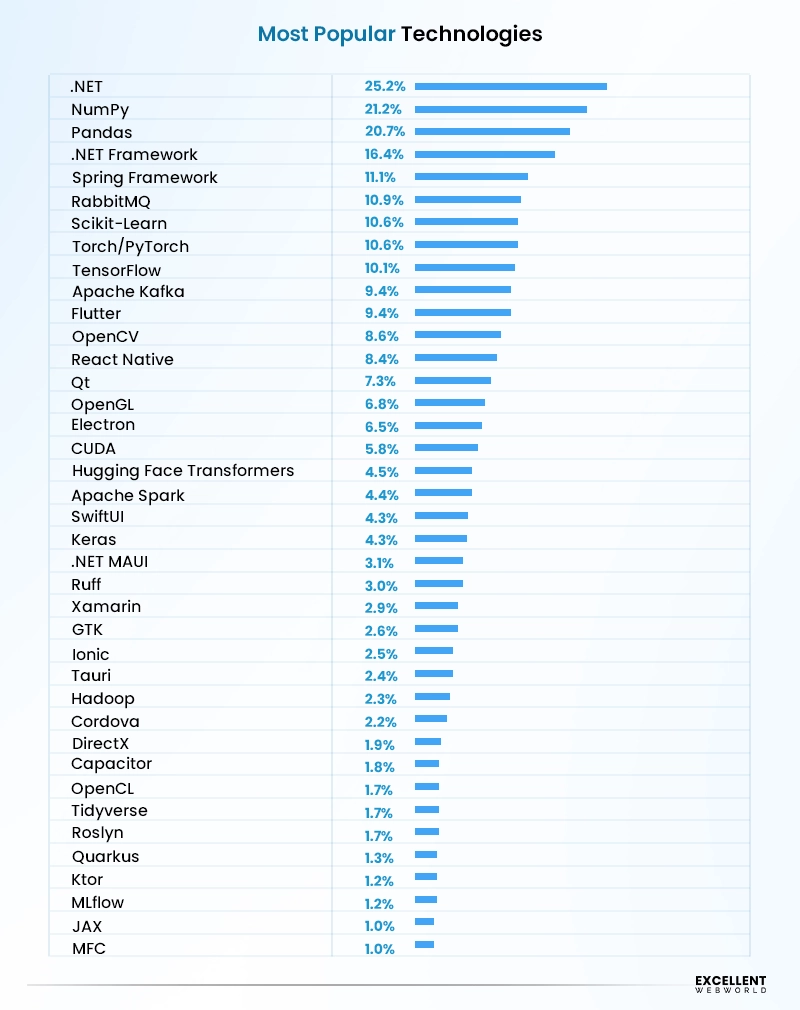
According to the Stack Overflow Developer Survey 2024, 9.4% of professional developers use Flutter.
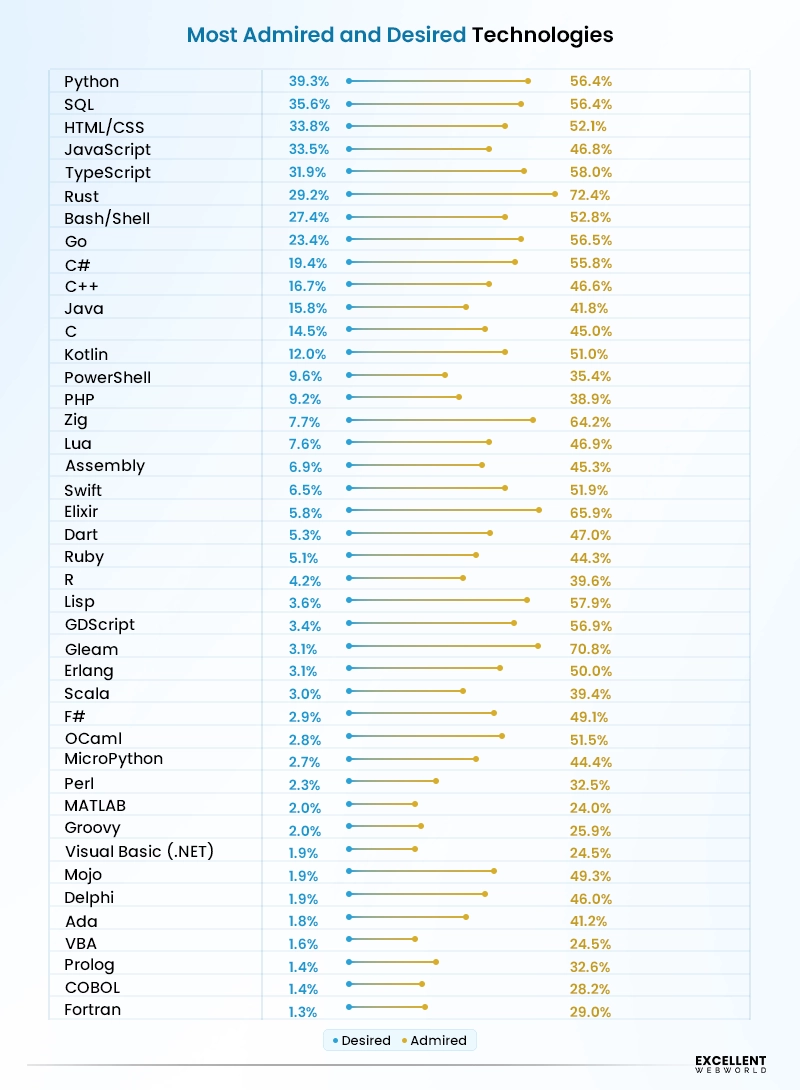
According to the Stack Overflow Developer Survey 2025, Dart, which is the primary programming language for Flutter, is admired by 47% of professional developers.
SEE COMPARISON of Flutter alternative Flutter Vs Kotlin
Flutter vs. Kotlin Multiplatform (KMP)
If you’re discussing the advantages of Flutter in 2026, a question that comes to mind is how Flutter pans out against Kotlin Multiplatform (KMP). While Flutter is a full-stack UI framework, i.e., a combination of code and a rendering engine, KMP focuses on business logic and data layers while keeping the UI native. Based on this distinction, you can say that KMP is a better choice when you want a native UI on each platform while sharing non-UI logic. On the other hand, Flutter is a preferred choice when you want a consistent UI across various platforms from a single codebase.
What Types of Apps Can Be Built with Flutter?
There are many niches where the Flutter framework excels in building mobile applications:
Utility Applications
Utility apps serve everyday practical needs – from file managers and compression tools to note-taking apps, flashlights, and media players. These apps demand smooth performance and broad device compatibility. Flutter’s cross-platform efficiency and consistent UI rendering make it an ideal choice for building lightweight, reliable utility apps that work seamlessly across platforms.
eCommerce App
There is no doubt that eCommerce applications have gained popularity today. To back this up with a statistic, retail m-commerce sales in the US will amount to approximately $850 billion by 2027. Shopping, grocery, retail, or any other type of on-demand app can fall under this title.
READ THIS ALSO: eCommerce UI/UX Design Tips To Increase Sales!
Lifestyle Apps
Users love using the apps wherein they can blurt out their feelings. Daily journals have always been a hyped up habit. Launching such an app can be very fruitful because of the high demand of mental health stability in this generation.
Also, another addition to the similar category would be the health and fitness apps. People skip gyms due to numerous reasons but they do choose to workout in the comfort of their home.
FinTech Applications
Having to carry cash is immensely boring and unsafe. It is not uncommon to use banks on phones. As the education ratio rises, people have been adopting online transactions worldwide. Banks, Insurance, etc.
Entertainment Mobile Apps
This can involve OTT platform apps or the musical band’s personal applications. Die hard fans collect the smallest possible insights about the bands. Imagine the overflowing number of downloads if you launch an entertainment app made in the Flutter framework.
Flutter Social Media Apps
The projected rise of users on social media is over 6 billion by 2028. The advanced framework of Flutter offers top-notch font faces, icons, typography, and scrolling behaviors. These altogether help in making the best UX.
There are not one but many niches in which we can use the Flutter framework to build mobile applications. Drive your digital product to success with Excellent Webworld’s Flutter App Development Services.
Flutter & Other Tech Trends – A Perfect Combination!
Fun Fact – Flutter not only rhymes but is also like water. Just as water takes the shape of a container it is poured in. Similarly, Flutter gels in with other trends very well too. It is a must-say that Flutter is an easy-to-blend framework.
Apart from digging into the question “Is Flutter Good for App Development?”, let us go into the depth of the trending Flutter best practices.
ML & Flutter
In recent years, Flutter has enabled developers to access world-class machine learning capabilities. The Machine Learning kit offered by Flutter allows developers to do API development and integration with utmost ease. Be it text recognition, face detection, image recognition, barcode scanning, image labeling, or language identification, all can be integrated into Flutter applications.
To integrate ML Kit into your Flutter applications, developers should use the google_mlkit_* family of packages (e.g., google_mlkit_text_recognition, google_mlkit_face_detection). The older plugin, such as firebase_ml_vision, is deprecated and should not be used in new projects.
You can host the custom ML models via Firebase ML or TensorFlow Lite. Lastly, the ML Kit works very well whether it’s on-device or in the cloud.
AI & Flutter
In 2026, Flutter’s support for AI has increased significantly. You can now integrate LLMs directly into your Flutter apps via REST APIs (OpenAI, Gemini, Anthropic, etc.), use on-device generative AI via TensorFlow Lite and MediaPipe, leverage Google’s Gemini API, and build AI-powered chat interfaces. The advantage of Flutter’s reactive architecture is that it makes it an ideal choice for streaming AI responses into real-time UI updates.
SEE COMPARISON of Flutter alternative Flutter vs React Native
Scope of Flutter In and Beyond 2026 — Is Flutter the Future?
Flutter has gained momentum as the most popular and widely used cross-platform development platform in the last decade or so. Major companies like BMW, Nubank, Groupon, and many Google products use Flutter, underscoring the trust the framework has earned in recent years.
Started as a mobile-only framework, Flutter has since expanded to support six platforms and now also embraces AI integrations and the Impeller rendering engine. All these innovations show how Flutter has continuously evolved over the years and has always adopted the latest market trends.
The developer satisfaction rates, growing package ecosystem, and continued Google investment all answer the question: “Is Flutter Good for App Development” with a YES.
Cost Estimate to Develop Apps in Flutter?
The future of Flutter is bright! Having covered major topics about ‘Is Flutter Good for App Development?’, let us deep dive into the cost of developing an app in Flutter.
- For a simple app made in Flutter, you would have to spend approximately $25k to $35k.
- On the other hand, for a more complex application, Flutter app development can cost you around $35k to $50k.
These figures vary based on developer location, engagement model, feature complexity, and project duration.
Read More: Best Utility App Development
When NOT to Use Flutter
Flutter is not an ideal choice for:
- Deep, platform-specific OS integrations
- Platform-native accessibility features
- Web-based applications where SEO is critical
- App scope is very platform-specific
- Building a lightweight application
Conclusion — Fluttering Towards the Future
Throughout this blog, you’ve seen the benefits of Flutter, its ecosystem, and how top companies are choosing it for cost-effective app development. You must also have gotten the answer to the question: “Is Flutter Good for App Development?” Flutter is not a universal solution for every app development requirement. However, when it comes to cross-platform app development, it excels by providing speed, efficiency, and a rich set of customizable widgets that help you streamline development across six different operating systems with a single codebase.
With Flutter 3.x fully stable, a thriving community, excellent AI integration capabilities, and continued Google investment, the framework’s position in 2026 is stronger than ever.
We are a decade-old Flutter app development company with a base of 600+ clients in Flutter projects and many more in various other front-end and back-end technologies.
Go through the excellent Clutch reviews for more details.
FAQs - Flutter App & Web Development
Yes, Flutter is definitely a good choice for web app development, especially since Flutter 3.0, the web support is stable. It also aligns really well with modern-day rendering technology. However, for SEO-heavy content sites, Flutter is not an ideal solution.
Yes, modern-day Flutter can build cross-platform apps that require high-quality graphics and animations. You can also design complex hierarchical structures in Flutter with the help of the Dart programming language. Large enterprises like BMW and Nubank are using Flutter for their highly complex business applications.
Yes, Flutter supports web development natively. You can build and deploy web apps using the same codebase as your mobile app, eliminating duplicate effort. Flutter web apps can function as Progressive Web Apps (PWAs), offering offline support and fast load times, making it a genuinely versatile choice beyond just mobile.
Yes, Flutter requires coding to develop applications. Flutter uses the Dart programming language. So, you need to know Dart to develop apps with Flutter.
Flutter uses the Dart programming language for improved application performance and responsiveness.
Flutter doesn’t use HTML to render UI; it draws everything on its own canvas using the Skia or Impeller engine. However, when deploying Flutter web apps, HTML is part of the underlying output. Developers can also embed web content within Flutter apps using the WebView plugin when needed.

Article By


Mahil Jasani began his career as a developer and progressed to become the COO of Excellent Webworld. He uses his technical experience to tackle any challenge that arises in any department, be it development, management, operations, or finance.