Your backend choice is something that either makes your web app or breaks your web app.
- Slow load times
- Scalability nightmares
- Developer burnout from wrestling with the wrong tools
If you feel these problems are small, then you are thinking the wrong way. It costs you time, money, and users.
Whether you are a CTO evaluating tech stack or a developer who wants to upgrade skills, picking the right backend framework for web app development is what you need.
However, in 2026, the options are better and more confusing than ever.
Let’s help you break the ice. We have researched and categorized the 12 most popular backend frameworks for your web app.
Why Do Developers Use the Backend Frameworks for Web App Development?
Developers are now more into advanced tech like AI, ML, and so on. Modern frameworks are the entry point for AI integration, cloud-native deployment, and multi-region scalability. These are the areas where developing from scratch is no longer viable. The advantages for developers using backend frameworks are:
- Production Speed: Development cycles are reduced by 40-60% with the help of pre-build routing, ORM, and middleware.
- Architectural Enforcement: Inconsistent patterns across teams are escalated by frameworks like Django and Rails.
- AI/LLM Integration: FastAPI’s async architecture and native validation are made to build LLMs and RAG pipelines.
- Security: You get protection with enterprise-grade CSRF, SQL injection, and XSS protection.
- Ecosystem Velocity: Your integration problems are addressed with package ecosystems (npm, PyPI, Packagist).
Top 12 Backend Frameworks for Web App Development
Frameworks have become an essential part of developing a robust application for both frontend and backend, and it creates seamless online platforms and lead to solving any complexities.
With multiple choices available in backend frameworks, finding which suits your application best is challenging. Hence, to help you with the best, we present the trending backend frameworks of 2026 that ensure scalability and high performance.
Let’s read the list of top backend frameworks in 2026 to know better!
| Framework (Language) | Best For | Performance Level | Learning Curve | Enterprise Adoption |
|---|---|---|---|---|
| Laravel (PHP) |
|
Medium | Moderate | Very High (Invoice Ninja, Pfizer, Morgans Hotel Group) |
| Node.js (JavaScript) |
|
High | Moderate | Very High (Netflix, Uber, PayPal, LinkedIn, Walmart) |
| Express.js (JavaScript) |
|
High | Low | High (IBM, Accenture, Uber, Fox Sports) |
| Django (Python) |
|
Medium | Moderate | High (Instagram, Mozilla, Disqus, Washington Post) |
| Ruby on Rails (Ruby) |
|
Medium | Moderate | Medium (Shopify, GitHub, Airbnb, Basecamp) |
| FastAPI (Python) |
|
Very High | Low | Growing (Microsoft, Uber, Netflix (ML layers)) |
| NestJS (TypeScript) |
|
High | Steep | High (Adidas, Roche, Autodesk, Capgemini) |
| Spring Boot (Java) |
|
High | Steep | Very High (Amazon, Google, Netflix, Intuit, Ticketmaster) |
| Go Gin / Fiber (Go) |
|
Very High | Moderate | Medium to High (Google, Dropbox, Docker, Cloudflare) |
| CodeIgniter (PHP) |
|
Medium | Low | Medium to Low (Nissan, Casio, Accenture, Ola) |
| Flask (Python) |
|
Medium | Low | High to Low (Netflix, Reddit, LinkedIn, Mailgun) |
| CakePHP (PHP) |
|
Medium–Low | Moderate | Declining (Mapme, Followmy.tv, Vamcart, QuickApps) |
1. Laravel

Taylor Otwell developed Laravel in 2011, and since then, it has been the best backend technology for mobile apps.
Laravel is a free, open-source PHP framework with MVC architecture. Furthermore, it follows the model-view-controller pattern based on Symfony. With this, Laravel is a web development framework with clean and straightforward syntax.
This PHP framework gives a syntax that is both elegant and expressive. It helps users access the relational database like an ORM with maintenance and deployment utilities.
Scalable Laravel development services can turn development into a fun process that makes basic operations like routing, authentication, and caching easier. A flawless and creative syntax creates high-performing web apps, which Laravel promises in 2026.
Features of Laravel
- Security : Laravel offers hashed and salted password methods with the Bcrypt Hashing Algorithm to ensure double security of passwords and protect against attacks. To prevent such attacks, the framework uses ready-made SQL statements.
- Template Engine: Laravel boasts built-in templates for generating layouts and seeding content—these templates design simple and complex layouts with JS and CSS widgets.
- MVC: MVC architecture supports separate business logic and presentation layers. The MVC offers functions and boosts security to aid performance growth.
- Unit-Testing: The Laravel framework performs testing to ensure that the development process does not break the new changes unexpectedly.
Benefits of Laravel- The Best Backend Technology
- Ease of User Authentication: Implementation is easy with this powerful PHP framework. For the reason that it provides a simple configuration. Simple control of access aids easy authentication with Laravel. With the Plug-and-Play method, users can safely access through a fast and intuitive UI.
- Faster Caching Integration: Laravel supports built-in backend caching like Memcached and Redis. It’s a quick and fast caching integration, leaving a stunning UX for the website.
- Safe Transactions: When a business develops a web application, safety is the prime concern. However, when using Laravel as your backend framework, it gives the best solution, and its in-built system protects against SQL injection, scripting, etc.
- Open-Source Community: Laravel is a strong community and an open-source framework that constantly supports developers to continue their work without interruption.
Top Web and Mobile Applications Built with Laravel
- Invoice Ninja
- BarChart
- Pfizer
- Studio Stomp
- Creative Spaces
- Morgans Hotel Group
Being one of the most popular backend frameworks of today, consider the above features and benefits, and develop a robust Laravel web application. Hire Laravel developers now!
2. NodeJS

NodeJS is the most in-demand backend framework among backend frameworks. To keep up with modern technologies, one needs to understand why NodeJS is important and where one can find NodeJS developers.
Node.js, now in its v22 LTS cycle, has evolved significantly from its 2009 origins. What began as a solution to I/O-blocking problems in web servers is now the runtime of choice for API gateways, real-time services, serverless functions, and edge deployments. There are possibly no programmers who are not aware of what JavaScript is.
With the rise of technology development, there is often debate for web app vs cloud app discussions, which often highlight Node.js as a cost-efficient one for both platforms. Its capability to manage real-time and synchronous processing makes it a powerful tool. While traditional web apps utilize Node.js for the backend operations, the cloud apps leverage its scalability to handle real-time processing, making it powerful for both platforms.
What are the NodeJS frameworks that have added to the value of this framework to ease the work?
- Nest.js
- Express.Js
- Fastify
- Socket.io
- Koa.js
- Hono
Features of NodeJS
- Event-driven: A server built on NodeJS will never wait for a response from an API. It is a non-blocking framework in nature that receives and tracks reactions of the previous API named Events.
- Single-threaded: The event mechanism allows the NodeJS server to respond in a non-blocking manner with a single-threaded architecture. NodeJS uses a single-threaded program to handle a considerable number of requests.
- Scalability: NodeJS is a software development framework that addresses one of the biggest concerns while building an app, i.e., scalability. NodeJS can handle requests efficiently with cluster modules to balance the load across all the CPUs. The capability of this framework lies in partitioning applications horizontally, which gives an appealing feature.
- Cross-platform: NodeJS is compatible with various systems such as Windows, Linux, Unix, Mac OS X, and mobile devices, and it is compatible with all the systems.
- Fast data-streaming: Other frameworks that came before NodeJS were slow and took a lot of time to process. NodeJS transmits data fast. Resultantly, this improves the overall speed of the internet and data streaming without buffering.
Benefits of NodeJS
- Easy to learn: Node.js is easy to learn. If one has mastered JavaScript and Object-Oriented Programming basics, Node.js is easy to start. Have a thorough understanding of the client-server model. Increase and brush up on your knowledge from tutorials or GitHub.
- Keeping it simple: There is no necessity to switch from backend to frontend. One code, one deployment, and everything falls in place with NodeJS. This framework requires less code and a few files that help speed up the development process.
- Saves time: Time is money for startups. During the initial development process, they work relentlessly to iterate fast, test, deploy, and deliver the project. The technology is lightweight and can decrease time without sacrificing functionality.
Top Web and Mobile Applications Built with NodeJS
- Netflix
- Uber
- Paypal
- eBay
- Walmart
Hire Dedicated developers now to develop an app like any of the above.
3. Express.js

Express.js is a NodeJS framework available under an MIT license. Express.js is a MEAN stack backend framework with an Angular frontend combination. It is known as one of the best backend frameworks for web development. Developers use this framework to develop APIs and online applications.
Features of Express.js
- Server-side programming: What is Express.js server-side programming? It is a part of NodeJS that serves widely used features to utilize at different program points. Web application development is faster with Express.js than with Node.js.
- Routing: Routing is a feature that retains web pages through URLs. Express.js provides fundamental routing, but Node.js allows sophisticated routing.
- Debugging: Bugs are common in every web app development and can cause immense malfunctions. Developers need to identify and correct bugs. However, Express.js has a convenient debugging system to identify bugs.
Benefits of Express.js
- Low maintenance Cost: Express is a full-stack JavaScript framework that eliminates hiring additional resources. With the assistance of NodeJS, you can rapidly scale up your app.
- Google V8 Engine Support: This supports the framework in offering better performance without any errors.
- Support for Both Frameworks: Express uses JS for coding the frontend and backend, making the platform easy.
Top Web and Mobile Applications Built with Express.js
- IBM
- Accenture
- Fox Sports
- Uber
- Countly
Also Read: What Is Vue.js Used For Web App Development?
4. Django
A Python-based open-source web framework is a free solution to database-driven complex web applications. Startups and enterprises emphasizing high-quality web design should opt for the Django framework using XML, JSON, and HTML formats.
Features of Django
- Scalability: Django is scalable because of its caching feature and code reuse. This makes Django apps work more efficiently during high traffic demand.
- Security: Security problems like SQL, CSRF attacks, and XSS become the default when Django developers refrain from addressing the issues.
- Added battery: Developers can use the packages instead of writing the code from the beginning. With this feature, developers can save time and concentrate on other app areas.
- Non-blocking programming: Depending on the MVC module, Django can run anywhere and support non-blocking programming.
Benefits of Django
- Speedy development: You don’t have to write separate code for each element you add to the web app. Developers utilize different elements simultaneously; moreover, it creates an MVP swiftly.
- Large community: Django’s community has scaled dramatically beyond the early contributor count. As of 2025, Django powers over 82,000 live websites globally (BuiltWith), maintains an active GitHub repository with 80,000+ stars, and hosts one of the most active Python framework forums
- Versatile use cases: The Django framework is versatile. The reason behind this is that it allows the creation of all types of websites and web applications, from CMS to social networking sites.
Top Web and Mobile Applications Built with Django
- Disqus
- Eventbrite
- Washington Post
- Mozilla
- Bitbucket
5. Ruby on Rails

Commonly known as Rails, it is an open-source backend framework for web app development with patterns like MVC and DRY to use.
Features of Ruby on Rails
- Libraries: Ruby on Rails contains an extensive library to build a high-quality database accessible and a common tasks library.
- Localization: This helps developers to combine their code to implement in big projects.
- Testing: RoR runs the tests on the code written by the programmers, which saves time and effort while delivering quality development.
Benefits of Ruby on Rails
- Accuracy: Due to built-in automated testing features, RoR provides accuracy in detecting errors. RoR is easy to handle, resulting in better consistency.
- Rapid development: RoR functions quickly and saves a lot of time, ensuring outstanding quality.
- Consistency: You may hire web developers to develop a web app with RoR. This is because they can standardize file storage and maintain the structural readability of the project.
Top Web and Mobile Applications Built with Ruby on Rails
- Shopify
- GitHub
- Basecamp
- Fiverr
- Airbnb
- SoundCloud
Read More: Is Flutter Good for App Development?
6. FastAPI
FastAPI is built on top of Starlette for web handling and Pydantic for data validation, making it an ideal choice for building production-ready REST APIs and microservices. Its automatic documentation generation and type-safety features make it the go-to backend framework for data science and ML-powered applications in 2026. For complex Python projects, this makes FastAPI particularly valuable as part of a broader application architecture, where a Python development company can connect APIs, ML models, and backend services into a production-ready system.
Features of FastAPI
- Automatic Interactive Documentation: FastAPI automatically generates interactive API documentation using Swagger UI and ReDoc out of the box. Developers no longer need to spend additional time writing API documentation separately — the framework does it for them. This dramatically reduces onboarding time for new team members and simplifies API testing.
- Type Safety and Data Validation: FastAPI leverages Python’s type hints and Pydantic models to enforce strict data validation at runtime. This means invalid data is rejected automatically before it even reaches your business logic, reducing bugs and improving overall application reliability.
- Asynchronous Support: FastAPI is built with async/await support at its core, making it capable of handling thousands of concurrent requests efficiently. This makes it an excellent choice for real-time applications, streaming services, and high-throughput APIs that demand non-blocking I/O operations.
Benefits of FastAPI
- Exceptional Performance: FastAPI is one of the fastest Python frameworks available, comparable in speed to NodeJS and Go. Its asynchronous architecture ensures high throughput with minimal latency, making it ideal for performance-critical applications like financial platforms and real-time data pipelines.
- Faster Development Cycle: With auto-generated documentation, built-in validation, and intuitive syntax, FastAPI reduces the overall development time by up to 40%. Developers can focus on building features rather than writing repetitive boilerplate code, resulting in faster time-to-market for startups and enterprises alike.
- Seamless Integration with ML and AI: FastAPI integrates natively with popular Python libraries like TensorFlow, PyTorch, and Scikit-learn. This makes it the preferred backend framework for serving machine learning models and AI-driven applications, which is a significant advantage in today’s AI-first development landscape.
Top Web and Mobile Applications Built with FastAPI
- Microsoft
- Uber
- Netflix
- Explosion AI (spaCy)
- Jupyter
7. NestJS
NestJS is a progressive Node.js framework used to build reliable and scalable server-side applications. The framework built with TypeScript and NestJS was created by Kamil Myśliwiec in 2017. It has quickly become a favorite among enterprise developers. The framework takes heavy inspiration from Angular’s architecture. This makes it familiar and intuitive for frontend developers transitioning to backend development.
The way NestJS combines the best elements is exceptional. It includes Object-Oriented Programming (OOP), Functional Programming (FP), and Functional Reactive Programming (FRP). Also, the opinionated structure ensures consistency across large teams. This is something that makes it an ideal choice for enterprise-level applications.
Features of NestJS
- TypeScript-First Architecture: NestJS is built entirely with TypeScript, providing strong typing, better IDE support, and early error detection during development. The integration ensures that large codebases remain maintainable and scalable as the application scales, reducing technical debt.
- Modular Structure: NestJS follows a highly modular architecture where each feature of the application is encapsulated within its own module. This promotes clean code separation. Reusability of components. Easier unit testing. All of these are essential qualities for maintaining large enterprise applications.
- Dependency Injection: NestJS comes with a powerful built-in Dependency Injection (DI) container. This design pattern promotes loose coupling between components. It makes the codebase more testable and easier to maintain.
Benefits of NestJS
- Enterprise-Ready Scalability: NestJS suits enterprise applications. Its modular architecture and support for microservices out of the box allow development teams to build and scale individual services independently.
- Extensive Ecosystem Support: NestJS integrates easily with libraries and tools. This includes TypeORM, Mongoose, GraphQL, WebSockets, and gRPC. Such an extensive ecosystem gives developers the flexibility to choose the right tools for each specific use case.
- Improved Developer Productivity: NestJS reduces the learning curve for teams familiar with TypeScript or Angular. It involves an Angular-inspired structure and excellent documentation. The upcoming developers can become productive quickly. The results are lower onboarding costs and faster delivery timelines.
Top Web and Mobile Applications Built with NestJS
- Adidas
- Roche
- Autodesk
- Capgemini
- GitLab
8. Spring Boot
Spring Boot is an open-source framework used to build production-grade Spring applications with minimal configuration. This Java-based framework has become the gold standard for enterprise Java development, developed by the Pivotal Team and first released in 2014. It simplifies the complex setup of the Spring Framework and allows developers to get an application up and running in minutes.
Spring Boot remains one of the most trusted and widely adopted backend frameworks. Its just because enterprises continue to rely on Java for critical systems. Its strong ecosystem and enterprise-level support make it an indisputable choice for large-scale backend systems.
Features of Spring Boot
- Auto-Configuration: Spring Boot eliminates tedious manual configuration by automatically configuring your application. This is carried out based on the dependencies present in the classpath. Developers no longer need to write extensive XML configuration files. This is what leads to reduced setup time and configuration errors.
- Embedded Server Support: Spring Boot comes with embedded servers. These include Tomcat, Jetty, and Undertow, which allow developers to run applications as standalone JAR files. Also, this simplifies the deployment pipeline and makes containerization with Docker more straightforward.
- Spring Actuator: The built-in Spring Actuator provides production-ready monitoring and management features out of the box. Developers can track application health, metrics, and environment details. All of these critical requirements are for maintaining reliable enterprise applications in production environments.
Benefits of Spring Boot
- Rapid Application Development: Spring Boot’s approach for convention-over-configuration accelerates the development process. Pre-built templates and auto-configuration allow developers to focus on business logic instead of infrastructure setup. This way, your deployment time is reduced.
- Robust Security: Spring Security (integrated with Spring Boot) offers detailed authentication and authorization mechanisms. With the help of OAuth2 to JWT tokens, Spring Boot provides enterprise-grade security features that protect sensitive data and prevent unauthorized access.
- Microservices Ready: Spring Boot is tailor-made for microservices architecture. With Spring Cloud integration, developers can easily build, deploy, and manage distributed microservice systems. Complete with service discovery, load balancing, and fault tolerance. Critical for cloud-native applications.
Top Web and Mobile Applications Built with Spring Boot
- Amazon
- Netflix
- Intuit (TurboTax)
- Ticketmaster
9. Go Gin / Fiber
Go Gin and Fiber represent the next generation of backend frameworks. The ones that are built for cloud-native computing. Gin is a web framework written in Go (Golang). Renowned for its minimalist design and blazing-fast HTTP routing. Fiber is a framework inspired by Express.js with simplicity and extreme performance in mind.
Both frameworks benefit from Go’s inherent strength. In the current year, businesses demand lower latency, reduced infrastructure costs, and cloud-scalable backends. Go Gin and Fiber are considered alternatives to Node.js and Python-based frameworks for performance-critical systems.
Features of Go Gin / Fiber
- Ultra-High Performance: Go Gin and Fiber are benchmarked among the fastest web frameworks available today. Gin uses Go’s httprouter for lightning-fast routing. And Fiber is built on top of Fasthttp. Both frameworks process tens of thousands of requests per second with minimal memory overhead.
- Lightweight and Minimalist Design: Both frameworks follow a minimalist philosophy. Shipping with only the essentials needed to build a web application. This lean design reduces the application’s footprint. This makes it easier to deploy faster and with lower infrastructure costs.
- Built-in Middleware Support: Gin and Fiber come with a rich set of built-in middleware for logging, authentication, rate limiting, and CORS handling. Developers can also create custom middleware. This gives them fine-grained control over the request-response lifecycle.
Benefits of Go Gin / Fiber
- Superior Concurrency Handling: Go’s goroutines and channel-based concurrency model allow Gin and Fiber applications to handle massive numbers of concurrent connections. This makes them perfect for real-time applications and data processing pipelines.
- Low Memory Consumption: Compared to frameworks built on Node.js or Python, Go Gin and Fiber consume less memory per request. This translates directly into lower cloud infrastructure costs. This is a critical advantage for startups and enterprises operating at scale in cost-sensitive cloud environments.
- Easy to Deploy and Maintain: Go compiles to a single static binary with no external runtime dependencies. This means deploying a Go Gin or Fiber application is as simple as copying a single file to a server or container. Result? You get a dramatically simplified CI/CD pipeline and reduced operational overhead for DevOps teams.
Top Web and Mobile Applications Built with Go Gin / Fiber
- Dropbox
- Docker
- Cloudflare
- Dailymotion
10. CodeIgniter
While considering a powerful PHP framework that helps developers to make a robust web application offers a helpful set of code from scratch. CodeIgniter has been in the market since 2006, which has allowed performing various operations like sending emails, uploading huge files, and managing sessions by connecting to the database.
CodeIgniter is also an open-source framework that contains huge libraries, plug-ins, and helpers to facilitate complex functions and processes.
It is another model-view-controller framework like Laravel. The structure is developed for the best usage of programmers who use frameworks to transform a simple platform into a superior application.
Read below the CodeIgniter architecture to understand its working.
- The user requests data at CodeIgniter, which will proceed to the index.php page.
- Request proceeds a step further for a security check.
- If there is a cache in the requested page, the routing shifts to the previous step, releasing the user’s response. Or, if there isn’t any cache, the process moves further to the next step.
- Once the security check is thoroughly completed, the application controller loads the necessary libraries, models, views, scripts, plugs in, and moves to View.
- The View will provide accessible and readable data to the user.
Features of CodeIgniter
- MVC Architecture: MVC model means model, View, and controller architecture. It contains the data, views the presentation layer of the web application, and controls the app’s logic. Building large applications is possible, and CodeIgniter allows new routes instead of the traditional way.
- Error Handling: Error-free application, or detecting error function due to UI, CodeIgniter has logging files to convert the error files into txt format. Logs are txt files that find error functions and reports of errors to provide an error-free application.
- Security: An essential feature of CodeIgniter is the built-in security tool that includes XSS filtering, CSRF protection, Password handling, input validation, cookie encryption, etc. You can also define the level of security the application needs by switching off the runtime directives while initializing the system.
- Unit Testing: When QA comes into the picture, unit testing is the most important factor in the project. CodeIgniter framework PHP unit testing assures simple and easy-to-understand tasks with an evaluation function and two result functions.
- Query Builder: CodeIgniter gives you access to a Query builder with a minimum line of code that allows CRUD operations. It also allows safer queries and creates database-independent applications. CRUD is to create, edit, update, and delete operations with more features like image manipulation, file uploading, benchmarking, data encryption, etc.
Benefits of CodeIgniter- The Best Framework for Backend
- Customization: According to experts, CodeIgniter is the only framework that allows for the ease of customizing the app without squandering time. Configuring the files in the simplest form is why developers rely heavily on CodeIgniter to promise custom web applications. You can always hire CodeIgniter developers with expertise in customizing your app.
- User-friendly Interface: CodeIgniter has the finest interface for developing a web app with dynamic functionality. This can provide the best responsive web experience. You can experience great flexibility and UI, which is why it is an ideal choice for an app development company.
- Quick Migration: CodeIgniter can migrate the data from one server to another, and that is why many companies rely on this framework, as it allows hassle-free migration. No matter where the old data is stored, you can transfer it all to this platform without hassle. Get the proper support from the web development team to sort out any technical glitches.
- Quick Development: In providing quick services, CodeIgniter is no less than Laravel. It becomes necessary to rely on this framework if you need fast development services. This framework requires less code when compared to the other frameworks that were built earlier, and it provides better functionality.
- Better SEO: CodeIgniter gives the ability to uplift the website’s ranking, which results in new customers. The main focus of CodeIgniter is to enhance traffic. The CodeIgniter development company offers multiple features that optimize the app without affecting any feature or the UI of the app.
Top Web and Mobile Applications Built with CodeIgniter
- Nissan
- Casio Computers
- Bonfire
- Accenture
- Birdview
- Ola
11. Flask

Flask is a WSGI framework that runs better on a web server than any user browser. It’s a Python-based web application framework to develop modern web applications.
Features of Flask
- WSGI Assistance: The Flask features a toolkit to create a robust WSGI-compatible web app and Jinja for templates.
- In-built server: The built-in server in Flask provides a debugger and enables developers to implement Python if any mistake occurs.
- Minimalistic: Flask can rapidly set up web servers so that it can bundle the core elements by default.
- RESTful Request Dispatch: A RESTful extension is available that allows setting REST APIs.
Benefits of Flask
- Flexible: Flask offers different URLs, dynamic URL parameters, and HTML attributes to boost web app responsiveness.
- Scalable: Flask can possess many requests at a time and create scalable web apps.
- Quick Implementation: Flask implements the latest and trending technologies to develop web applications quickly.
Top Web and Mobile Applications Built with Flask
- Netflix
- Mailgun
- Twilio
12. CakePHP
Released in 2005, CakePHP is an open-source backend framework available under an MIT license. CakePHP developers follow MVC architecture for data mapping, front controller, and model-view-controller.
CakePHP (current stable: v5.x) remains a viable choice for teams with existing PHP codebases who need a convention-heavy MVC framework with strong built-in security. However, its adoption has declined sharply — BuiltWith data shows approximately 29,000+ live sites using CakePHP versus 600,000+ on Laravel. It is not a recommended greenfield choice in 2026 unless the team already has CakePHP expertise. For new PHP projects, Laravel’s ecosystem, Composer integration, and community support make it the clear default. CakePHP’s strongest remaining use case is maintaining or extending legacy PHP applications where rewriting to Laravel is cost-prohibitive.
Features of CakePHP
- Reusability of Code: CakePHP enables users to reuse a single code multiple times to reduce the efforts of the developers.
- Testing: CakePHP enables the testing feature when you hire developers. It is challenging to analyze the errors and fix them without the testing process that the CakePHP development company offers.
- Database interactions with CRUD: This is one of the most important features of CakePHP development. The single line of code creates and generates the significant activities of the application.
Benefits of CakePHP
- Pre-configuration not required: One need not waste time in configuring the Linux-Apache-MySQL-PHP setup. With the built-in features, CakePHP enables the auto-detected settings to be used.
- ORM: ORM is a technique used to convert incompatible system data using an object-oriented programming language. That is why working with CRUD features becomes easy.
- Security: Security is the biggest concern for many. With CRUD, securing the user submission process requires less time, and with CakePHP, there’s built-in security.
Top Web and Mobile Applications Built with CakePHP
- Mapme.com
- Followmy. tv
- Vamcart
- QuickApps
How to Choose the Best Framework for Backend Web Development?
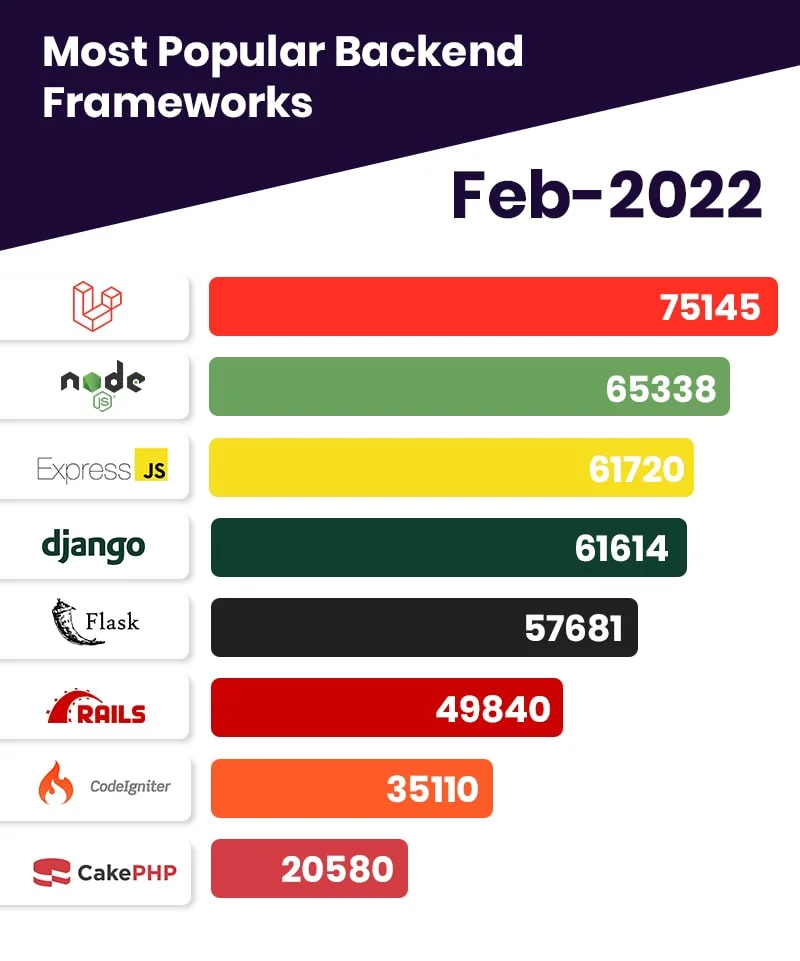
Apart from these eight most popular backend frameworks, there are more to add to the list with their features and benefits. However, it is up to you to decide on an API stack development for your project, and it relies on the company’s project, target, and vision.
Ensure that the framework you choose includes speed, reliability, and scalability. Follow your company’s requirements to decide on the most appropriate technology in line with the industry trends.
Nonetheless, to select one of the most popular backend technologies, we recommend that you discuss backend development services with experts to take the process further.
In a Nutshell – Most Popular Backend Frameworks
Laravel, Node.js, FastAPI, NestJS, Spring Boot, and Go Gin/Fiber. Every backend framework that is trending and must be used in the current development field is highlighted in this guide. Each of the frameworks comes with unique strengths, so choosing the correct one is one of the most important decisions you will make. The decision defines the performance, scalability, and success of your application.
Excellent Webworld has successfully developed an alcohol delivery app, a taxi app, and a smart home application with Laravel, CodeIgniter, and NodeJS frameworks. Irrespective of these apps, there are multiple other web applications that our team can build for you. Not only in web app development, but we are also exceptional at mobile app development services.
We provide end-to-end PHP development services and Java development services tailored to your business goals. Even if you require with or without frontend integration.
Thinking of an idea to convert it to an app? Let Excellent Webworld build it with the right backend technology stack for your business.
Backend Frameworks – FAQs
Laravel, CodeIgniter, Express.js, and Node.js are commonly used as backend frameworks in developing any web application. Hire backend developers to help you build the best custom web application.
Laravel is the most popular backend framework among the rest that is often used for any kind of web application development. Any industry or niche that needs a web app will surely need a backend framework, without which frontend development cannot proceed.
PHP is the most popular backend language used for all the trending frameworks. Be it Laravel or CodeIgniter, PHP is the only language used to write the code and run the framework as a server-side application.
There are cross-platform and open-source web development frameworks with an MIT license that help you build a robust web application for your business. The most common frameworks are:
- Laravel
- CodeIgnigter
- NodeJS
- Express.js
- Django
- Ruby on Rails
- CakePHP
- Flask

Article By


Paresh Sagar is the CEO of Excellent Webworld. He firmly believes in using technology to solve challenges. His dedication and attention to detail make him an expert in helping startups in different industries digitalize their businesses globally.