Property management software development cost typically range from USD 10,000 to over USD 60,000+.
These estimates vary based on project scope, developer location and other factors. As a result, searches for property management software costs often show very different numbers. Some software prices are as low as an annual streaming subscription. Others look more like a big business expense.
The reason?
- Pricing depends on how many units you manage, the tools you need, and whether you choose a ready-made system or build one from scratch.
- The cost of property management software is closely tied to how much functionality the system is expected to handle. Costs change as operations grow.
This becomes clearer when you look at how such platforms are typically structured.
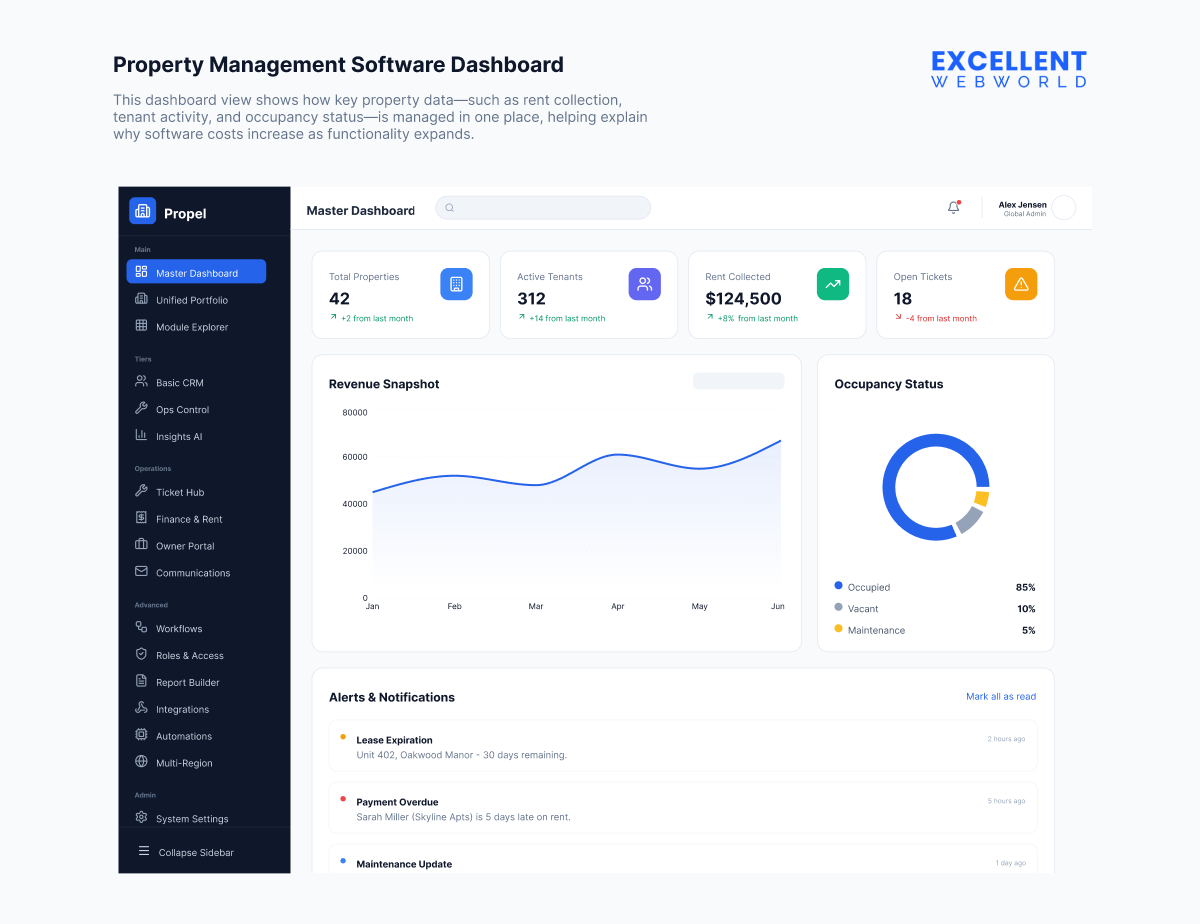
This difference in scale is exactly why pricing can vary so widely. It differs between individual landlords and property managers handling multiple units.
For a small landlord, the cost might just cover basics like rent collection and tenant screening. But larger portfolios often need advanced features. These include accounting integrations, automation, and multi-property dashboards, pushing the software development cost higher.
Here’s a quick look at average cost of property management software in 2026:
| Tier | Ideal For | Typical Monthly Price Range (2026) | Key Features Included |
|---|---|---|---|
| Basic | Startups, Idea validation | USD 10,000 – USD 15,000 | Online rent collection, tenant screening, basic reporting |
| Mid-range | Medium portfolios | USD 15,000 – USD 25,000+ | Accounting tools, maintenance tracking, marketing listings |
| Enterprise | Large portfolios | USD 25,000 – USD 35,000+ | Advanced automation, custom integrations, multi-location support |
This overview shows how property management software prices scale with portfolio size and feature requirements. For a broader context on the industry, it’s helpful to consider some key Proptech statistics. In the next section, we’ll also explore what it costs to develop custom property & lease management software.
Understanding Costs of Custom Property Management Software Development
Real Estate firms often reach a point where ready-made tools on the market are simply not enough. That’s where custom property management software development becomes essential.
Instead of being limited by generic features, custom software is built around your exact needs. This includes handling large-scale lease agreements, managing mixed-use properties, or integrating with smart building systems. However, understanding its cost can be tricky. Many sources online report very different numbers when it comes to software costs.
Every growing real estate firm must master this variable, as it is necessary to remain profitable. In order to understand these expenses, you must look past the initial pricing of the system.
- View the software as a long-term operational asset
- Do not see it as a recurring monthly bill
The initial software project estimation is key to a successful build.
What Are the Estimated Cost Ranges for Developing Property Management Software?
Most firms find that their rental management software pricing falls into one of three primary brackets:
| Property Management Software Type | Estimated Average Cost of Development (USD) | Time Frame |
|---|---|---|
| MVP (Minimum Viable Product) | 10,000 – 25,000+ | 2–3 months |
| Application-Level Custom Solution | 15,000 – 50,000+ | 3–4 months |
| Enterprise-Grade Platform | 60,000+ | 4–5+ months |
The next logical step is to see why a custom build gives better financial returns than ready-made solutions.
Why Develop Custom Property Management Software Over Ready-Made Solution?
Custom-built property management software isn’t just about having a branded dashboard. It’s about flexibility, control, and long-term efficiency. Many businesses evaluating building vs buying software often choose custom solutions because:
- Off-the-shelf tools can’t handle unique workflows.
- Large property portfolios demand automation beyond basic rent collection.
- Advanced integrations (IoT devices, CRMs, ERPs) are critical for scaling.
- Data security, compliance, and reliability are non-negotiable.
- Long-term cost savings outweigh the limitations of pre-built software.
What Technical Factors Most Influence the Property Management System Price?
The property management software development price depends on multiple technical factors:
- Feature complexity: Adding AI-driven automation, payment gateways, or predictive analytics significantly raises the price.
- Integration needs: Connecting with accounting systems, IoT devices, or ERP platforms extends development timelines.
- Design & scalability: A clean, modern UI with scalable architecture ensures the platform grows with your portfolio.
- Portfolio size: Managing hundreds of units requires more modules, user roles, and data processing power.
- Expertise level: Hiring a professional property management software development service ensures quality but comes at a higher investment.
The software development process itself has a profound impact on the total cost and project timeline, from initial planning to final deployment.
When Is the Right Time to Invest in Full Custom Property Management Software?
Not every business needs to start big. In fact, many successful companies begin with a Minimum Viable Product, a lighter version of custom software that focuses on core features like rent collection, tenant management, and lease tracking. All of these are essential in the growing property management market, which is projected to reach over $42 billion by 2030.
Building an MVP for property management software (costing around 10,000–25,000 USD) allows you to test the market, refine your workflows, and reduce risk before investing in a full-scale platform.
You should consider full custom development when:
- You manage large property portfolios with complex workflows.
- Data security and compliance are top priorities.
- You need a system that adapts to your business, not the other way around.
- Long-term scalability and operational control matter more than upfront savings.
In short, while custom property management software prices are higher than standard tools, the investment pays off in control, scalability, and competitive edge—especially for enterprises managing multi-property portfolios. These benefits of custom software development are what justify the initial higher cost.
What Features Should You Add to Property Management Software for Maximum Value?
When it comes to rental property management software development, the real value lies in the features you include. A well-designed platform not only makes operations smooth but also ensures better tenant satisfaction and long-term growth.
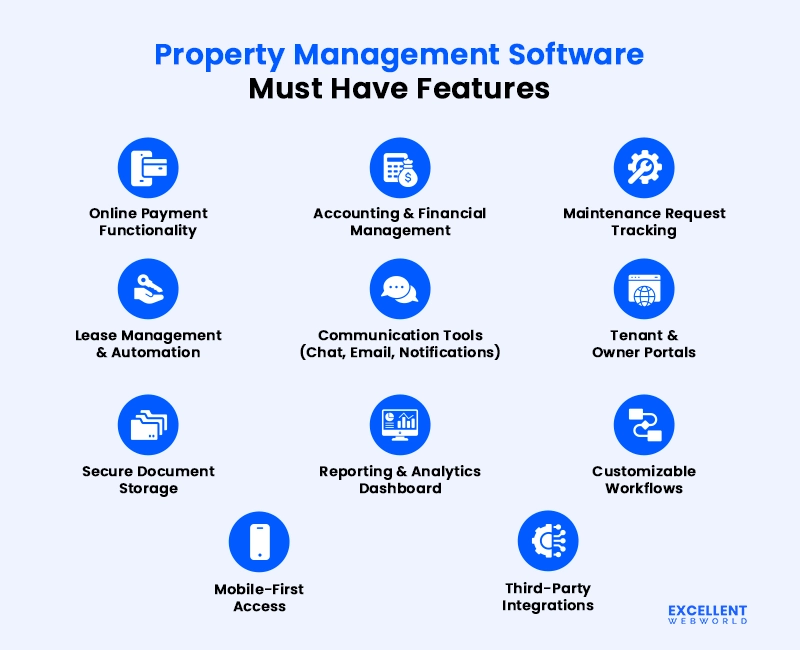 As a software development consultant we recommend the following key features of a property management system that every real estate business should consider:
- Online Payment Functionality: Allow tenants to pay rent securely online using credit cards, bank transfers, or digital wallets. This reduces delays, improves cash flow, and provides transparency in transactions.
- Accounting & Financial Management: Integrate tools to track income, expenses, and taxes. A strong financial module is essential for multi-property management systems handling different portfolios.
- Maintenance Request Tracking: Tenants can raise maintenance tickets, while managers can assign tasks, schedule repairs, and track updates, all in one place.
- Lease Management & Automation: Automate lease renewals, rent reminders, and legal compliance. This is critical in multiple property management systems to avoid manual errors.
- Communication Tools (Chat, Email, Notifications): Provide direct communication channels between tenants, owners, and property managers. This reduces misunderstandings and improves service quality.
- Tenant & Owner Portals: Dedicated dashboards for tenants and owners help streamline rent payments, service requests, and document access.
- Secure Document Storage: Centralized storage for lease agreements, invoices, ID proofs, and compliance documents ensures safety and quick retrieval.
- Reporting & Analytics Dashboard: A real estate management software development project must include detailed insights into occupancy rates, revenue, and performance metrics.
- Customizable Workflows (Configurability): Every property business has different needs. Configurable workflows let you adapt processes without starting from scratch.
- Mobile-First Access: In today’s digital age, mobile apps are a must. A trusted real estate app development company can help property managers, tenants, and owners manage everything on the go.
- Third-Party Integrations: Connect your property management software with CRM, ERP, IoT devices, and even smart locks for a truly modern building property management software ecosystem.
Another emerging trend is AI in real estate. AI can predict tenant behavior, automate rent reminders, suggest dynamic pricing for rentals, or even flag unusual payment patterns for fraud detection. When paired with IoT devices in smart buildings, AI makes building property management software even more efficient. For businesses looking for innovative real-estate business ideas, integrating AI is becoming a game-changer.
How Much Does Industry-Specific Property Management Software Cost?
Not every landlord or property owner needs the same type of software. The property management software cost often changes based on the type of real estate you manage, whether it’s a single-family home, a short-term rental, or a large commercial property.
Now, at first glance, ready-made SaaS tools look cheaper. But businesses often outgrow them. The problem is that SaaS platforms are built to serve the “average” landlord. If you need unique workflows, brand-specific features, or the ability to scale across multiple property types, you’ll eventually face limitations. That’s why you need custom property management software development.
With a custom build, you control the features, integrations, and scalability. Whether you need an apartment rental portal like Bayut or a short-term rental search app like Zumper, custom development ensures the system works exactly the way your business requires.
Here’s a breakdown of custom development costs by property type:
| Category | Key Features | Custom Development Cost (USD) |
|---|---|---|
| Small Landlords (1–10 units) | Rent tracking, tenant communication, lease storage | 12,000 – 14,000 |
| Single-Family Homes | Maintenance tracking, online payments | 14,000 – 16,000 |
| Apartment Complexes | Accounting, tenant portals, reporting tools | 16,000 – 18,000+ |
| Short-Term Rentals (Airbnb, Vrbo style) | Booking engine integration, dynamic pricing, and cleaning schedules | 20,000 – 40,000 |
| Hotels & Hospitality | Reservation systems, staff scheduling, guest management | 50,000 – 100,000+ |
| Commercial Property Owners | Lease analytics, facility management, IoT integrations | 80,000 – 120,000+ |
What External Factors Impact the Total Cost of Ownership for Real Estate Software
The property management software cost is never one-size-fits-all. It depends on what type of real estate you manage, the level of complexity, and how scalable you need the solution to be. When building a custom platform, these are the key factors that shape development costs:
- Geographic pricing insight: Development costs vary significantly by region. For example, US and Western European firms charge premium rates, while India offers competitive pricing for the same level of expertise.
- Number of units & portfolio size: Managing a handful of properties requires fewer modules, while large portfolios demand complex dashboards, multi-property tracking, and role-based access.
- Feature complexity: Adding AI automation, advanced accounting, predictive analytics, or smart integrations (IoT, ERPs, CRMs) significantly raises development time and investment.
- Customization & workflows: A tailored UI/UX, unique business processes, and brand-specific features require more engineering compared to standard property management systems.
- Integration requirements: Connecting with payment gateways, document storage systems, or enterprise-grade accounting tools can extend timelines and cost.
- Data security & compliance: For enterprises, ensuring encrypted data, regulatory compliance (GDPR, SOC2), and audit-ready reporting adds additional layers of development.
- Scalability & architecture design: If your platform is designed to handle future growth, thousands of units, multi-location operations, or high transaction volumes, it requires a more robust architecture, increasing the upfront cost.
- Ongoing support & upgrades: Custom development doesn’t stop at launch. Regular maintenance, security patches, new feature rollouts, and performance optimization also factor into the long-term cost.
Why Is Excellent WebWorld the Best Choice for Property Management Software Development?
Understanding the cost of property management software development is key for businesses that want to grow efficiently and stay ahead in the future of real estate. Whether you’re comparing basic SaaS tools or planning a custom residential management system, the right investment is always less than the long-term losses from poor management or limited scalability.
At Excellent Webworld, we don’t just develop software; we craft intelligent, scalable, and business-ready marketplace platforms that help you move faster and grow smarter.
With 13+ years of experience, 900+ projects, and deep expertise of AI integration in software development, we help businesses develop property management software that is not only affordable but also future-proof.
Whether you’re planning an MVP or a feature-rich real estate solution, our team is here to guide you through every step, from idea to launch.
Let’s build something great together.
FAQs About Property Management Software Costs
Developing property management software from scratch typically costs between USD 10,000 and USD 60,000. Highly complex or large-scale solutions can cost more. It also depends on the number of integrations and scalability requirements.
Absolutely. Many startups begin with a basic MVP (Minimum Viable Product), covering essentials like rent collection, tenant management, and lease tracking—at a cost of around USD 10,000–25,000. This allows businesses to validate the idea, test the market, and expand features later.
It usually takes around 3 to 9 months. A simple MVP (Minimum Viable Product) may take around 2–3 months, while a full-featured, enterprise-grade system can extend beyond 9 months.
On average, each feature or module can cost between USD 2,000 to 8,000, depending on its complexity, design requirements, and integration needs.
Long-term pricing is influenced by:
- Portfolio size and property mix
- Feature complexity (accounting, portals, automation)
- Subscription vs custom ownership model
- Integration depth (APIs, payment gateways, CRMs)
Custom software costs are driven by business logic, not recurring unit fees.
No. With custom property management software, costs are transparent after development, reducing long-term financial uncertainty.
Yes. SaaS is cheaper initially. However, custom-built property management software becomes more cost-effective over time. It eliminates per-unit pricing and transaction fees. It also eliminates forced feature upgrades. This is especially true for mid-market and enterprise portfolios.
Yes. Custom-built solutions are designed to scale with your portfolio, adapt to unique workflows, and integrate advanced technologies (AI, IoT, CRMs, ERPs). Unlike generic tools, they give you long-term control, security, and efficiency.

Article By


Mayur Panchal is the CTO of Excellent Webworld. With his skills and expertise, he stays updated with industry trends and utilizes his technical expertise to address problems faced by entrepreneurs and startup owners.