A Series B remittance startup once told me that “We budgeted for the core features, but not for any fraud that may happen in a money transfer application.” Ten months before their EU launch, they had to build their risk and compliance system from scratch due to a major fraud issue. And the investors kept asking why you missed the pre-defined timeline.
This is exactly what you will face when you treat money transfer app development as a race to ship flashy features rather than focusing on a compliance-first build. I’ve worked with fintech companies in 40+ countries over the past 15 years, and I can tell you that this is an avoidable mistake. And if you don’t give this aspect the importance it deserves, the risk keeps growing.
According to the Nasdaq Verafin report, illegal financial activities accounted for $4.4 trillion in 2025. It clearly means static, rule-based fraud checks won’t work anymore. This is the gap that Agentic AI is trying to close. As per McKinsey’s Global Banking Annual Review, 50 of the world’s largest banks are already using 160+ agentic AI use cases, many tied to fraud monitoring, risk scoring & compliance, functions that make or break a money transfer app.
Founders who wait to adopt this will pay more to catch up later, just like that startup learned the hard way. What you need instead is a fintech app development company that’s already shipped AI-driven fraud tools, not one still learning on your budget. I’ve personally delivered 100+ fintech projects, and this guide shares that exact roadmap with you.
What is an AI-Native Money Transfer App?
An AI-native money transfer app is a money-sending app built around AI from the start, not added later. It uses AI to detect fraud, find the best exchange rates, predict problems, automate customer support, and make transfers faster, safer, and smarter, giving users a smoother, more personalized experience than regular money transfer apps.
Market Overview of Money Transfer App
- According to Grand View Research, the global digital remittance segment will reach $60.05 billion by 2030.
- According to eMarketer, nearly three-quarters of U.S. smartphone users will use mobile P2p payments by 2028.
- According to the FDIC’s report, 49.7% of U.S. households already use nonbanking money transfer apps such as Cash App, Venmo, and PayPal.
These trends suggest that the future belongs to money transfer apps. So, if you’re thinking about building a fintech app today, or looking to start a fintech company from scratch, then digital transfer app development is the way forward.
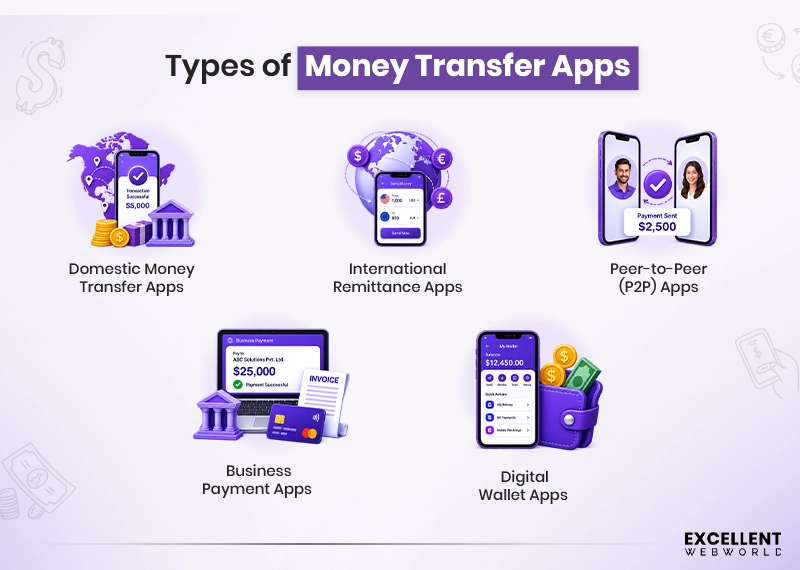
What are the Various Types of Money Transfer Apps?
There can’t be a one-size-fits-all approach to building a money transfer app. There are various categories of money transfer apps, each with their own banking integration, revenue model, and compliance burden. An experienced money transfer app development company can help you identify the right category that fits your requirements.
Here’s a breakdown of each category, what it’s built for, and what the core challenges one has to overcome while building it:
| Type | Best For | Core Challenge | Compliance Load | Revenue Model |
|---|---|---|---|---|
| Domestic Money Transfer | Everyday transfers within one country | Instant settlement at scale | Moderate (KYC & AML compliance) | Transaction fees, float interest |
| International Remittance | Cross-border transfers for migrant workers, expats | FX volatility, per-corridor licensing | High (AML, multi-country licensing) | FX spread, transfer fees |
| P2P Apps | Splitting bills, sending money to friends and family | Real-time fraud prevention and consumer trust | Moderate | Instant-transfer fees, premium features |
| Business Payment Apps | B2B invoicing, payroll, vendor payments | Integration with accounting/ERP systems | High (PCI DSS, audit trails) | Subscription, per-transaction fee |
| Digital Wallet Apps | Stored balance, prepaid spend, embedded lending | Balance security, interoperability | High (data privacy, PCI DSS) | Interchange fees, partnerships |
1. Domestic Money Transfer Apps
Domestic money transfer apps help you move money within one particular country’s banking system. The main concern here for the user is speed, as they expect real-time payments and settlements within seconds.
So, as a founder or owner of any enterprise fintech company, if you’re planning to develop such apps, don’t think that it’s too easy because there is no role for currency exchange or cross-border licensing. I’ve seen many teams make this mistake: they don’t prioritize building robust infrastructure capable of handling real transaction volume, and they end up facing the consequences later on.
2. International Remittance Apps
International remittance is not the same as a domestic transfer, because the whole business here is built around licensing rather than logic. As you’re dealing with multiple countries here, you need to deal with cross-border compliance challenges. That is the very reason why remittance app development timelines are longer than those for domestic money transfer apps. So, if you’re opting for international remittance app development, plan for licensing delays in advance and adjust your budget accordingly.
3. Peer-to-Peer (P2P) Apps
Any P2P app fails or succeeds on one major thing, and that is whether you can establish trust among the users that their money will move only to the people they’re meant to move to. P2P payment app like Zelle is a perfect example of this, as it moved $1.2 trillion in 2025, while maintaining a fraud rate of just 0.02%, a result directly tied to AI-driven fraud monitoring on every transaction. So, if you’re planning to opt for P2P money transfer app development, this is a standard you need to set.
4. Business Payment Apps
Business payment apps help you move money between companies, not individuals. This shift changes the entire priority of engineering from design to integration. The market supports this theory; according to Grand View Research, automated accounts payable software will grow to $7.1 billion by 2030.
This growth is directly related to businesses replacing manual invoice processing with automated, AI-assisted approval workflows. Given these requirements, proper payment gateway integration services matter much more for existing accounting and ERP systems, since a business payment app succeeds or fails based on its integration capabilities.
5. Digital Wallet Apps
Earlier, digital wallets just held a balance, but nowadays they’re becoming full-fledged financial platforms with services like spend tracking, lending & rewards layered in. According to Grand View Research, the global mobile wallet market will grow to $51.53 billion by 2030. This growth is directly tied to rising smartphone usage and merchants also pushing contactless payment options.
So, as a founder, if you’re planning to develop a digital wallet, try to benchmark it against the best mobile payment apps to set a bar. In addition, if you want to create a money-lending app as part of a digital wallet ecosystem, give utmost importance to security and compliance rather than flashy features.
How Does an AI-Native Money Transfer App Work?
I’ve reviewed many failed money transfer app launches, and based on that experience, I can tell that founders generally get the registration and payment initiation steps spot on. But they’re stuck when the process reaches the verification or payment-processing stage, and real transaction volume kicks in.
A typical money transfer app moves users through seven connected steps, and so, when any single step breaks, the entire transaction fails. So, as a founder, you need to take this aspect into account while scoping any mobile money transfer app development project.
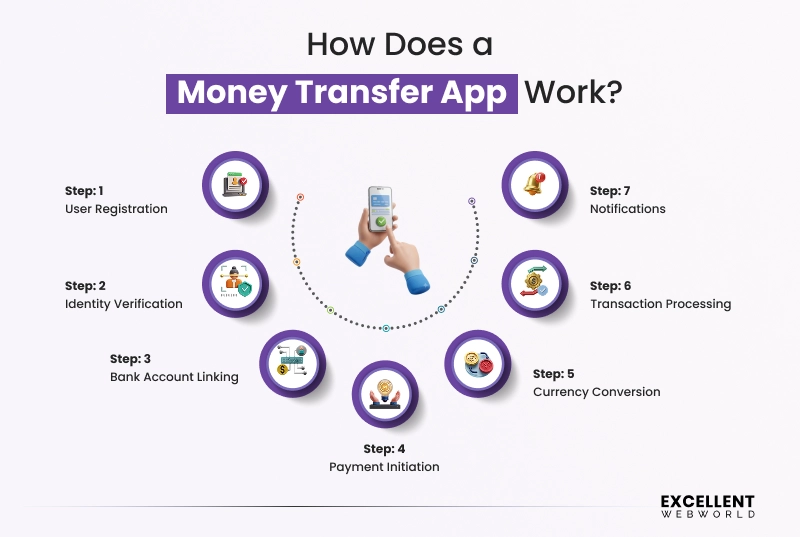
1. User Registration:
First, the user creates an account and sets up a profile by entering basic details such as name, email, and phone number. This is where a mobile app development company designs a roadmap for your money transfer app, which will impact future decisions because every field collected here will either support compliance or create friction later on.
2. Identity Verification:
After the user signs up for the app, KYC verification is conducted to validate the user’s identity through document uploads, selfie matching, and database checks. This step determines whether you will retain a customer. According to Fenergo’s report, 70% of financial institutions will lose clients due to slow onboarding in 2025; therefore, designing a seamless KYC experience is vital for anyone considering investing in an online money transfer app development project.
Another thing to keep in mind is that AI’s role in KYC has become prominent in the last few years; adoption of AI-driven KYC tools has increased from 42% in 2024 to 82% in 2025, nearly double. So, without a seamless AI-based identity verification process, your money transfer app is like building a digital wallet full of money but nowhere to send it.
3. Bank Account Linking:
After the verification, the app connects to the user’s bank account domestically via ACH, RTP, or Open Banking APIs, or via SWIFT for cross-border transfers and SEPA for transfers within the Eurozone. With these networks, you can confirm ownership and allow funds to move in the appropriate direction. As each bank and network has its own onboarding process, security requirements, and response times, there could be integration-related delays at this stage.
4. Payment Initiation:
Once the bank account is linked, the user selects an amount, chooses a recipient, and confirms the transfer, after reviewing the delivery time and processing charges. It’s a phase where peer-to-peer payments may feel instant or broken to the user. Therefore, you need to design an interface that is as fast as the backend.
5. Currency Conversion:
If you’re dealing with cross-border transfers, a real-time exchange rate is applied at this point in your payment transfer app development process as it converts the sender’s currency into the recipient’s currency at the rate set for the particular transaction. An incorrect exchange rate here can break trust at this stage, even when every other step works, because any user will notice pricing faster than anything else.
6. Transaction Processing:
The funds move through payment rails and a fraud-checking mechanism in parallel to detect any suspicious activity before settlement is complete. According to PaymentsJournal, FedNow processed $853.4 billion in transactions, and RTP processed $1.3 billion in 2025. According to the Press Information Bureau, India’s UPI processed transactions worth $241.6 billion in FY 2025-26. This is the volume of transactions a money transfer app must process, so you need a robust infrastructure to handle this demand.
7. Notifications:
The user receives instant confirmation once the payment is cleared, along with updates if anything is flagged for review or delayed. Today’s mobile banking app development trends have normalized instant payment and real-time notifications. So, a missed or delayed notification at this stage would undermine the trust established through previous steps.
What Features Can Your AI-Native Mobile Transfer App Borrow from Top AI-Native Money Transfer Apps in the Market?
As a founder, if you’re looking to build a money transfer app, then you should be analyzing the top apps in the market and studying their cross-border money transfer app development strategy to know what they’re doing to be this successful. To help you with that, I’ve built the following table, which provides a detailed comparison of top fintech money transfer solutions.
| App | Best For | Standout Strength | Role of AI | Compliance & Trust Signal | Features To Borrow |
|---|---|---|---|---|---|
| Wise | Cross-border transfers | Mid-market exchange rate, no markup | Automated risk scoring powers instant transfers at scale | Publicly traded (LSE), 70+ global licenses | Upfront fee transparency; real-time rate comparison calculator; multi-currency account holding |
| Remitly | Remittances to family abroad | Flexible payout: bank, cash pickup, mobile wallet | AI-driven delivery-time prediction and risk checks | US-regulated money transmitter | Delivery-time guarantee with live tracking; first-transfer promotional pricing |
| PayPal | Global online checkout + P2P | Broad merchant acceptance worldwide | Machine learning fraud detection across billions of transactions | Publicly traded (Nasdaq: PYPL) | Buyer/seller protection guarantees; one-click checkout; dispute resolution center |
| Cash App | P2P + everyday spending | Cash Card, Bitcoin-linked features | Real-time transaction risk monitoring | Owned by Block Inc., FDIC-insured accounts | Instant cash-out with debit card; round-up savings/investing; boosts and cashback rewards |
| Venmo | Social P2P payments | Social feed, bill-splitting | Shared fraud infrastructure with parent company PayPal | Owned by PayPal, US-regulated | Social/activity feed for engagement; group expense splitting; emoji/notes on transactions |
| WorldRemit (Zepz) | Remittances to emerging markets | Mobile money, bank, and cash pickup options | AI-based compliance screening across payout corridors | Regulated money transmitter, multi-country licensed | Wide payout corridor coverage; localized payment methods (mobile money integration) |
| Zelle | Instant US bank-to-bank transfers | Built into 2,300+ bank apps, no separate download | Industry-leading AI fraud monitoring system | Bank-owned (Early Warning Services) | Zero-friction bank-app integration; no separate account/balance needed; near-instant settlement |
What are the Essential Features of an AI-Native Money Transfer App?
Every money transfer application requires two distinct feature sets: one for the user and one for the admin. Getting that balance right is what separates successful international money transfer app development projects from those that stall midway.
User Features
Here is a list of features that help users from signing up to sending money, and each one of them shapes whether your users trust your application or not:
| Features | Description |
|---|---|
| Registration | A quick sign-up that asks only for the personal information needed for verification, so users don’t feel frustrated during onboarding. |
| KYC | A verification that confirms whether the user is the same person they’re claiming to be, using the same identity verification logic applied in the BNPL app development process to approve credit. |
| Bank Integration | Linking a bank account so that users can easily fund and receive money transfers, which is one of the most common and useful fintech API use cases today. |
| Beneficiary Management | Saving a recipient’s banking details so that sending money to the same person next time takes a couple of steps instead of five to ten minutes. |
| QR Payments | Scan-to-pay for instant person-to-person transfers, made possible by a fast online payment API that approves the transaction the moment the code is scanned. |
| Multi-Currency Wallet | Holding and converting money across currencies in a wallet is the core infrastructure of any cross-border payment app development process. |
| Live Exchange Rates | Shows the real-time currency exchange rates before a user confirms a money transfer, as even a low stale rate can erode users’ trust in the application. |
| Transaction History | A simple, easy-to-scan and searchable history of every money transfer, so users feel that they’ve control over proceedings and support teams can resolve disputes quickly. |
| Push Notifications | An instant alert whenever money is sent, received, or delayed, so users don’t need to open the app to check the balance. |
| AI Chat Support | Quick automated answers to most frequently asked questions with conversational AI so that users get their problem resolved even at 2 am without any human intervention. |
Admin Features
Here is a list of features your internal team or admin team uses to manage users, manage risk, and always stay ready for an audit.
| Features | Description |
|---|---|
| User Management | A simple and easy-to-use dashboard to view, verify, and block accounts, the same control panel that every neobank app development project builds once it moves past transfers-only mode. |
| Compliance Dashboard | One comprehensive dashboard to see KYC status and licensing across every market, so that admins can quickly check whether the app is compliant or not. |
| Transaction Monitoring | A live view of every money transfer in the system, so admins can detect any unusual activity before it becomes a major issue. |
| Fraud Alerts | An automatic flag is raised when something appears suspicious, giving your development team time to resolve it before it can harm your customers. |
| Reports | A simple, exportable summary of revenue, compliance, and transaction volume, so that the leadership team gets clear numbers and makes informed decisions. |
| Analytics | A clear view of users’ behavior when they drop off and what keeps them coming back to your application, thereby helping you to refine your customer experience. |
| Commission Management | Easy control over revenue splits and transaction fees across various partners, so the finance team can adjust the pricing without waiting for a development sprint. |
What are the Advanced Features that Differentiate Your AI-Native Money Transfer App?
Basic features can help you launch a money transfer application in the market. But to stay competitive in 2026 and beyond, you need to layer in AI, biometric, and blockchain payments on top of the basic features.
These advanced features are what separate a next-level, secure money transfer app development project from an ordinary application. Whether you’re building fully custom or white-label money transfer software, you need to account for the following advanced features, as they drive customer retention today.
| Features | Description |
|---|---|
| AI-Powered Fraud Detection | Flags suspicious activities in real-time by continuously learning from normal user behavior to catch the fraud patterns that a static, rule-based system would miss. |
| Predictive Transaction Monitoring | Learn from users’ historical patterns to flag any kind of risk before a transaction completes predictive modeling approach that an insurance mobile app development process relies on to predict risk price before a policy is issued. |
| Smart Exchange Rate Recommendations | The system suggests the best time to transfer money based on currency exchange rate trends, thereby helping users transfer money cross-border automatically. |
| Voice Payments | Allows users to transfer money via voice commands, aligning with accessibility standards modern banking apps rely on. |
| Biometric Authentication | Uses fingerprints or Face ID to confirm the user’s identity in milliseconds, the same functionality that empowers best NFC payment apps and makes them feel instant to the end-users. |
| Blockchain Settlements | Helps you settle cross-border transfers related to distributed ledgers, thereby reducing settlement time from days to a few minutes without a correspondent bank. |
| OCR Document Verification | Scans identify documents automatically using KYC, fetching data instantly instead of waiting for manual intervention for every new user. |
| AI Customer Support | Resolves commonly asked account and money transfer queries instantly, escalating to a human support team only when required. |
| Spending Insights | Shows users where their money is going, the same behavioral data that wealth management software development process uses to recommend investment tips to users. |
| Personalized Payment Suggestions | Recommends saved beneficiaries or repeat transfers based on your past behavior, thereby cutting the time by half for money transfers. |
Which is the Best Technology Stack for AI-Native Money Transfer App Development?
There is no single “best” stack for money transfer app development. The right tech stack depends on your transaction volume, project timeline, and compliance requirements. From my years of experience working with various fintech institutions, here’s the tech stack that I recommend for a money transfer application:
| Layer | Recommended Tech |
|---|---|
| Frontend | Swift (iOS), Kotlin (Android), or React Native for cross-platform builds |
| Backend | Node.js, Java (Spring Boot), or Go |
| Cloud | AWS, Azure, or Google Cloud with Kubernetes orchestration |
| Database | PostgreSQL or MySQL with Redis caching |
| Payment APIs | Stripe, Plaid, or direct ACH/RTP/SWIFT integration |
| Authentication | OAuth 2.0, biometric login, multi-factor authentication |
| AI Tools | TensorFlow, PyTorch, or AWS SageMaker for model training and inference |
| Blockchain | Ripple, Stellar, or a permissioned ledger for cross-border settlement |
What are the Compliance & Security Standards You Need to Follow for an AI-Native Money Transfer App?
You can’t treat compliance like a checkbox that you just ticked off and never have to worry about it again. It’s the foundation on which the entire money transfer app workflow is built. I’ve watched many founders treat money transfer app compliance requirements as an afterthought, only to get penalized for it by the regulatory bodies later on.
To get rid of that issue, here are the standards that you should follow for a money transfer app:
| Standard | What It Covers |
|---|---|
| KYC | Verifies a user’s identity through documents and identity checks before they can start any transaction to prevent fraud and fake accounts. |
| AML | Monitors transactions to analyze any patterns related to money laundering. It also applies to founders who’re considering creating a stablecoin and enabling money transfers through it. |
| PCI DSS | It sets the bar for handling and storing card data, which is required before you can process a single card payment in your money transfer app. |
| PSD2 | An EU regulation requiring strong customer authentication for any money-transfer app handling European-currency transactions. |
| GDPR | Governs how EU user data gets collected, stored, and deleted, with stringent financial penalties for applications that mishandle it. |
| SOC 2 | An independent audit that helps you know whether your system is protecting customer data as claimed by you, required by enterprise partners before any integration. |
| Data Encryption | Protects sensitive data in transit and at rest, a basic requirement that you need to follow if you’re planning to create your own cryptocurrency website alongside a money transfer app. |
| Tokenization | Replace sensitive account numbers with unusable tokens during transactions, thereby reducing the attack surface in the event of a breach. |
| MFA | Requires a second verification step in addition to the password to close the gap that attackers exploit due to hijacking of accounts. |
| Biometric Authentication | Confirms identity with fingerprints or Face ID in a few seconds, a much-needed security feature for oney transfer apps today. |
How to Develop an AI-Native Money Transfer App: Key Steps to Follow
Ideation is always the easy part; the challenges are in the implementation phase, as it determines whether you will launch your app on time. Here’s the money transfer app development process that you need to follow for a timely launch:
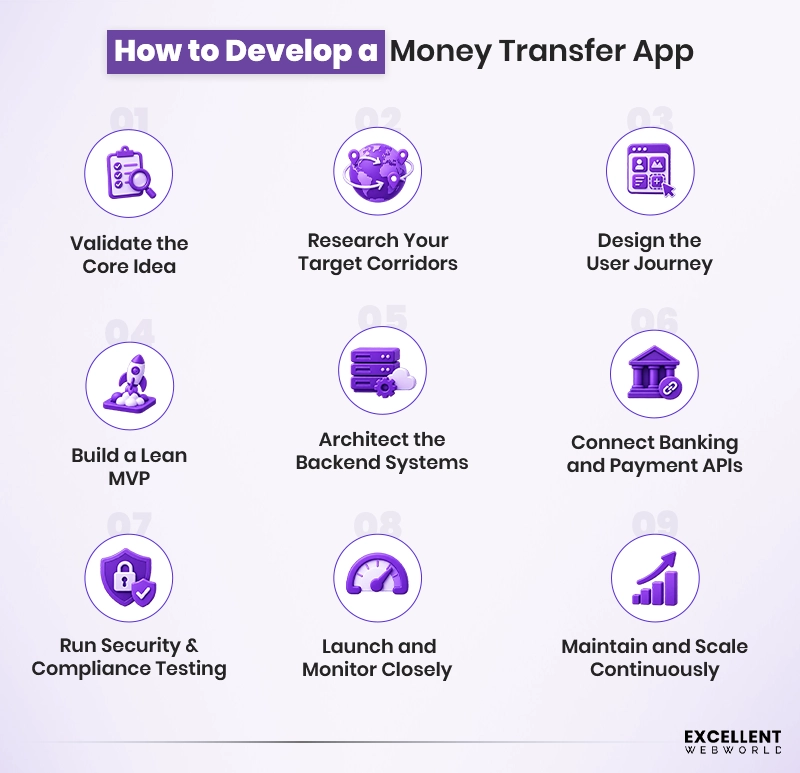
Step 1: Validate the Core Idea
Before writing a single line of code, you need to validate the feature or the purpose for which you’re developing a money transfer app. Are there any gaps in the market that you’re trying to fill? If the answer is YES, you can go ahead with the idea. Otherwise, you need to revise the idea.
It’s the most basic and obvious step, but I’ve seen many founders just start building the best money transfer app without validating its need, which costs them later on.
- Share your idea (without giving away all the details) on Reddit and Quora. People there will give you honest feedback based on their own experiences.
- Talk to your friends and colleagues about it. Ask random people too; see if they’ve faced a problem that a money transfer app could actually solve.
- Do a Q&A with ChatGPT, Claude, Gemini, or any other AI tool of your choice, and ask it to break down your idea in detail.
Step 2: Research Your Target Corridors
Once the idea is confirmed, the next thing to consider is not the technical requirements but the regulatory needs. You should map the banking landscape for every country you plan to serve, as licensing rules & compliance standards vary by region, and what worked smoothly in one region can stall your progress in another.
- You should map licensing requirements by region rather than as a single blanket assumption.
- Verify which banking partners support your target regions before finalizing them.
- Mark any target market where you need a local entity, banking license, or additional approval before product launch.
Step 3: Define the User Journey
Once you define your target market, the real question is: can a user navigate your app without giving up halfway through? If the answer is YES, then you’re good to go. You should map every screen from signup to transfer confirmation, prioritizing speed and clarity, which directly impact your user experience.
- Cut down every field that isn’t needed for compliance or the money transfer workflow.
- Test the workflow with someone who’s never used a money transfer application before.
- Track the points where first-time users pause, hesitate, or drop off.
Step 4: Build a Lean MVP
After the user journey is mapped, don’t try to build everything at one go. The reason is that it can blow your entire budget without you even knowing the value of your product. Start with an MVP that includes registration, KYC, and only a single payment corridor. It is the fastest way to test real demand without burning through your entire capital on features nobody wants.
- Start with only one region initially, no matter how tempting the bigger vision may feel.
- Use third-party KYC solutions instead of building an in-house identity verification system.
- Use AI tools to speed up routine tasks, but don’t blend it with compliance logic.
Now comes the real deal. If you know how to code, you can use AI coding tools like Claude Code, Cursor, GitHub Copilot, or Replit to build a working prototype yourself and see how your idea actually holds up.
But if you’re not technical, or you’d rather not risk wasting time figuring it out on your own, it’s smarter to connect with a fintech development company that can build it for you the right way.
Step 5: Architect the Backend Systems
Here, your MVP either becomes a real, scalable product or a liability that surfaces at the worst possible moment. Always take real transaction volume into account from day one while building the money transfer app to ensure scalability. The same discipline you apply to stock trading app development needs to be applied to a money transfer app, because both types of apps can fail in the same way the moment a real load hits the system.
- Always design for horizontal scalability before you actually require it.
- Separate transaction processing from reporting & analytics workloads so that an issue in one workflow doesn’t affect the other.
- Build compliance logic as a dedicated service.
Step 6: Connect Banking and Payment APIs
With a robust backend architecture in place, it’s time to move real money by connecting your money transfer app to banking and payment APIs such as ACH, RTP, SWIFT, or Open Banking. This phase sits at the core of payment gateway development. You should test every single integration under real transaction volume, not in a sandbox environment, as a sandbox won’t show the exact failures that may occur in front of live users.
- Conduct load testing of every integration at 5x of your projected transaction volume.
- Define a fallback mechanism for what to do when a banking partner’s API goes down unexpectedly.
- Document every partner’s SL before you define a promised launch date based on that.
Step 7: Run Security and Compliance Testing
Before anyone else tries to access your application, you should be actively trying to break it yourself. You should run fraud simulations.
- Hire a third-party organization to run penetration testing to ensure you get an unbiased check of your architecture’s robustness.
- Simulate real fraud attempts, not just tick off a checklist that conforms to basic compliance boxes.
- Verify that your AML monitoring services flag subtle, unusual patterns, not just the obvious red flags.
Step 8: Launch and Monitor Closely
After the rigorous testing process is completed, focus on deployment, but treat the launch week as extended testing rather than a finish line to celebrate. You should monitor the transaction success rate and fraud alert rates in real-time. These are parameters in the first week that determine the fate of your financial app categories, whether it’s the money transfer app or a P2P payment app development project.
- Maintain a dedicated support team with additional resources for the first two weeks after the product launch.
- Monitor transaction failure rates hourly, not daily or weekly.
- Devise a rollback plan ready in advance before you actually need it.
Step 9: Maintain and Scale Continuously
Once the product has been launched successfully, the work doesn’t stop here. You should keep improving the fraud detection rate, add new regions, and optimize performance to stay competitive in the market even after so many years of launch.
- Review the fraud detection model performance monthly.
- Expand to new regions once your current ones are stable and proven.
- Every time your transaction volumes double, revisit your infrastructure capabilities.
How AI is Transforming Money Transfer Apps?
AI in money transfer apps is not a nice-to-have feature anymore. It’s about deciding whether the user trusts you with their money. Many teams treat AI as an add-on feature, only to realize later on that it was a huge mistake the moment fraud hits your money transfer platform.
Here’s how AI is making a massive impact in money transfer applications:
| Functions | What It Does |
|---|---|
| Fraud Detection | It learns from users’ behavior and flags anything suspicious in real time that a static, rule-based system can’t catch. |
| Risk Scoring | Assigns a risk level to every transaction so your system can pass safe transfers through instantly while flagging those that need a closer look. |
| AML Automation | It checks your transactions against watchlists to prevent money laundering, thereby reducing your manual review time from hours to seconds. |
| Smart Customer Support | AI in fintech helps you answer users’ frequently asked questions instantly, allowing your team to focus on complex issues that require human intervention. |
| Personalized Offers | It learns the purpose for which your users are using the money transfer app and, based on that analysis, offers them a better rate or discounts. |
| Predictive Analytics | Helps you to forecast transaction volume before it spikes so you can scale up your infrastructure in advance. |
What is the Role of Blockchain in AI-Native Money Transfer Apps?
Blockchain isn’t a future trend anymore for money transfer apps. It has become part of the core infrastructure, and I’ve seen it replace traditional banking chains that made cross-border transfers slow and expensive. Instead of a money transfer moving through three to four intermediary banks, each of which charges its own fee, blockchain settles the same transfer through a shared ledger in minutes, saving time and money.
Benefits of Blockchain in Money Transfer Apps
- Reduces settlement time from days to minutes by removing intermediary bank chains.
- Increases transparency, as every transaction occurs on an immutable ledger that both parties can easily verify.
- Cuts transaction fees because there’s no chain of correspondent banks charging fees.
- Allows money transfers 24*7, unlike traditional banking, which remains closed on weekends and holidays.
Challenges of Blockchain in Money Transfer Apps
- User trust remains low, as many users don’t understand how blockchain can protect their money.
- Regulations vary by country, making compliance harder to standardize across the various corridors you operate in.
- Integration complexity means your team needs blockchain engineering expertise; a standard backend development skill set won’t work here.
- Volatility in crypto-based rails can create pricing risk if your funds sit in mid-transfer for too long.
Use Cases of Blockchain in Money Transfer Apps
- Tokenized assets, the same technology that founders use when they’re looking to create an NFT marketplace.
- Real-time currency conversion using stablecoins that have a fixed value.
- Cross-border remittance settlements, reducing transfer times from days to minutes.
- Smart contracts that help you automate conditional payments, thereby releasing funds only once the validation is complete.
How Much Does it Cost to Develop a Money Transfer App?
If you ask anyone about the cost to build a money transfer app in 2026, they won’t be able to give you a fixed number, and if they do, I can tell you they’re lying. I’ve worked with various money transfer companies, so I know the final cost depends on many factors, such as corridor count, compliance depth, number of features, the developer’s location, and whether developing an MVP or a full-fledged solution.
Based on my years of experience, here’s an approximate cost that you can take into account while planning your budget for a money transfer app:
| Tier | Cost Range | What You Get |
|---|---|---|
| MVP | $40,000–$90,000 | Core transfer flow, KYC, single payment corridor, basic fraud checks |
| Mid-Level | $90,000–$200,000 | Multi-currency support, multiple banking integrations, compliance dashboard, AI fraud detection |
| Enterprise | $200,000–$500,000+ | Full multi-corridor compliance, advanced AI risk scoring, high-availability infrastructure, dedicated audit tooling |
Factors Affecting Cost:
- Number of payment corridors: Each new country adds its banking, licensing, and compliance overhead to the overall scope.
- KYC & AML depth: If your region requires stricter identification checks and reporting rules, it will increase engineering & review time, which directly increases the overall budget.
- Banking integration type: The legacy banking integration will take longer than integrating Open Banking APIs.
- AI fraud & risk scoring: AI-driven fraud detection and risk scoring may add an upfront cost but also help you avoid costly penalties later on.
- Platform choice: Native apps will obviously cost you more per platform, while cross-platform apps can save you a lot of time and cost, but you won’t be able to give your user a native experience.
- Team structure: Partnering with an experienced development partner will cost you more than hiring a freelance developer.
- Post-launch maintenance: Ongoing compliance monitoring, adding new features, and performance optimization add costs to the overall project budget.
- Scalability needs: If you’re building your money transfer app to accommodate 100x transaction growth, it will cost you more because you’ll need to invest heavily in robust infrastructure.
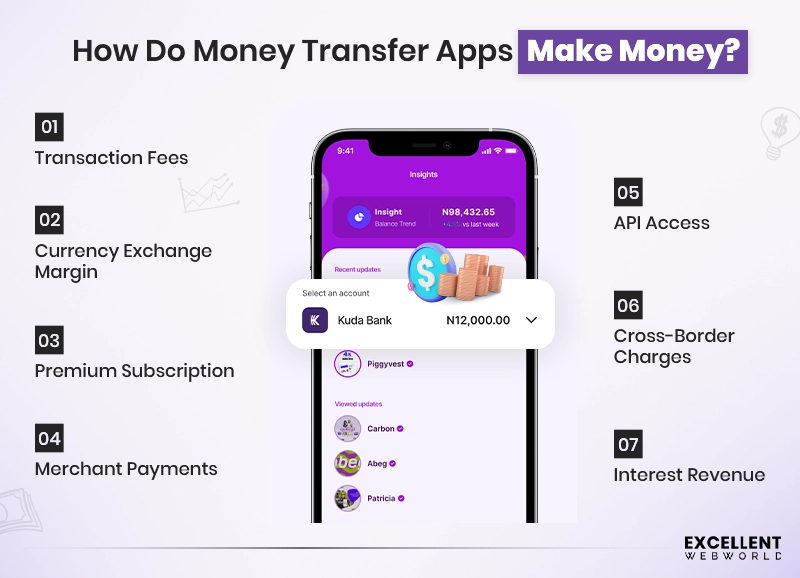
How Do AI-Native Money Transfer Apps Make Money?
I’ve seen many founders build a very good money transfer application, but still can’t make good ROI from that. The reason behind that is a lack of a good monetization strategy. You need to think up front about how you’re going to generate revenue from your application to make your business profitable. Here are some of the popular money transfer app monetization strategies:
| Revenue Stream | How It Works | Who Pays | Best Fit For |
|---|---|---|---|
| Transaction Fees | A flat or percentage fee charged per transfer. | The sender, at the point of transfer. | Domestic and P2P apps with high transaction volume. |
| Currency Exchange Margin | A small markup on the exchange rate applied to cross-border transfers. | The sender, built into the conversion rate. | International remittance and cross-border apps. |
| Premium Subscription | A monthly fee unlocking faster transfers, higher limits, or lower fees. | Power users transferring frequently. | Apps with a loyal, high-frequency user base. |
| Merchant Payments | Fees charged to businesses accepting payments through the platform. | Merchants, per transaction processed. | Apps expanding beyond individual users into B2C commerce. |
| API Access | Charging other companies to build on your payment infrastructure. | Third-party businesses and developers. | Platforms with proven, reliable backend infrastructure. |
| Cross-Border Charges | Additional fees layered onto international transfers for compliance & settlement. | The sender, added to the base transfer fee. | Apps operating across multiple regulated corridors. |
| Interest Revenue | Earning interest on user balances held before withdrawal or transfer. | The platform earns interest on idle account balances. | Digital wallets and apps with high average balances. |
What are the Key Challenges in Money Transfer App Development?
Here are the key challenges that you may face while developing a money transfer application and the possible ways to overcome them:
| Challenge | Impact | Possible Solutions |
|---|---|---|
| Security | One small breach can erode customer trust, no matter how amazing your product is. | Implement biometric authentication, tokenization, encryption, and continuous monitoring. |
| Compliance | Regulatory complications can slow down launch speed and create licensing uncertainty across various markets. | Build GDPR, KYC/AML, and PCI DSS into your architecture from day one. |
| Scalability | Performance issues begin to worsen as transaction volume increases. | Use cloud-native architecture with auto-scaling infrastructure and load testing. |
| Latency | Slow transfer can damage your reputation among users as they expect settlements within a few seconds. | Use real-time payment rails and optimize backend infrastructure to facilitate speedy transfers. |
| Currency Coversion | Delayed or inaccurate exchange rates break trust in cross-border transfers. | Integrate live FX rates into your money transfer app to show real-time pricing. |
| Fraud | Fraud losses are climbing every year, and static, rule-based systems can’t match the speed of attackers anymore. | Implement AI-driven fraud detection that adapts to newer challenges. |
What are the Future Trends of AI-Native Money Transfer App Development?
The apps launching today may not be relevant tomorrow. The pace of technological innovation has taken a new leap over the last 3-4 years, making it imperative for you to keep up with the latest fintech trends.
Here are the future trends of money transfer app development that you should be aware of:
| Future Trend | What It Means For You |
|---|---|
| AI Agents | Autonomous systems that can handle customer support, compliance review, and fraud checks without waiting for human intervention. |
| Embedded Finance | Payment features integrated directly into non-financial apps, allowing any platform to offer a transfer facility without being a bank. |
| Open Banking | Standardized APIs that help you connect directly with user bank accounts, thereby reducing integration time compared to legacy systems. |
| CBDCs | Central bank digital currencies: adding a new money-transfer settlement rail alongside traditional banking. |
| Stablecoins | Flat-rate digital currency is increasingly used for cross-border settlement, reducing both costs and delays. |
| Voice Payments | Hands-free money transfer through voice commands, facilitating accessibility and convenience. |
| Biometric Payments | Face ID and fingerprint-based authentication replacing traditional passwords to tighten up security posture. |
| Instant Cross-Border Payments | Real-time settlements replacing the multi-day money transfer process for international payments. |
| Hyper-Personalization | AI-driven recommendations that personalize features, exchange rates, and corridors based on users’ behavior. |
Why Choose Excellent Webworld for AI-Native Money Transfer App Development?
Most money transfer apps don’t fail for lack of a good idea; they fail for lack of a tech partner with firsthand experience handling high-volume transactions under regulatory pressure. I’ve watched this gap sink many good money transfer companies, and I’m here to fill it with fintech expertise and experience in custom software development.
Here’s what you will avail of by partnering with Excellent Webworld for money transfer app development:
- Experience of 100+ fintech platforms delivered across money transfer, payments, and remittance platforms.
- Knowledge of 120+ payments and banking APIs shipped, comprising ACH, SWIFT, and cross-border rails.
- A dedicated team that can work inside your infrastructure and ensures 99.9% uptime SLAs.
- PCI DSS, SOC 2 Type II, ISO 27001, GDPR, and PSD2 architected in from day one.
- AI-driven fraud detection and risk scoring to catch errors under 200 ms.
- Automated AML monitoring with audit trails built in.
- Post-launch support for continuous monitoring and performance improvement as compliance rules and payment corridors shift.
Ready to launch a money transfer app that’s scalable, secure, and compliant? Connect with our money transfer app experts today, and let’s lay out your detailed roadmap.
Frequently Asked Questions
There is no one-size-fits-all approach to determining the cost of a money transfer application. It depends on core features, compliance, and corridors. An MVP with features such as core transfer flow, KYC, and basic fraud checks costs between $40,000 and $90,000. Mid-level applications with multi-currency support can cost between $90,000 and $20,000. Lastly, enterprise-grade platforms with full compliance and advanced risk scoring range from $200,000 to $500,000+.
The timeline varies based on compliance complexity and the number of corridors. If you’re talking about a simple domestic MVP, it can be developed more quickly, while international remittance apps take a little longer due to licensing across multiple regions.
The correct option depends on your corridors and banking partners. Common options include Open Banking APIs, ACH, and RTP for domestic transfers, SWIFT for cross-border transactions, and SEPA for the European Union. Stripe and Plaid are also widely used by money transfer apps.
The security of your money transfer apps depends on multiple layers of defense, including multi-factor authentication, tokenization, and data encryption. You can also implement AI-driven fraud detection, which adds real-time monitoring to the ecosystem. Lastly, compliance standards such as SOC 2 and PCI help protect sensitive data and transactions by reducing the risk of breaches and increasing customer confidence.
YES, we can help you build an international money transfer app. It requires us to navigate challenges such as AML compliance, cross-border licensing, and FX volatility across every corridor you serve. Unlike with domestic apps, success here depends heavily on regulatory posture rather than technology capabilities.
Core standards include AML, PCI DSS, KYC, and data encryption. If your app serves users in the EU, you need to comply with GDPR and PSD2. If you’re integrating enterprise partners into your ecosystem, you need to comply with SOC 2. You should treat this as a foundational architecture, and not as an afterthought.
The most common tech stack for money transfer applications comprises Swift or Kotlin for native applications, Node.js or Java for the backend, and PostgreSQL with Redis caching. You should use cloud platforms like AWS or Azure for scalability, while OAuth 2.0 and biometric logic secure authentication. Lastly, AI tools such as TensorFlow support fraud-detection models.
YES, AI-driven fraud detection learns from users’ behavior to flag suspicious activity in real time. It also helps with risk scoring and AML automation, reducing manual review time from hours to seconds while catching patterns that traditional systems would otherwise miss.
Common revenue streams include transaction fees, premium subscriptions for frequent users, and currency exchange margins. Some applications also earn through API access charges, merchant payment fees, or interest on idle balances. Choosing the right monetization models depends on your app type and target audience.
Key challenges comprise regulatory compliance across regions, scalability under transaction volume, security breaches, and fraud prevention. Latency and inaccurate currency conversion are also among the biggest challenges in money transfer app development.

Article By


Mayur Panchal is the CTO of Excellent Webworld. With his skills and expertise, he stays updated with industry trends and utilizes his technical expertise to address problems faced by entrepreneurs and startup owners.