The Swift vs Objective-C debate between your development team is getting out of hand. Some developers still defend Objective-C, and the rest refuse to write a single line of code without Swift.
Meanwhile, you are the one holding the call. The decision of choosing the right one is tough, right? It directly or indirectly affects project deadlines and hiring pipelines. Even the next three years of the product roadmap might be affected.
What’s more concerning is that a wrong pick here will compound your damage. Everything connects with the language you choose.
It’s not about Swift developers or Objective-C developers, but about business risk conversation. Let’s check out both languages and choose the right one for your iOS app development.
What Is Swift Programming Language?
Swift is a popular, powerful, and intuitive programming language developed by Apple platforms. And firstly, it was introduced to the world in 2015. Swift is an open-source language that mainly emphasizes modern technology. Moreover, this programming language supports development in iOS, macOS, Linux, tvOS, and watchOS environments.
Swift Features & Functionalities
- Simplified complex asynchronous code
- An open-source community
- Built-in powerful error handling
- Dynamic libraries linking
- Automatic repetitive code generation
- Native API interoperability
- Catches logic errors during development
If these Swift capabilities align with your project requirements, you might need to hire a Swift developer to use these functionalities into your app.
Advantages & Disadvantages of Swift Programming Languages
Let’s check out the pros and cons of the Swift programming language to help you decide if this is the right choice for your project.
| Advantages of Swift | Disadvantages of Swift |
|---|---|
| The language is easy to adapt as the Swift code is clearer and easier to understand. | Swift offers new features but limits compatibility. |
| It does not require license fees, making it easy to use for commercial & non commercial companies. | It does not work for older iOS versions or older devices. |
| It is highly secure and will help cut out the basic errors from the code. | Swift’s limited cross-platform support is still maturing, which makes it unsuitable for hybrid app development. |
| Swift is faster as well as more customizable compared to Objective-C. | Large projects take more time to compile as the language relies on strong typing and safety checks. |
| It includes more accessible tools than Objective-C. | – |
What Is Objective-C Programming Language?
Objective-C is a general-purpose, object-oriented programming language. The initial release of this iOS language happened in the 1980s by Stepstone Company. Mainly, as the name suggests, it is a C programming-based language.
Moreover, Objective-C retains C concepts like pointers, giving developers direct memory management capabilities that can be valuable for applications that are critical to performance.
Besides, this language is dynamic and is even more universal to use, and that is the reason people around the globe are adopting Objective-C app development services. Let’s discuss the Objective-C features to learn more about this programming language.
Objective-C Features & Functionalities
- Dynamic runtime
- Smalltalk messaging
- Custom methods to existing classes
- Automatic Reference Counting (ARC)
- Dynamic Data Observation (KVC/KVO)
- Encapsulation feature
- The Inheritance feature
- Unified Polymorphism (Access to different elements via a single interface)
Exploring Objective-C’s features & functionalities is just the first step. Let’s check out the benefits and limitations.
Advantages & Disadvantages of Objective-C Programming Language
Getting a clear view of the pros and cons of the Objective-C programming language helps you decide if it’s the right fit for your project.
| Advantages of Objective-C | Disadvantages of Objective-C |
|---|---|
| Access to diverse libraries and built-in tools to accelerate development and ensure code reliability. | Objective-C’s syntax is quite complex as well as challenging to read compared to Swift. |
| Being an old language leads it to have comprehensive documentation and legacy support. | The language has become outdated, which makes iOS developers rely more on the newly arrived languages. |
| Objective-C functions are more extensive and can be easily customized. | Technically, it leads to manual memory management risks and a lack of namespaces. |
| It supports binary frameworks more efficiently than the earlier version of Swift. | Access to experienced Objective-C developers is hard, as most teams are shifting to modern languages. |
| Offers easy compatibility with C & C++ languages to operate code smoothly. | – |
Now, after knowing the concepts of both programming languages in brief, let’s move on to find the primary distinction: Objective-C vs Swift.
Objective-C vs Swift: Know The Key Differences
Comparatively, let’s understand the primary difference: Swift vs Objective-C.
| Point of Difference | Objective-C Programming Language | Swift Programming Language |
|---|---|---|
| Design & Developed | Brad Cox and Tom Love designed it. After some time, it was adopted by Apple for iOS and macOS development. Mainly, it was founded in 1984. | Chris Lattner and Apple developers designed it. Officially introduced in 2014 as a modern replacement for Objective-C. |
| Syntax | Objective-C uses a more complicated syntax. | Whereas Swift uses more not-so-abbreviated syntax. |
| Community | Stable but shrinking | Growing at a rapid pace |
| License | Objective-C Program is licensed under the General Public License. | Swift programming is an Apache-licensed open-source project. |
| Security & Type Safety | Dynamically typed. Vulnerable to nil pointer exceptions and runtime exploits. | Strongly typed and memory-safe. Optionals catch nil-related crashes at compile time. |
| Documentation | Comprehensive and well-established documentation. | Actively maintained documentation by Apple. |
| Memory Management | Supports ARC but still requires manual intervention. ARC support is limited to Cocoa API. | Fully automated ARC, leading to reduced risk of memory leaks. |
| Interoperability | Compatibility with C & C++ languages is ideal. | Fully interoperable with Objective-C. |
| Support for Earlier Versions of iOS | The earlier version of OS fully supports Objective-C. | Moreover, you need help finding support for the earlier versions of OS with Swift. |
| Peak TIOBE Rank | #3 (2012, 2014) | #9 (Jan 2020) |
| TIOBE Popularity (2026) | It’s declining with a constant graph. No longer holds a top 20 position. | Re-entered the top 20 position in early 2026. The adoption is driven by Apple’s continued investment. |
Comparing Objective-C vs Swift at a Deep Level
For a decision maker, it’s important to evaluate performance, memory management, syntax, security, and support. These factors translate into development speed and team efficiency for business. Let’s compare it in detail.
Which iOS Programming Language is Faster in Performance?
Speed is something that not only developers are concerned about. Slower performance opens the door for longer load times and higher server costs.
If you observe Apple’s own benchmarks, it shows that in terms of compute-heavy tasks, Swift outperforms Objective-C. Swift constantly stays ahead when considering complex object initialization and repeated function calls.
| Metric | Swift | Objective-C |
|---|---|---|
| Sorting Speed | Up to 2.6x faster | Baseline |
| Incremental Build | Improving steadily | Historically faster |
| Function Call Overhead | Lower | Higher due to dynamic dispatch |
| Binary Size | Slightly larger | Slightly smaller |
On one side of the coin, Objective-C uses dynamic dispatch to resolve method calls at runtime. This is what adds flexibility, but also introduces overhead. On the other side of the coin, Swift uses static dispatch to resolve method calls at compile time. This is what adds to faster execution with less runtime overhead.
Both programming languages use Automatic Reference Counting for memory management. Look closer, and you will see each of the languages handles it differently in ways that matter to your team’s productivity and app stability.
ARC was later introduced in the Objective-C language lifecycle. The developer who is working with older codebases faces manual memory management patterns. Something that creates additional cognitive load and increases memory leak risks.
ARC was built into Swift. Developers get warned about potential retain cycles before they become runtime issues. Even Swift comes with weak and unowned references with clearer syntax. This is what makes it easier for developers to write memory-safe code.
Swift vs Objective-C in Terms of Syntax & Code Readability
Code is hard to maintain when it’s hard to read. And the maintenance is expensive. Syntax comparison is something that affects onboarding time and overall pace of iOS development.
Check out this image containing the code written for an example of creating a function that greets a user:
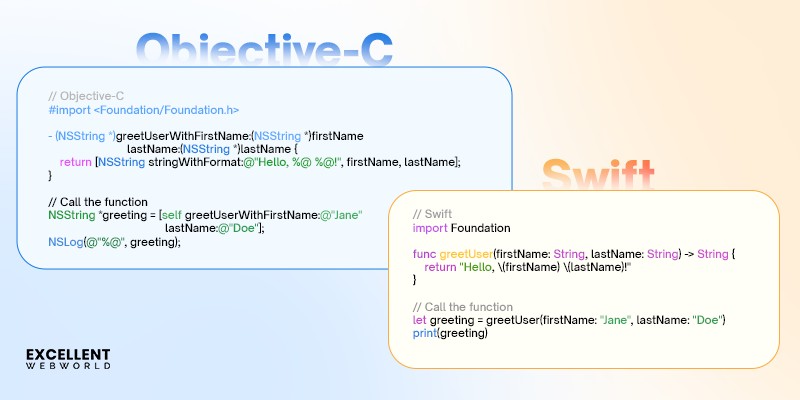
You can see the difference, right? It’s clearly visible that Swift reads closer to plain English. If a beginner developer joins the team, prioritize Swift as it reduces the learning curve, along with the time taken to become productive.
In any application, string operations are the most common tasks developers carry out.
- Objective-C: String operations require verbose syntax using NSString, NSMutableString, and format specifiers.
- Swift: It treats strings as a native type with built-in interpolation. This is what makes string manipulation intuitive and less error-prone.
What takes multiple lines in Objective-C collapses into a single clean expression in Swift. This difference in verbosity adds up to hours saved every week for teams who are managing large codebases.
In Objective-C, nil pointer exceptions are one of the basic sources of app crashes. Nil objects slip through without crashing. The result is bugs that are notoriously difficult to trace.
Through optionals, Swift tackles nil handling at the language level itself. With Swift, a variable cannot carry a nil value unless declared optional. This is enforced at compile time, which means catching nil bugs before the app runs.
Security & Safety When it Comes to Swift vs Objective-C
Security vulnerabilities in your app are a liability. User trust and brand reputation are at risk even with a breach from unsafe memory access. Let’s check out both languages in terms of safety.
Swift is a strongly typed language where every variable has a defined type. The compiler ensures type consistency at every level. The bugs caused by unexpected conversions or mismatched data are whipped out entirely. Swift also introduces features like:
- Optionals: To prevent nil crashes at the language level.
- Pattern matching: To make conditional logic safer and more predictable.
- Value types: To reduce unintended side effects from shared state.
Objective-C’s dynamic runtime is powerful. However, it introduces security considerations that Swift avoids by design. A technique named Method swizzling allows runtime modification of method implementations but if it’s in the wrong hands, it directly faces security vulnerabilities.
Also, type related bugs are not caught at compile time. They surface in production. What’s common in Objective-C is buffer overflows and format string vulnerabilities. This risk is highest in legacy codebases that have not seen modern standards in years.
When we talk about design, Swift seems to be a more secure choice. The factors that make it a security advantage compared to Objective-C are its nil safety via optionals and reduced reliance on dynamic runtime behavior.
Objective-C is not inherently insecure. Its codebase can be secure when followed by modern practices. However, it requires more deliberate efforts and ongoing vigilance from the development team.
If it’s about new projects, Swift gives your team a safer starting point with less room for mistakes related to security. For projects already existing in Objective-C code, a gradual migration strategy toward Swift is the most practical path one can choose.
Integrating Swift & Objective-C into AI, ML & Blockchain Apps
Today, it is important to know whether Swift and Objective-C are up to date enough to adapt to new emerging tech like AI, ML & Blockchain. Also, know which language is better to adopt such a futuristic technology:
Is It Possible To Merge AI, ML & Blockchain In Swift & Objective-C?
Though they are not specifically designed for AI, ML & Blockchain development, they can still be used in these areas with the help of specialized libraries and frameworks. AI and ML app development can use Swift and Objective-C through machine learning models, preprocess data, and deploy models available on various platforms.
Several open-source libraries, such as TensorFlow, PyTorch, and CoreML, can easily support both languages and be used to develop AI & ML apps. Regarding Blockchain development, both languages can be used to create decentralized applications (DApps) on blockchain platforms such as Ethereum.
Many blockchain Development frameworks, such as Truffle, Embark, and Web3Swift, support both languages and can be used to develop several user-friendly blockchain-integrated apps.
Swift or Objective-C: Which Language Is Better To Integrate?
We have gained knowledge about both languages in the prior section, and that makes it easy to say that Swift can be considered better for such high-tech app development. Due to its robust support for advanced technology and frameworks, it is well-suited for such new-tech app development.
On the other hand, Objective-C is an older language that needs Swift’s modern features and syntactic elegance. While Objective-C still can be used, Swift’s advancements have better support for modern programming paradigms, such as functional programming, and are optimized for better performance. And all of these factors make Swift an apt choice for AI, ML & Blockchain amalgamated apps.
Is Objective-C Still Used in 2026?
It’s definitely used, but not in the way it was used earlier. Objective-C has just changed its role. The numbers below tell a clear story of decline.
- A developer survey in 2023 by JetBrains found that only 2% of all the respondents used Objective-C in the past year.
- As per the survey of Stack Overflow, 62.88% of developers love to use Swift for their projects.
The language is not totally eradicated or dead, but it’s just no longer growing. See here how industries and companies are still relying on Objective-C.
- Banking & FinTech: Core transaction systems and trading platforms built over a decade ago; rewriting poses major financial and operational risks.
- Healthcare: HIPAA-compliant medical apps require regulatory re-validation for migration, expensive and slow.
- Enterprise & Legacy Systems: Millions of lines of production code in critical applications worldwide.
Swift has taken clear ownership of new iOS development. In 2026, the PYPL index ranks Swift 9th among the most popular programming languages. Objective-C continues its gradual decline. It shows no signs of recovery in new project adoption.
Even the job market of Objective-C seems to be getting fewer candidates. On the other hand, Swift is the only game in town. Specialists who still work in Objective-C do so for maintenance or migration, not new builds. Expect higher rates and harder searches when hiring for legacy Objective-C projects. Let’s check out why developers migrate to the Swift programming language.
Migrating from Objective-C to Swift
When it comes to migration, it does not lead to rewriting everything overnight. Following such an approach breaks things fast and burns budget faster.
Then what’s the smartest approach? It’s to integrate Swift modules with the existing Objective-C files. Apple’s interoperability makes it easier to carry out gradual shifts without interrupting the existing functionality. Let’s check out how to approach the migration without errors.
Identify modules with the heaviest maintenance burden. Also, detect the known technical debt before writing a single line of new code.
Splitting large codebases into manageable chunks. This is what keeps your team shipping while migration happens in the background.
Swiftify automates a significant portion of code conversion. Make sure to follow it with manual reviews and use Xcode’s Instruments for memory and concurrency checks.
Unit tests written during the Objective-C phase are your safety net. Ensure this with utmost attention so that you do not skip them mid-migration.
Swift and Objective-C can coexist. So use bridging headers and migrate one module at a time instead of forcing a hard cutover.
If you go for a phased migration, it protects your existing users and gives your team time to build Swift fluency. The cost of migrating gradually is always lower than the cost of maintaining a fully Objective-C codebase 5 years from now.
Wrapping Up the Swift vs Objective-C Debate
In this iOS Swift vs Objective-C comparison, we have given you all the information you need to choose the best programming language. And it is crucial to do so as the chosen programming language directly impacts the app’s architecture and framework.
The Swift mainly wins the battle here as it is fast, safe, modern, etc. Mainly, it consists of all the attributes to create the best iOS app.
Moreover, you will surely need an expert development team to build an iOS app. Don’t worry; here is your solution!
We are Excellent WebWorld, a custom iOS app development company that comes with years of splendid experience in:
- Full-Cycle App Development
- Product Engineering
- Web App Development Services
To build a top-notch iOS app for your business – Contact Us Now!
FAQs
It is a general-purpose, high-level programming language that adds to Smalltalk messaging in the C programming language. It is Apple’s primary programming language for the OS X and iOS operating systems and their respective APIs, like Cocoa and Cocoa Touch.
Swift is a powerful and intuitive programming language. Besides, this programming language supports IOS, iPadOS, macOS, and TvOS.
Swift’s simple and direct syntax makes it twice as fast as Objective-C. That is why developers choose Swift Playgrounds to learn more about this robust programming language.
In terms of comparison of Swift vs Objective-C, Swift might take over Objective-C entirely by looking at the pace. There is a high chance of Swift being a go-to programming language for iOS app development.
The main difference between Swift and Objective-C is that Swift is shorter and easier to grasp. At the same time, Objective-C is based on C-style and OOP syntax.
Mainly possible by using the ‘bridge header’ file that allows the Swift code to be accessible by Objective-C code and otherwise. Another way is to use ‘mixed language frameworks’, mainly by creating a framework that can help to modify Objective-C to Swift and vice versa.

Article By


Paresh Sagar is the CEO of Excellent Webworld. He firmly believes in using technology to solve challenges. His dedication and attention to detail make him an expert in helping startups in different industries digitalize their businesses globally.


