Building an AI agent looks very simple at the ideation stage. Still, when you dive deeper into the process, you will face challenges such as integration breakdowns, outputs that do not meet your expectations or needs, and frequent missed deployment deadlines.
However, if you don’t build an AI agent in today’s time, you will lose out to your competitors in the market and also increase your operational cost due to manual workflows and teams focusing on solving errors in repeated tasks that could have been avoided.
We have seen over the last few years, while providing AI solutions, that most enterprise teams don’t fail to build an AI agent due to a lack of resources or passion. They have a good idea of the tools and use cases to choose from. They fail due to a lack of planning and a lack of a proper step-by-step roadmap for building an AI agent.
This guide aims to solve this issue. After reading this guide, you will have a good understanding of how to build, deploy, and scale AI agents in a step-by-step manner. You will also know the nitty-gritties, such as tools, architecture, common mistakes, and best practices to follow.
What is an AI Agent?
“An AI agent is a special type of software that is self-sustainable in nature and designed in a manner that it can understand the environment around it, make informed decisions, and take necessary actions required to achieve specific business goals without any human intervention.”
Unlike simply building an AI model, developing an AI agent involves creating a system that can perceive, think, and evolve through intelligent behavior.
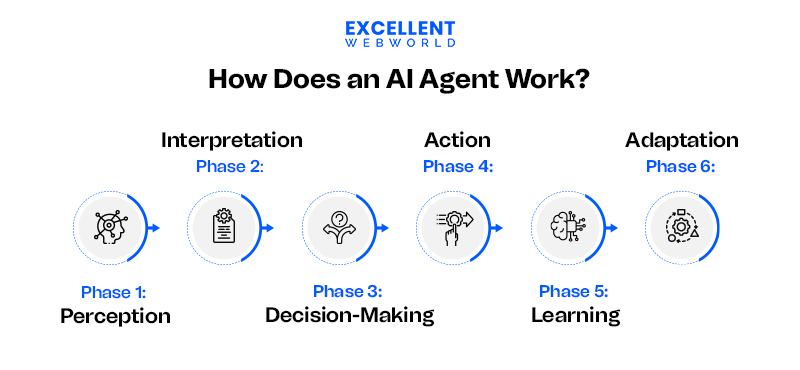
How Does an AI Agent Work?
As shown in the image, there are six major phases in AI agent development. Now, let’s analyze each of these phases to understand how the functioning of an AI agent takes place.
Types of AI Agents for Custom AI Agent Development
Here are various types of artificial intelligence agents that you should be aware of before developing AI agents.
| Type of AI Agents | Description | Pros | Cons | Best For | Real-Time Examples |
|---|---|---|---|---|---|
| Simple-reflex agents | Act based on current percepts only | Fast response, simple implementation | Cannot handle uncertainty or hidden states | Controlled environments | Thermostat, automatic doors |
| Model-based reflex agents | Maintain an internal model of the world | Can handle partially observable environments | More complex to implement | Dynamic environments | Self-driving car sensors |
| Goal-based agents | Work toward specific objectives | Solution-oriented, more flexible | Requires search algorithms, computationally intensive | Complex problem-solving | GPS navigation systems |
| Utility-based agents | Maximize “happiness” metrics | Optimize for best outcomes | Complex utility functions require balancing priorities | Decision-making under uncertainty | Recommendation system |
| Learning agents | Improve performance over time | Adaptable to new situations | Requires training data, can be unpredictable | Evolving environments | Virtual assistants, game AI |
By deciding on the proper agent type for your assignment, you will set up a solid basis for development.
Steps to Build a Successful AI Agent
Creating an intelligent agent that could recognize, propose, and act autonomously calls for cautious planning and execution. Building an AI agent entails multiple disciplines, spanning data science, software engineering, and domain expertise.
Let’s explore the vital steps to create an AI agent and convert your AI idea into reality.
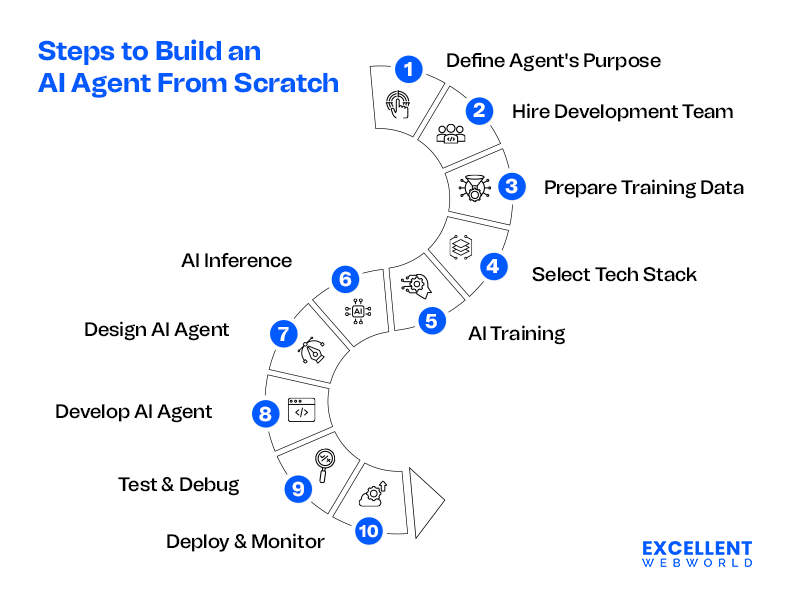
Step 1: Define the AI Agent’s Purpose and Scope
Before starting the development process for an AI agent, answer the following questions:
Once you’ve clarity about these questions, you can list out various scenarios that your AI agent may face to get an idea of how it will operate in the real world. It will help you to avoid scope creep and align your AI business ideas with development.
Lastly, set up KPIs such as response time, accuracy, and customer satisfaction ratio to determine whether your AI agent is performing as intended.
Step 2: Hire the AI Agent Development Team
An ideal team for developing an AI agent may look like this:
Everyone on the team has a specific role and responsibilities. You should hire a dedicated developer with experience developing AI agents, or someone who has been part of a team that successfully delivered custom AI agents across various industries.
If you don’t want to perform this complex task of setting up a world-class team, then hire AI developers from a top-rated firm like ours that has the experience of delivering end-to-end AI development services.
Step 3: Gather, Clean, and Prepare Training Data for AI Agent Workflow
If you want your AI agent to be high-performing, then feed a high-quality training dataset.
For your custom AI agent, you should collect data from multiple sources, such as:
Once collected, implement rigorous cleaning procedures to:
In the end, prepare your training data for the AI agent by following these best practices:
Always remember that this phase takes the most time in your development process, but it is the one that sets the foundation for how good or bad your AI agent will become later on. That’s why carefully perform all these best practices without any mistakes.
Step 4: Select the Right AI Agent Tech Stack and Development Tools
Selecting the right technology stack is vital to building a cutting-edge AI agent because the technology choices that will determine whether the AI agent will be scalable, reliable, secure and high-performant.
Here are the factors you should keep in mind when choosing your technology stack:
Here is the ideal technology stack to build a world-class AI agent for your business:
Always remember that your technology choices must meet your current business needs and support your future growth plans.
If you’re still not able to figure out the right tech stack for your AI agent, connect with a top-rated AI agent development company like us. Our developers will help you select technologies that facilitate scalability, security, and reliability for your AI agent solution.
Step 5: AI Agent Training and Model Selection for Intelligent Automation
This is the most critical phase of your AI agent development because here you form the core of your AI agent’s intelligence and decision-making capabilities.
Here are the most commonly used methodologies to train your AI agent:
When you’re selecting a model for your AI agent’s intelligent automation process, keep these factors in mind:
You should keep a note of your experiments and document them into particular file or Google Doc. Also, mention what types of results you got for a particular method or workflow. Always use cross-validation to ensure robustness in your experiments and prevent overfitting. If you follow this type of approach, you will be able to know the most suitable model for your AI agent with utmost accuracy.
Step 6: AI Agent Inference and Model Deployment
This is the phase where you shift from training to production environment, and that’s why you need to carefully implement the inference capabilities for your AI agent.
Here are the most common things that you should always consider for AI inference capabilities:
Here are the model deployment strategies you should consider: Here are the most successful model deployment strategies that you should consider for your AI agent:
If you can successfully implement inference systems for an AI agent, then you will make sure that your AI agent is reliable, secure, scalable and provides business value.
Step 7: Design Your Custom AI Agent Architecture
If you want to design a custom AI agent that meets your specific business requirements, you should place strong emphasis on developing a solid architecture blueprint.
Your ideal architecture blueprint for building an AI agent should comprise:
Here are the key architectural decisions that you have to make as an enterprise owner:
Your AI agent architectural design should balance a robust technical foundation with practical considerations, including maintenance, scalability, extensibility, and flexibility.
Step 8: Develop Your AI Agent Using Best Practices and Frameworks
This is the step that helps you to convert your rough idea into reality. Therefore, you should focus on these things in the implementation phase to develop a robust AI agent:
Here are the software development best practices that you must follow while developing your custom AI agent:
Always start by developing a minimum viable product (MVP) for your AI agent to validate your thinking and find product-market fit. After that, you can develop a full-fledged development and build an AI agent that is scalable and secure. Finding this process too complex? Then partner with a top-rated software development company like us to accelerate the validation process while keeping overall costs within budget.
However, if you’re someone who is operating their business in the Middle East and are in search of a partner to develop an AI agent that is near your location and aligns well with your time zone, then you should consider nearshore software development services.
Step 9: Test and Debug Your AI Agent for Optimal Performance
Continuous and comprehensive testing ensures that your AI agent performs the desired functions and maintains peak performance over an extended period. You should always use a mix of manual and automated testing to achieve broader coverage.
Here are the testing methods that you must implement for your AI agent:
After conducting comprehensive testing of your AI agent, you should focus on debugging, and for that purpose, you can use the following tools and methodologies:
You should always document all issues you identify during testing and debugging, along with the best possible solutions, in a file or Google Doc. It will help you build a good resource that you or other members of your team can use in the future.
Step 10: Deploy and Monitor Your AI Agent
The deployment phase helps you put the AI agent in front of your target audience.
Consider these AI agent deployment options:
Implement comprehensive monitoring for your AI agent with the following:
Regular maintenance should encompass model retraining schedules, data refreshes, and machine updates to ensure continued relevance and overall performance.
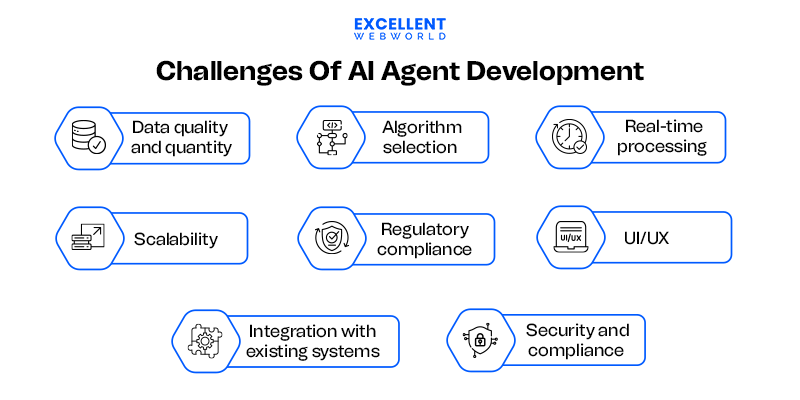
Challenges You May Face While Building and Deploying AI Agents
Here are major challenges that you may encounter while developing and deploying an AI agent:
1. Data Quality and Quantity in AI Agent Development
You need to find a high-quality, unbiased, clean dataset aligned with the real-world problems you want to solve with your AI agent.
Pro Tip: Focus on data collection and cleansing from day one, and use a data augmentation method to increase the data quantity.
2. Algorithm Selection and Model Quality
You need to find a machine learning algorithm that strikes the right balance among accuracy, speed, and resource constraints while avoiding overfitting or underfitting.
Pro Tip: Start with simple machine learning algorithms, and as your understanding grows, you can move on to more advanced ones.
3. Real-Time Processing and Scalability
Your AI agent should be able to process large amounts of information within a few seconds and provide appropriate responses, even with limited computational resources.
Pro Tip: Speed should be the basis for refining your machine learning algorithms, and edge computing can support this aspect.
4. Scalability of Enterprise AI Agents
Your AI agent should scale up as your customer base grows without compromising peak performance, keeping all responses unchanged, and without increasing your infrastructure costs.
Pro Tip: Scalability should be your top priority when designing your AI agent, and always use modular components you can reuse later.
5. Ethical and Regulatory Compliance
You have to address moral issues such as bias, transparency, and inclusiveness when developing an AI agent. Your agent should display all these characteristics while complying with all applicable regulations.
Pro Tip: Create an ethical and moral evaluation system for your AI agent and update it regularly to keep it aligned with the latest compliance guidelines.
6. UI/UX Considerations in AI Agent Design
Focus on designing a highly engaging and easy-to-navigate UI/UX through which you can display your AI agents’ core features. The UI/UX should be such that users can interact with it correctly without reading detailed documentation.
Pro Tip: Opt for the best usability testing tools and run tests to collect feedback from your end users, which you can use to refine your UI/UX.
7. Integration of AI Agents with Existing Enterprise Systems
Integrating artificial intelligence into app development can lead to compatibility issues. You need to ensure that data can move easily between AI agents and your existing system without disrupting the workflow.
Pro Tip: Build world-class middleware solutions and develop amazing APIs, as they will help you integrateAI agents into your existing system.
8. Security and Privacy in AI Agent Workflow
While developing your custom AI agent, you may encounter security vulnerabilities such as adversarial attacks, privacy issues, and data poisoning. So, protecting sensitive user data can bea highly challenging task for the development team.
Pro Tip: Focus on implementing security best practices, such as data encryption, regular authentication, and role-based access control, while developing the AI agent.
Use Cases of AI Agents in Enterprise Automation
Here are the top use cases of AI agents in various industries:
1. eCommerce AI Agents for Business Process Automation
Want to provide the next-level shopping experience to your customers where they get personalized recommendations based on their past purchases and have a seamless checkout experience? eCommerce AI agents should be the way forward.
Example: Amazon’s Rufus and Shopify’s Kit.
2. Healthcare AI Agents for Intelligent Automation
If you’re someone who wants to automate primary-level diagnosis of patients, efficiently schedule patient visits, and enable medicine reminders, Healthcare AI agents should be your best bet. AI in healthcare statistics support this hypothesis.
Example: Mayo Clinic’s symptom checker and Ada Health’s diagnostic assistant.
3. Fintech AI Agents for Secure and Compliant Solutions
If you want efficient portfolio management, automated fraud detection, and personalized banking services, consider using AI in finance or fintech AI agents.
Example: Wealthfront and Betterment.
4. Customer Service AI Agents for Enhanced Workflow
Want to reduce response times for customer queries and provide accurate answers to FAQs? Then, you should think about using customer service AI agents.
Example: HubSpot’s chatbots and Intercom’s Resolution Bot.
5. LLM-Based AI Agents for Advanced NLP and Decision-Making
If you want to perform any complex or creative tasks, like in-depth scientific research, reasoning, and content creation, then LLM-based AI agents should be your go-to choice.
Example: GitHub Copilot for coding and Jasper for content creation.
6. AI Voice Agents for Real-Time Enterprise Applications
If you have voice-enabled AI agents integrated into your business, you can enhance customer experiences by providing quick, relatable answers in their native language.
7. Role-Based AI Agents for Custom Business Needs
With the help of role-based AI agents, you can play the role of a professional who’re subject-matter expert in a particular field.
Example: ELSA for language learning and IBM’s Watson Assistant.
The Future of AI Agent Development and Enterprise Adoption
The world of AI agents promises to bring a whole new chapter in tech. We’re seeing more and more AI agents emerge to transform enterprises, and very soon, they will become part of your daily routine.
Uh… Did I accidentally coin one of the most famous quotes in A.I.?
I would love to confirm this if it's true.
The quote is "A.I. won't replace humans, but humans using AI will replace humans who don't".
It's everywhere, and the origin of it seems to be this tweet. https://t.co/YSua8UdFBB
— Lucas Rizzotto (@_LucasRizzotto) April 15, 2024
AI agents are no longer just a fancy term but a necessity for every business today.
However, creating an AI agent is not as easy as it sounds. You need a partner with the skills and experience to craft custom AI agents for a range of businesses. That’s where Excellent Webworld can be your best bet. We have helped many businesses to convert their AI agent ideas into reality.
With 15+ years of experience and 35+ industries served, we know what it takes to build a winning AI agent that aligns with your vision and industry needs. Talk to our AI experts and avail a custom AI agent development roadmap that puts you ahead of the competition.
FAQs on Building and Deploying AI Agents From Scratch
AI agents act independently toward goals, making decisions without continuous human guidance. Regular AI solutions just respond to specific commands without genuine autonomy. Agents can adapt their behavior based on environmental feedback.

Article By


Paresh Sagar is the CEO of Excellent Webworld. He firmly believes in using technology to solve challenges. His dedication and attention to detail make him an expert in helping startups in different industries digitalize their businesses globally.