Whether you are a solo attorney, law firm, lawyer, legal tech startup, or corporate legal consultant, you must have faced challenges of managing legal processes, client acquisition, consultations with clients from other regions, and streamlined data management in this rapidly expanding legal segment.
A lawyer consulting app solves this issue by offering an optimized platform that helps with on-demand consultations, AI-driven automation, secure document sharing, and efficient case management. This empowers legal professionals to work smarter and offer top-notch services. A study by Mordor Intelligence suggests that the legal service market is rapidly expanding, and it is estimated to reach 0.82 trillion in 2026 and 1.03 trillion by 2030.
This guide will cover detailed insights to brief you on what all goes into developing and launching a lawyer consulting app. This comprehensive guide will provide small, mid-sized, and large law firms detailed insights to modernize and step into digital transformation.
Challenges in Traditional Legal Consulting
Traditional legal consulting methods often struggle with inefficiencies that harm productivity and client satisfaction. As the legal industry evolves, these challenges highlight the need for more streamlined and tech-driven legal solutions.
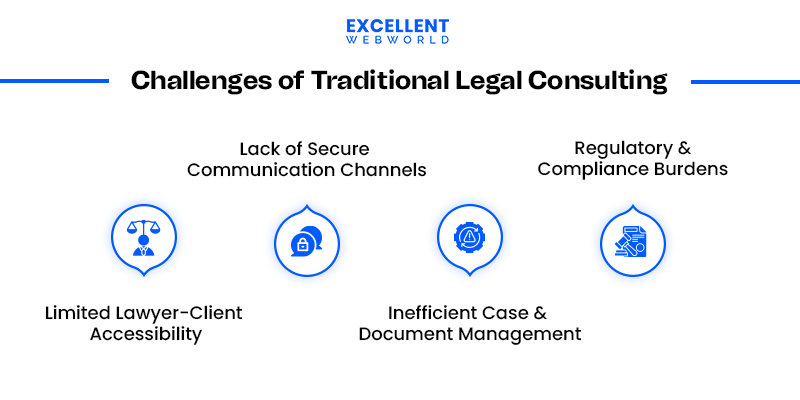
1. Limited Lawyer-Client Accessibility
Clients must schedule consultations with a legal expert, which takes time. Traditional legal consulting does not offer enhanced accessibility, and clients often cannot consult with advocates due to geographical constraints, such as a lawyer’s location in another city or residence in a place with a different time zone, which can harm the case-handling process.
Solution: Integrated AI lawyer app can help clients schedule appointments at their convenience. Additionally, virtual legal consultations can be done securely to bridge geographic gaps, enabling lawyers to connect with clients from any location.
2. Lack of Secure Communication Channels
Sensitive legal and client data can be leaked due to the lack of secure communication channels. To safeguard against data breaches, secure and encrypted communication channels are required. With increasing digital threats, it is required to have secured platforms to protect both lawyer and client data and legal communications.
Solution: A lawyer consultation app with end-to-end data encryption to protect client and case-sensitive data from unauthorized access, compliance with industry standards, and integrity of legal communication. These platforms should be designed with built-in compliance GDPR (for users in the EU), CCPA (for California users), or PIPEDA (for Canada) to establish secure data-sharing processes..
3. Inefficient Case & Document Management
Traditional legal case management involves an extensive amount of paperwork, which can be prone to error or lead to disorganization. This leads to a delayed or slow case-handling process.
Consultation involves much paperwork, and physical data management leads to unstructured data management. In addition, the manual contract view is time-consuming and missing necessary case details, leading to inefficiency in handling contracts.
Solution: Adopting and implementing AI-powered systems for document storage and retrieval automates manual tasks. These systems also help automate tasks such as contract review and case management by reducing manual effort and errors.
4. Regulatory & Compliance Burdens
Legal professionals must adhere to necessary compliances and regulations like GDPR and HIPAA to ensure data safety, which can be challenging and time-consuming. This raised the need to establish secured solutions to ensure security in virtual consultations.
Solution: To navigate this hurdle, legal institutions require virtual legal consultation platforms that follow compliance and fulfill the American Bar Association (ABA) standards. The ABA-compliant virtual law firm app helps with smooth case management, secure communication, and data management.
The Shift Towards Digital Legal Consulting – Why It’s Inevitable
Traditional legal consulting is heavily dependent on phone calls, emails, in-person meetings, and paper-based legal documentation. This leads to delays, conflicting appointment schedules, and inefficient case management, which raise operational costs and overhead expenses. Additionally, security issues like data leaks and compliance risks hamper the remote consultations without secured virtual law firm software.
These challenges can be resolved by using technological advancements to create legal app development solutions to provide streamlined, secure, and accessible legal consulting services. Well-known platforms like Rocket Lawyer and LegalZoom have also disrupted traditional legal services and offered online access to legal consulting services.
Adapting to the shift in digital legal consulting is essential because:
How Does the Lawyer Consulting App Help Solve Inefficiencies in the Legal Industry?
A lawyer consulting app addresses key challenges in the legal industry by offering secure, streamlined solutions for lawyers and clients. It ensures adherence to compliance, facilitates better client engagement, and automates administrative tasks like billing and case tracking.
Lawyer-Specific Technical Challenges
Lawyers face various challenges when they are dependent on traditional platforms. However, creating HIPAA-compliant software guarantees the secure management of confidential legal data. Let’s understand some of the technical challenges faced by lawyers using conventional methods:
Fragmented Legal Software
Lawyers rely on tools like email, spreadsheets, case management solutions, and document storage systems to streamline their practices. These scattered platforms lead to inefficiency, manual data updation, and time-consuming system checks, which raise the risk of errors.
Difficulties in Managing Multiple Cases Simultaneously
Managing multiple clients and cases together can be complex and raise concerns about progress tracking, case dates, and documents for each case without an integrated solution. As a result, missed deadlines and disorganization impact case outcomes and client satisfaction.
Inadequate Communication Systems
Traditional communication channels are risky for time-sensitive legal data. Lack of centralized and secured channels for miscommunication and delays in responses hampering the overall efficiency of legal activities.
Client Acquisition & Retention Issues
Traditional approaches create a hurdle to ensure a smooth client acquisition and retention. Lawyers often struggle with client retention due to inadequate follow-up systems, communication channels, and a lack of trust for unverified service providers. Let’s understand some of the challenges faced:
Inefficiency in Reaching Potential Clients
Traditional marketing approaches are ineffective in the digital legal segment, as client acquisition becomes challenging without streamlined legal solutions. Digital solutions for online consultations, appointment booking, and case management can resolve this by providing convenient and quality legal services.
Limited Client Engagement
Clients often lack access to necessary documents and are unaware of legal processes and the next steps. A case management system for law firms provides document details, appointment scheduling, and AI-driven suggestions to engage and maintain relationships through timely follow-ups.
Inconsistent Client Communication
Client retention is dependent on lawyers’ transparency and communication with clients to provide details about case progress and further steps. The lack of real-time communication tools and smooth tracking of client queries predominantly affects client satisfaction.
For example, due to inconsistent communication, many clients are not updated on the status of court proceedings or key compliance requirements mandated by law.
Billing & Time Tracking Complexities
Manual billing increases the risk of errors, leading to discrepancies in invoicing, missed payments, or overcharging. Resolving such disputes can be time-consuming and damaging to relationships. Let’s understand some of the challenges faced:
Inaccurate Time Tracking
Lawyers often use manual logs and outdated systems to track billable hours, which leads to inaccuracies and missed necessary charges. This creates billing inefficiencies and a sense of inconvenience for clients.
Complicated Billing Structure
Various law firms offer hourly, flat rate, or contingency fee structures, making billing complicated to manage digitally. Without an automated system, generating detailed invoices can be time-consuming and lead to errors.
Benefits of a digital billing system:
What are the Different Models of Lawyer Consulting App Development
With advancements in the legal tech industry, various lawyer consulting app development models serve different needs. Whether you are a legal startup, law firm, or lawyer, choosing the most suitable model depends on your target market, business model, and service region. The most common lawyer consulting app development models are:
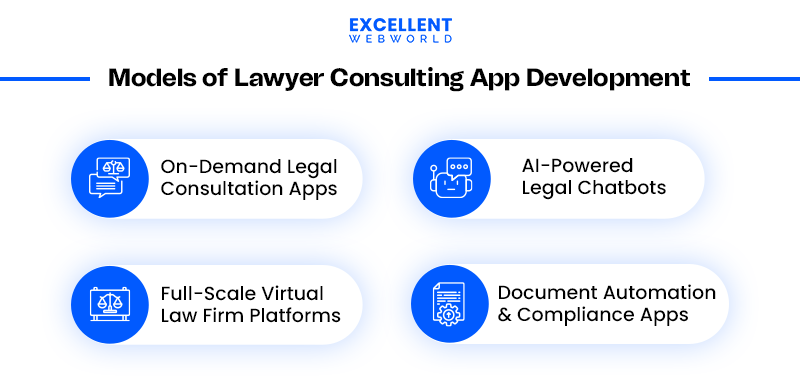
1. On-Demand Legal Consultation Apps
The on-demand legal consultation apps help users connect instantly with lawyers for convenient legal advice and timely updates on legal proceedings. Clients can easily search for attorneys, schedule calls, and get guidance on legal matters without visiting a law office.
The essential features of an on-demand lawyer consultation app include video/audio consultations, appointment booking, lawyer directories, and secure messaging. Popular examples of this approach are LawTap, Avvo, UpCounsel, etc.
Reasons to choose this model
2. AI-Powered Legal Chatbots
AI-powered legal apps integrated with chatbots provide instant answers to basic legal questions and assist clients in generating essential legal documents. They use advanced natural language processing (NLP) algorithms to understand and respond to basic queries without human intervention. It is most suitable to respond to frequently asked legal questions & basic consultations.
The necessary features include AI-driven chat, document drafting, legal FAQs, and automated client onboarding. Popular examples of AI-enabled legal chatbots are DoNotPay, LawDroid, and LISA.
Reasons to choose this model:
3. Full-Scale Virtual Law Firm Platforms
The full-scale virtual law firm platforms offer a full range of legal services remotely. Users can approach attorneys, sign contracts, manage cases, and handle payments within a single platform.
It is ideal for large law firms, remote legal teams, and online legal service providers. Popular examples include Rocket Lawyer, LegalZoom, etc.
Reasons to choose this model:
4. Legal Document Automation & Compliance Apps
Legal document and compliance apps help businesses automate legal paperwork by reducing the need for in-person attorney consultations. These apps also ensure compliance with legal regulations by offering pre-built document templates.
It is best for businesses that require legal documentation & compliance management in corporate law and compliance-heavy sectors. Popular examples of legal resources and compliance apps include DocuSign, ContractSafe, and Clio.
Reasons to consider this model:
Core Features of a Lawyer Consulting App
| Feature | Description |
|---|---|
| AI-powered legal assistant | An AI-driven chatbot that provides instant legal insights before connecting to a lawyer. |
| Blockchain-based document verification | Secure document authentication and tamper-proof legal agreements using blockchain. |
| Augmented reality (AR) courtroom simulation | AR-based virtual courtroom practice sessions for clients and lawyers. |
| Automated legal document generator | An AI-powered tool that helps users create basic legal contracts, agreements, and wills. |
| Instant lawyer matching | AI-based matchmaking suggests the best lawyer based on case details and past success rates. |
| Voice-activated legal search | Users can ask legal questions using voice commands and get relevant responses. |
| Crowdsourced legal opinions | A community-driven forum where users can seek general legal advice before hiring a lawyer. |
| Predictive case outcome analysis | AI analyzes past legal cases to estimate potential outcomes based on user input. |
| Geo-fenced emergency legal assistance | Real-time alerts to nearby lawyers for urgent legal matters (e.g., arrests, accidents). |
| Cryptocurrency payments for legal services | Enables payments using Bitcoin, Ethereum, or other crypto for privacy-focused users. |
| Smart contract creation | Automates contract execution using blockchain-based smart contracts. |
| Multi-party virtual legal meetings | Allows multiple users (lawyer, client, witnesses) to join a secure legal meeting. |
| Legal insurance integration | Users can check and use their legal insurance coverage for consultations. |
| Whistleblower protection mode | A secure, anonymous way for users to report legal violations while protecting their identity. |
Lawyer Consulting App Development Process
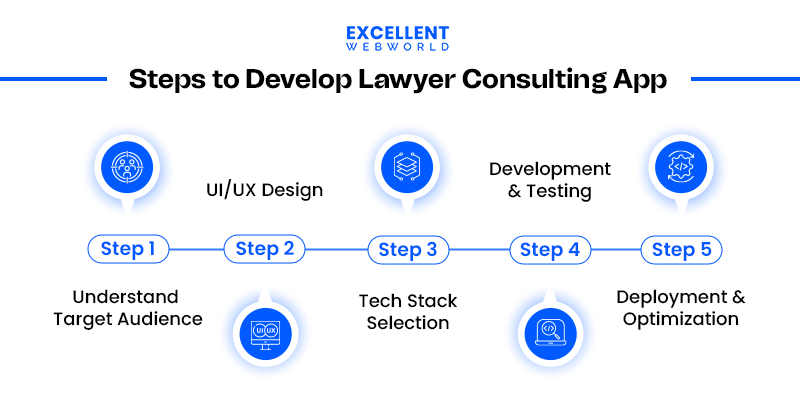
Step 1 – Understanding Target Audience & Legal Niche
Before beginning the lawyer consulting app development process, it is essential to understand the specific needs and challenges that target audiences face. Analyzing the requirements of niches like corporate law, family law, or immigration law helps create tailored legal consulting apps.
Analyzing existing apps to identify gaps and market opportunities(like better usability, unique features, or improved customer support) helps define the features of audience-specific solutions. Understanding target niches helps design and implement specialized features to fulfill user needs.
Checklist to Consider
Step 2 – UI/UX Design for High Usability
Lawyer consultation app development requires an intuitive, responsive design with an easy-to-navigate user interface. Streamlined navigation provides an accessible feature and an organized system that helps clients book consultations, access case files, and check invoices.
The design considers mobile-first aspects and specific user needs, as well as designing the responsive interface to boost overall usability.
Checklist to Consider
Step 3 – Choosing a Scalable Technology Stack
Selecting the best technology stack for web and mobile apps helps ensure smooth performance, scalability, and robust security. Various cross-platform (React, Flutter, and Ionic), back-end and platform-specific technologies help create a scalable solution.
Integration with third-party tools like payment gateways (Stripe or PayPal), legal document management systems, and AI-powered contract review tools is essential to enhance the app’s functionality. A robust app can be managed through a safe and secure database by ensuring compliance with data regulation acts.
Cloud infrastructure like AWS, Azure, and Google Cloud is recommended for enhanced scalability and functionality. This provides robust security measures and automated backup facilities to ensure easy accessibility.
Checklist to Consider
Step 4 – Development & Testing Phase
To efficiently meet user needs, the development process is divided into front-end and back-end development, ensuring it meets high security and compliance standards. The front end involves building a user interface, while the back end focuses on setting up secure servers and databases. Backend data security can be done by implementing encryption protocols and two-factor authentication to protect sensitive client and legal data.
Once the app is fully developed with the required features and functionality, comprehensive app and compliance testing can be done to ensure it is bug-free and adheres to data protection regulations like GDPR (for users in the EU), CCPA (for California users), and other relevant regional laws.
Checklist to Consider
Step 5 – Deployment & Continuous Optimization
Once the app is developed, tested, and refined, it is time for beta and official launch. Submitting an app to Google Play and Apple App Store involves a comprehensive review process(accessing performance, security, functionality, and responsiveness). Once approved, the app is available for public use. After launch, continuous monitoring, tracking user feedback, and resolving bugs if they arise.
Continuous updates and optimization help keep up with market trends. They also involve adding new features, improving UI/UX, and ensuring compliance with legal requirements. Regular updates ensure the smooth functioning of apps and update security measures.
Checklist to Consider
Cost to Develop a Lawyer Consulting App
With the growing demand for legal services and free online consultations, creating a fully featured lawyer consulting application is an upright business prospect. A well-designed and fully featured legal consulting app helps to provide on-demand legal assistance, safeguard document sharing, and establish uninterrupted communication between lawyers and clients.
However, building custom lawyer applications requires outsourcing to an app development company with experience in delivering secure solutions. The cost of developing a lawyer consulting application is based on various aspects, including features, complexity, use of technology, and utilization of third-party services or integrations.
Let’s uncover the important cost factors, breakdown of charges, and unseen expenses that need to be known before developing a lawyer consulting app.
What are the Factors Affecting Virtual Law Firm Software Development Costs?
Multiple factors impact the overall cost of creating a lawyer consultation app, including the Android app development cost, as well as the cost for iOS and web platforms mentioned below.
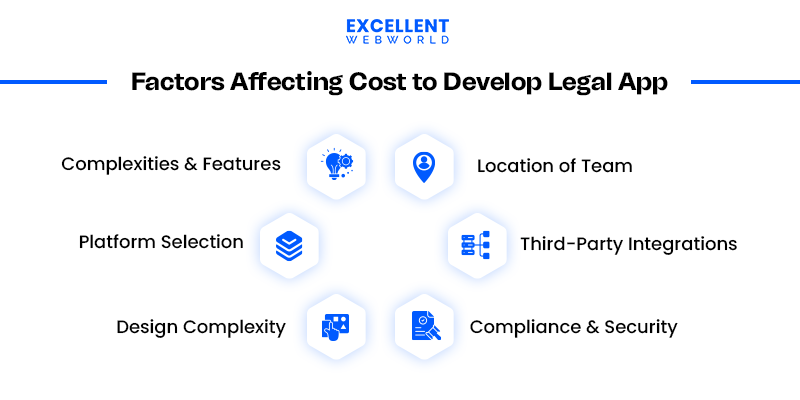
| Factor | Details | Impact on Cost |
|---|---|---|
| Complexities and Features | ||
| Platform Selection | ||
| UI/UX Design Complexity | ||
| Location of Dev Team | Major cost variation based on geography and team expertise | |
| Third-Party Integrations | Integration costs + recurring fees depending on usage and service level agreements | |
| Compliance & Security | High cost due to legal and technical audits |
The Cost Breakdown of Lawyer Consulting App Development
Lawyer app development can help lawyers and clients access convenient legal services. Thus, businesses are shifting their focus to investing in legal mobile app development services to generate diverse revenue streams.
Lawyer Consultation App Development Cost Breakdown
| App Type | Estimated Cost ($) | Features Included |
|---|---|---|
| Basic Lawyer Consulting App (MVP) | $20,000 – $32,000 | User registration & authentication Lawyer profile & client dashboard Appointment booking & management Simple chat support Push notifications & alerts |
| App with Medium Complexity | $32,000 – $49,000 | Video calling Third-party payment tool integration Document sharing & e-signing Search functionality & lawyer filters Multilingual support |
| Full-Featured Lawyer Consultation App | $50,000 – $100,000+ | AI-enabled chatbot assistant Highly secure document management Automated contract drafting Call recording & translation Analytics dashboard for clients & lawyers |
Cost Breakdown by Development Stage
The structured breakdown based on the development lifecycle helps in understanding the variations in web, Android, and iOS app development costs, making it easier to finalize the budget for each phase.
| Development Phase | Estimated Cost ($) |
|---|---|
| UI/UX Design | $600 – $10,000 |
| Frontend & Backend Development | $10,000 – $40,000 |
| API & Third-Party Integrations | $5,000 – $15,000 |
| Testing & Quality Assurance | $3,000 – $10,000 |
| Security & Compliance Implementation | $5,000 – $12,000 |
| Deployment & Maintenance | $2,000 – $8,000 |
What are the Hidden Costs You Should Consider?
Lawyer consulting app development incurs costs like development, designing, hosting, and marketing, but it also involves several hidden costs that need to be considered:
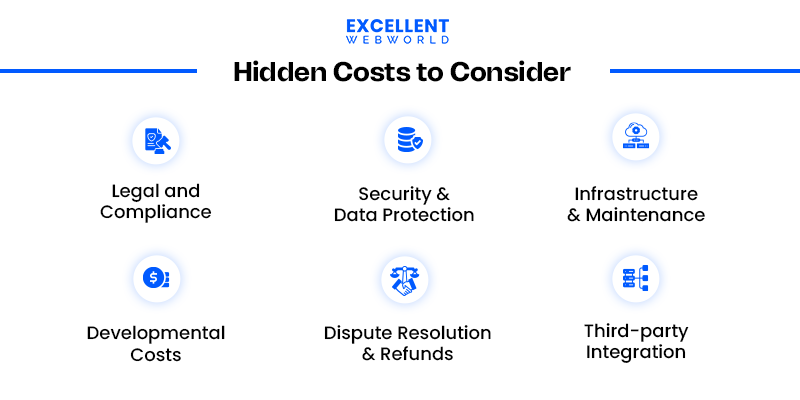
| Category | Description | Potential Hidden Costs |
|---|---|---|
| Third-party API Integrations | Use of services like payment gateways, e-signature platforms (e.g., DocuSign), legal research tools, and real-time status trackers for secure legal process. | Subscription fees, API usage costs, upgrade fees, and integration efforts. |
| Legal and Compliance Costs | Adhering to data protection laws (GDPR, CCPA), bar association rules, licensing, and other region-specific regulations. | Legal counsel fees, documentation, recurring audits, legal law practice license, certification renewals. |
| Security Costs | Protecting sensitive client-lawyer data with encryption, secure login, and regular cybersecurity audits. | Security software/tools, third-party audits, emergency patching. |
| Infrastructure & Maintenance | Cloud hosting (e.g., Google Cloud, AWS, Azure) for storing confidential legal data, backups, and server scaling. | Hosting fees, load balancing, storage upgrades, monitoring tools, and DevOps support. |
| Ongoing Maintenance & Enhancements | Continuous updates for OS/app compatibility, feature improvements, performance tuning, and user feedback-driven changes. | Developer salaries, testing tools, analytics services, and downtime management. |
| Dispute Resolution & Refunds | Handling user complaints, processing refunds, managing support tickets, and chargeback handling. | Chargeback fees, support staff costs, and third-party resolution tools. |
| Internationalization & Localization | Expansion to other regions may require translating UI, adapting to local laws, and cultural adjustments. | Translation services, legal research, localized content development, country-specific compliance updates. |
| AI & Automation Features | Implementing chatbots, document analysis, or legal brief generation powered by AI. | AI model training, third-party AI API usage fees (e.g., OpenAI, Google), ethical/legal review costs. |
Future Trends in Lawyer Consulting App Development
AI & Automation in LegalTech
The advanced AI tools and technologies help lawyers secure contract reviews, draft legal documents, book AI-driven appointments, and provide essential legal consultation. The AI-enabled app integrated with predictive analytics for legal case outcomes helps analyze case status, results, and other relevant data to predict the potential consequences of ongoing cases.
Using AI-powered dispute resolution platforms helps resolve legal disputes efficiently by automating processes. This allows lawyers save time and reduce human error.
Web3 & Decentralized Legal Platforms
Integrating Web3 technologies like blockchain and smart contracts helps ensure transparency, security, and decentralization of processes. Smart contracts are self-executing agreements written into code to provide more efficient, transparent, and secure agreements. By utilizing blockchain technology, these contracts can automatically execute processes without the need for intermediaries.
Non-fungible tokens (NFTs) help verify the authenticity of legal documents like property titles, contracts, or intellectual property. By tokenizing legal documents as NFTs on the blockchain, clients and lawyers can smoothly verify their legitimacy, preventing fraud and ensuring the authenticity of necessary information.
Virtual & Metaverse Law Firms
With advanced VR and metaverse technologies, integrating these into legal consulting solutions enhances clients’ experiences. AR/VR helps transform legal proceedings. Lawyers use VR to present evidence interactively, simulate courtrooms to practice their arguments, and visualize the possibilities.
With the shift of online legal services, it is essential to ensure that sensitive data is verified and secure for online consultations. Blockchain-based decentralized identity systems help securely authenticate clients and lawyers in virtual environments, ensuring the accessibility of sensitive data to authorized clients.
Develop Your Custom Lawyer Consulting App with Excellent Webworld
With Excellent Webworld’s expertise, law firms, independent attorneys, and legal tech startups can get feature-rich, scalable, and secure legal consultation apps tailored to their goals.
Our expert developers craft intuitive, user-friendly, and legally compliant applications by integrating essential features to provide a smooth client experience. Our solutions help streamline legal services, boost client engagement, and enhance operational efficiency with cutting-edge technologies, AI-driven automation, and robust security measures. Businesses can also outsource app development in India to get high-tech legal solutions at a cost-effective pricing structure.
Whether you are a business that wants to expand its legal business or a law firm aiming to digitize its services, we help you build a competitive, future-proof lawyer consulting app that stands out in the legal industry.

Article By


Paresh Sagar is the CEO of Excellent Webworld. He firmly believes in using technology to solve challenges. His dedication and attention to detail make him an expert in helping startups in different industries digitalize their businesses globally.