A Short Summary:-
This blog explains what a Single Page Application (SPA) is, how it works, and why businesses use it for modern web development. It covers the key benefits of SPAs, such as faster performance and improved user experience, along with common challenges like SEO limitations and initial loading issues. The blog also helps readers understand when an SPA is the right choice for their project.
The most sustainable way to build a successful business is to create user-centric websites and applications. You need an online platform or a digital footprint to be recognized by your target audience.
An online platform provides a seamless user experience, enabling you to dig deeper and find new ways to reach your customers. That is one of the core reasons organizations today are looking to build parts of their web applications as Single Page Applications (SPAs).
But the question you may have in your mind is: what is a Single Page Application, and why did the need for SPAs arise?
Gone are the days when browsers couldn’t deliver peak performance. Modern browsers can deliver high performance for your web applications. However, every time you click something, a new page is loaded from the server, making navigation time-consuming. But that’s not the case with a Single Page Application, as it only reloads the data the user has requested, thereby making the process faster.
So, that’s how Single Page Applications came into the picture. If you have a brilliant web app idea and are searching for the perfect technology to build your app, then this blog is for you.
Curious to know more about this one-page web app? Let’s deep dive into it!
What is a Single Page Application?

As the name suggests, it’s a Single Page Application where all the information is available within the same interface. It is one type of web application architecture that you can use to manage a web application’s components.
In an SPA, whenever you click something or scroll the page, only a few elements change, while the rest of the content stays the same. Single Page Application (SPA) monitoring generally runs in the browser and therefore doesn’t add any extra page load time. SPAs only load the information you requested with a click. For example, if you’re browsing a mail client, you’ll notice that the sidebar or header information remains the same, while the navigation only changes the main content area.
If you look at this from a technical perspective, you will find that all Single Page Applications use a design approach with HTML5 and modern browsers to shift page and UI logic from the server side to the browser side. SPAs use HTML, CSS, and JavaScript to load resources dynamically.
One key thing to keep in mind about SPAs is that the web page neither fully reloads itself at any point nor transfers control to another web page.
It’s a win-win situation for all: users don’t need to wait too long to retrieve information, and the server sends less data, thereby enhancing the user experience.
Best Single Page Application Examples Soaring High in the Market
Many of the world’s most popular digital platforms are built using the Single Page Application (SPA) approach. Companies such as Airbnb, Gmail, Trello, Meta, X, Netflix, and PayPal use SPAs to deliver seamless user experiences to millions of users every day.

Each of these platforms leverages SPAs differently:
- Gmail enables users to read, compose, and manage emails without constantly reloading pages.
- Trello provides real-time task management with instant updates across boards.
- Netflix allows smooth browsing between movies and shows.
- Airbnb offers a fast and interactive property search experience.
- Meta and X rely on SPA architecture to support continuous content feeds and user interactions.
These examples demonstrate how SPAs have become the preferred choice for businesses that require dynamic content, frequent user interactions, and responsive interfaces. From social networking and entertainment to productivity and eCommerce platforms, SPAs continue to power some of the most successful digital products in the market today.
So, what makes this architecture capable of supporting such large-scale applications? Let’s explore the architecture behind Single Page Applications in the next section.
How Does Single Page Application Architecture Work?
A Single Page Application creates a website or web application that dynamically interacts with users by rewriting the current page instead of loading entirely new pages from the server. This results in a faster, smoother user experience with fewer interruptions, making it an ideal choice for businesses looking to create a shopping app, eCommerce platform, or other highly interactive web application.
SPAs help you reduce page load time, making the website behave like a desktop application and providing a more seamless user experience.
As there are plenty of websites or web applications where there’s repetition of content – headers, footers, navigation- SPAs are an ideal choice for it. Some content stays fixed wherever the user navigates (header, footer, logos), while only the core content area gets updated.
Architecture of a Single Page Application
- Repetition is advantageous to Single page apps. Suppose you have requested a painting in your web browser. In that case, a traditional website tends to paint the entire picture for you. At the same time, a SPA will give paint-by-numbers for the site, including repeating guides that you might use to pipe the right paint to fill out the template.
- Either way, you are bound to see the same tree. But the main difference the SPA makes is the page loading speed, which is much faster in a traditional app.
- On a traditional website, you will see a completely new tree in a second request, as the server repaints and sends back the entire page. Otherwise, a SPA server will bring in a new tree, but the house will remain unchanged. They will load the tree and present it to you.
- Transferring painting work from the server to the client makes the page nearly dynamically re-rendered rather than reloading the entire page.
Hence, that’s how a Single Page Application works, making it even easier for end users to access your apps.
Advantages of Building a Single Page App

There are immense benefits of SPAs. Let’s get through some of them.
Faster Navigation After Initial Load
Once a Single Page Application loads, users can move between pages and access content without refreshing the entire page. Instead of reloading everything, only the required content is updated. This makes navigation faster and creates a smoother user experience, especially for applications that use the same layout across multiple pages.

If a page takes more than 3 seconds to load, the probability of a user “bouncing” (leaving immediately) increases. That’s where Single Page Applications can give you a real competitive edge.
Good Caching Abilities
One of the best advantages of Single Page Application development is its ability to cache local data efficiently. The SPA sends a single request and stores all data from the server. Since data access is ongoing, users can even work offline. Here, the local data is synchronized with the server.
When deploying SPAs to the cloud, businesses must follow a systematic approach to ensure a smooth transition. Using an application migration to the cloud checklist can help address key factors such as performance optimization, security, and robustness.
Improved User Experience
single page web apps are amazing for creating innovative pages and providing an excellent user experience, as users do not need to wait for a new page to load. Dynamic loading of content provides a seamless user experience.
Rapid Front-End Development
SPAs let developers build the front-end faster than before, thanks to a decoupled Single Page Application architecture.
It separates front-end and back-end development, allowing teams to build, test, and deploy the front-end independently.
Everything works through APIs that follow standard rules for structuring, exchanging, and retrieving data.
What are the Major Drawbacks of a Single Page Application Framework?
Along with benefits, SPAs also have a few disadvantages.
Search Engine Optimization
Historically, SEO has been a major challenge for SPAs because they rely on JavaScript for rendering, making it difficult for search bots to index web pages correctly. For this purpose, you can use Server-Side Rendering (SSR) or Static Site Generation (SSG), provided by frameworks such as Next.js (React) and Nuxt.js (Vue).
These modern approaches work very well because they pre-render HTML on the server, making content easily crawlable while preserving SPA interactivity. So, if SEO is a priority for your project, use SSR or SSG instead of a pure client-side SPA.
Complex SPAs Come with Issues
When you build a complex Single Page Application, it can become harder to manage as the application grows. Large SPAs may also take longer to load the first time because more files need to be downloaded and processed. For highly complex projects, alternatives like server-side rendering (SSR) or mobile apps may provide a better user experience.
Analytics
If you’re building an SPA, you need additional analytics tracking logic because it doesn’t perform a full page reload like a traditional website or web application. The good news is that Google Analytics 4 (GA4) now provides built-in support for SPA tracking, making tracking easier than older Universal Analytics (which was sunset in 2023). However, you still need to ensure that your analytics setup triggers events when routes change.
SPA Is Not Always the Answer: A 2026 Perspective
For most of the 2010s, SPA was the default choice for modern web development. However, in 2026, that has changed drastically. Now, you have modern-day frameworks like Next.js, Nuxt.js, and Astro, which provide Server-Side Rendering (SSR) and Static Site Generation (SSG), thereby addressing the SEO and performance issues that SPAs used to struggle with.
Several new architectural patterns now compete alongside traditional SPAs:
React Server Components (RSC)
React Server Components (RSC) allow certain parts of a React application to run on the server instead of the browser. This reduces the amount of JavaScript that needs to be downloaded, helping improve page load performance and Time to First Byte (TTFB) while still supporting interactive SPA experiences where needed.
Islands Architecture (Astro & Deno Fresh)
Islands Architecture was popularized by frameworks such as Deno Fresh and Astro. What these frameworks do is render pages as static HTML, small, isolated interactive components (“islands”) that are hydrated on the client-side. In this kind of setting, you get near-instant page loads and excellent SEO support while still providing the rich interactivity of an SPA.
Streaming SSR
Streaming SSR, available in React 18+ and Next.js, configures the server to send HTML chunks as they’re ready, rather than waiting for the entire web page to render. Basically, streaming SSR finds a middle ground between the instantness of SPAs and the crawlability of traditional server-rendered pages.
Partial Hydration and Resumability (Qwik)
With the introduction of frameworks like Qwik, you now have the concept of resumability. Instead of re-executing JavaScript on the client-side after SSR, the application resumes from the server-rendered state. It helps in improving the Time to Interactive (TTI), especially on mobile devices.
SPA + BFF (Backend for Frontend) Pattern
Another modern architecture pattern that you can easily pair with an SPA is a Backend for Frontend (BFF) layer. It’s a dedicated API customized for the frontend. BFF helps you with data aggregation, authentication, and transformation, thereby keeping your SPA lean and fast. Companies like Spotify and Netflix use the concept of BFF.
SEE ALSO: SPA vs MPA – Key Differences Explained
When to Use a Single Page Application?
single page web applications are an excellent choice for internal tools, dashboards, SaaS platforms, and social networks where SEO is less critical. However, if your web app development project has a strong emphasis on SEO, a multi-page application or an SSR/SSG framework is a better option.
On the other hand, if you want rich, real-time communication between your app and users, such as chat interfaces, live collaboration tools, or complex, data-intensive dashboards, SPAs remain a compelling option.
Choose a Single Page Application when:
- Users need to move between pages quickly without waiting for full page reloads.
- You want to provide a smooth, app-like experience in a web browser.
- Your application has many user interactions, such as dashboards, chat systems, or project management tools.
- Most users access the application after logging in, rather than through search engines.
- The same design and interface elements are used across multiple pages.
- Users need real-time updates without constantly refreshing the page.
- Fast navigation and responsiveness are important for the user experience.
- Your application updates only certain parts of a page instead of reloading the entire page each time.
Now you might be curious to get an answer to this question, ‘What is the process to build a Single Page Application?’, then swiftly move forward to know in detail about the development process in the next section.
When SPA Still Makes Sense — Decision Matrix
Use this quick guide to decide whether an SPA is right for your project:
| Use SPA If… | Consider SSR/SSG/Islands If… |
|---|---|
| SEO is not a priority | Public-facing site needs high SEO |
| The app is behind a login wall | Content needs to be indexed by Google |
| Heavy real-time interactivity | Mostly static or content-driven pages |
| Internal tool or dashboard | Fast initial load is critical |
| Team knows React/Angular/Vue | Mobile performance is the top concern |
How to Build a Single Page Application?
The two cornerstones for building a perfect single page app are tools & team. Let’s go through both of them in depth.
Single Page Application Technologies & Tools
The following are the technologies and tools you will require to build a Single Page Application.
- JavaScript Frameworks — The first and foremost requirement. See the framework comparison of the top JavaScript frameworks in the section below.
- Backend Technologies — Whether it is Node.js, Python, or any other backend, all work well with SPAs.
- Database — MongoDB and MySQL are popular choices for SPA backends.
- AJAX/Fetch API — Essential for client-server data exchange in SPAs.
Single Page App Development Team
The preferred option for building a Single Page Application is to hire a whole development team. The team will not only help you create a bug-free single page app but also come up with unique ideas for it.
Your single page app development team must include:
- UI/UX Designers
- Backend Developers
- Frontend Developers
- QA Engineer
- Project Manager
Frameworks That Can Be Used While Developing a Single Page Application
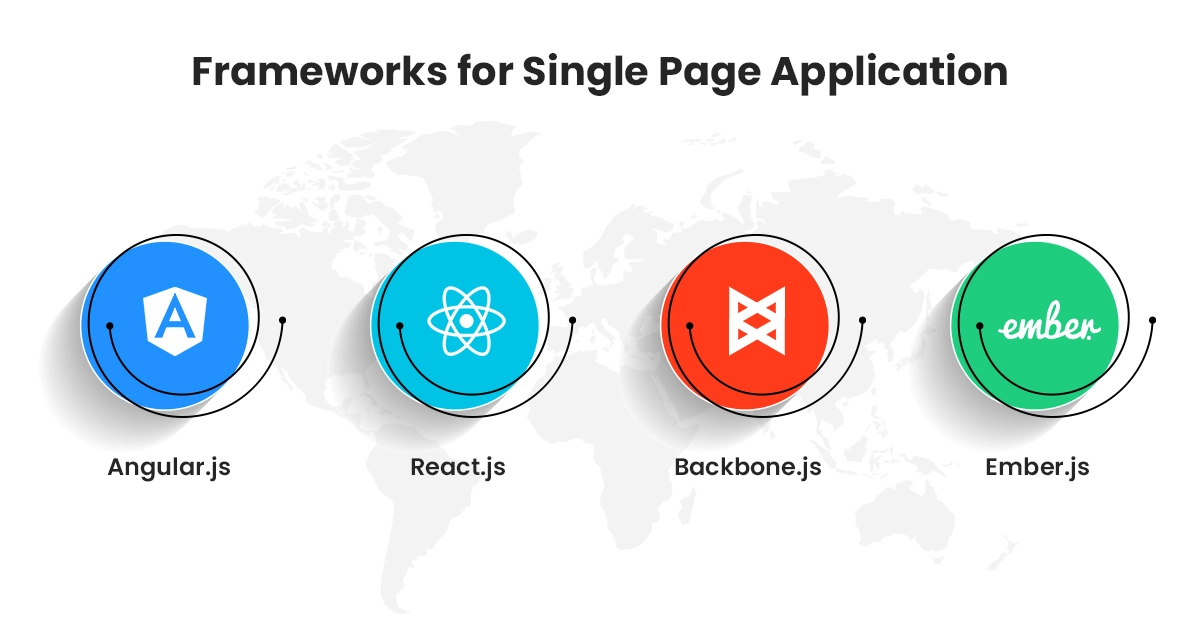
If you’re thinking about building your web app development project with an SPA, then knowing and selecting the powerful tools that align with your SPA needs is paramount.
Here is the comparison between the top frameworks for Single Page Application development in 2026:
Note: Remember that AngularJS (Angular v1.x) reached end-of-life in December 2021, so it’s not recommended for new projects. Instead, you should use Angular (v2, currently v22), the modern successor to AngularJS. Also, instead of Backbone.js and Ember.js, we have modern alternatives such as Vue.js and Svelte.
| Framework | React.js | Angular | Vue.js | Svelte |
|---|---|---|---|---|
| Description | JS Library for Building UI | Full MVC/Component Framework | Progressive JS Framework | Compiler-based UI Framework |
| Founded | 2013 | 2016 (Angular 2+) | 2014 | 2016 |
| License | MIT | MIT | MIT | MIT |
| Popular Websites | Facebook, Airbnb, Instagram | Google, Microsoft, Forbes | Alibaba, GitLab, Grammarly | Razorpay, The New York Times, Squarespace |
| Ideal For | Large apps with frequent data changes | Enterprise-scale SPAs | Flexible, easy-to-learn SPAs | Performance-critical apps |
| Homepage | https://react.dev | https://angular.dev | https://vuejs.org | https://svelte.dev |
Quick View: single page vs Multi-Page Apps
While a Single Page Application only loads the information you requested, a multi-page application reloads and downloads the entire content on each navigation.
When you’re targeting rich interactivity and user engagement, with SEO being a low priority, SPAs are your best bet. However, if you want to increase your reach to potential customers through search engines, multi-page applications should be your ideal choice. Generally, large-scale companies with multiple products prefer multi-page applications, while platforms targeting a focused user group opt for SPAs.
In 2026, you can’t go all-or-nothing. With new frameworks, you can adopt hybrid approaches like Next.js (React-based SSR/SSG), Nuxt.js (Vue-based), and Astro (Islands Architecture), which serve static or server-rendered pages as needed while maintaining SPA-like interactivity.
Are You Ready to Use a Single Page Application in Your Project?
Like everything else, SPA also has its pros and cons. So, you need to make a decision by keeping your business requirements in mind. SPAs are a good choice for dynamic, user-engagement-focused web application development. However, in 2026, you’ll have plenty of other architectural options available at your disposal.
If you’re a startup planning to develop a product with an emphasis on user engagement and visibility, you should not limit yourself to SPAs but also explore hybrid frameworks that offer SSR, SSG, and Island Architecture to get the best of all worlds. If you’ve decided to build a single page web application but are still confused about anything, feel free to talk to our experts!
FAQs for Single Page Application
Below are a few steps to follow for developing a single page website:
- Decide whether a one-page website is right for your business.
- Define your website goals and content structure.
- Choose the right technology and tools.
- Design a user-friendly and mobile-responsive layout.
- Build the website or work with an experienced development team.
- Optimize the website for speed and search visibility.
- Add clear calls-to-action and contact information.
- Test the website before launch.
- Launch and monitor performance regularly.
A single page app is a web application with a single page. In short, it is a website or web app that dynamically updates the current page with new data whenever a user requests it. Rather than loading a whole new page, only the needed information reloads and displays to the users.
Angular (v2, currently v22) is one of the best frameworks for building enterprise-grade single page web apps. To execute it, hire a development team with Angular experience. Share your web app idea with the team, and they will handle architecture, development, and deployment.
Oh, YES. Single Page Applications are an ideal solution for dynamic platforms with low-level data complexity. However, the future belongs to hybrid architectures that can support SSR, SSG, Island Architecture, and SPA. Frameworks like Next.js, Nuxt.js, Astro, and Qwik are leading this revolution.
SPAs work by loading a single HTML page upfront and then dynamically updating the content using JavaScript as the user interacts with the app. Instead of requesting a full new page from the server on every click, the app communicates with the server via APIs (typically REST or GraphQL) and updates only the parts of the UI that need to change. This results in faster navigation and a smoother user experience similar to a native desktop app.
In a Single Page Application (SPA), all navigation occurs on a single HTML page — content is loaded dynamically via JavaScript without full-page reloads. In a Multi-Page Application (MPA), every navigation triggers a full request to the server, which returns a new HTML page. SPAs offer faster, more fluid interactions but can be harder to optimize for SEO. MPAs are easier for search engines to index, but can feel slower due to full-page reloads. Modern hybrid frameworks like Next.js blur this distinction by combining both approaches.
A pure client-side SPA is not ideal for SEO out of the box. The best approach is to use a meta-framework that supports Server-Side Rendering (SSR) or Static Site Generation (SSG): Next.js (built on React), Nuxt.js (built on Vue), and SvelteKit (built on Svelte) are the top choices in 2026. These frameworks pre-render HTML on the server, making content easily crawlable by search engines while preserving the interactivity of a modern SPA.

Article By


Paresh Sagar is the CEO of Excellent Webworld. He firmly believes in using technology to solve challenges. His dedication and attention to detail make him an expert in helping startups in different industries digitalize their businesses globally.