If your legacy systems are still running, it’s easy to call them “stable.” However, a stable system doesn’t guarantee that it’s secure, scalable, or ready for growth.
A system that can’t move quickly reduces revenue. A system without a seamless integration process or AI support increases risk. Legacy software modernization is no longer an IT hygiene task. It is a business decision tied to cost control, compliance, and speed.
- The increased use of AI, stricter US regulations, and higher expectations of customers mean you can’t sit on your outdated system for a long time.
- What worked five or seven years ago can’t work in today’s scenario.
- If you run the same system today, you’re bound to experience slow performance. You will face security vulnerabilities, and a costly maintenance bill..
That’s why modernization conversations have shifted from IT teams to C-level executives. Business is feeling the impact firsthand.
By mapping architectural decisions with business decisions, business leaders can modernize their legacy systems without disrupting critical operations.
To make this a reality, you need a partner specializing in software development services. With 15+ years of experience and 300+ successful modernization projects, we at Excellent Webworld have compiled our experience and lessons learned in this guide.
By reading this guide, you will get a clear roadmap of what to modernize, what not to modernize, and how to execute each step seamlessly.
What is Legacy Software Modernization?
Legacy modernization simply means updating your old or legacy system that is slowing down your core business operations.
You modernize them to remove growth blockers without risking core operations. When done correctly, it connects technology to real business results rather than just infrastructure improvements.
The core purpose of modernizing legacy software is to remove blockers that limit your business’s growth. If you execute this perfectly, it will deliver better business results for your organization.
By modernizing the legacy system, you can fix:
- Slow releases that disturb the growth of the organization
- Maintenance costs that take a large piece of your innovation budget
- Security loopholes that increase the chance of a breach
- Relying on only a few legacy systems experts
A typical modernization combines cloud, AI, and GenAI with a software development process to mitigate risk and speed up delivery. A knowledgeable, experienced legacy software modernization company in the USA will advise you to execute modernization in phases to keep existing processes running smoothly.
Are Businesses Really Opting for Legacy Software Modernization?
Yes, businesses are opting for legacy software modernization because it helps them minimize operational risk, address scalability issues, and set them on a growth path.
And we’re not saying things for the sake of it,
You can clearly see this shift in market demand signals:
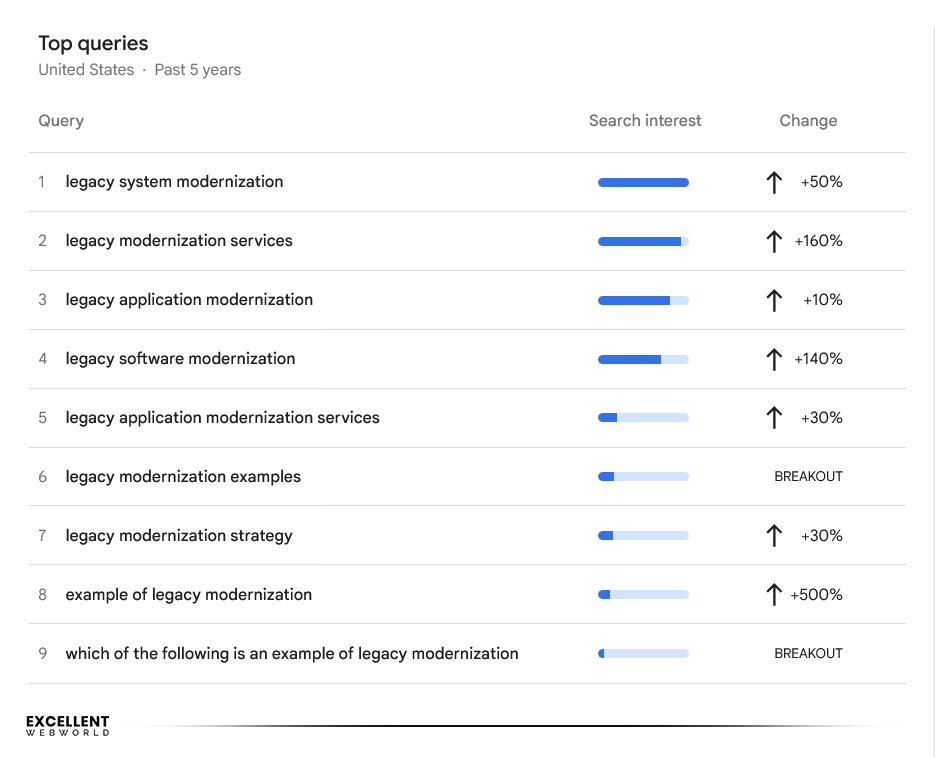 As you can see in the image above, interest in search terms in the USA such as “legacy software modernization” (+140%), “legacy modernization services” (+90%), and “example of legacy modernization” (+300%) has increased significantly over the last five years. (Source: Google Trends, Location: USA, Duration: Last 5 Years)
These signals indicate:
- There is urgency at the executive level to modernize. Leaderships are seeking effective strategies, right approaches, and best service providers. They want to validate success stories before starting their own digital transformation.
- The global enterprise data market is also supporting this trend. The global legacy software modernization market is expected to grow from $13 billion to $27 billion by the end of this decade.
Now, look at these two significant indicators together.
- Demand for these search terms.
- Strong investment data to back it up.
You can confirm that Legacy software modernization is no longer optional. Instead of being an IT initiative, it has become a board-level priority.
Update: According to the 2025 GAO Federal IT Report, over $100 billion is spent annually on IT, with leadership now legally required under White House OMB M-25-04 to prioritize legacy replacement to mitigate national security risks.
7 Signs You Need Legacy Software Modernization
Legacy software rarely breaks overnight. Instead, it shows clear warning signs over time – slower releases, rising costs, and growing technical friction – that quietly hold your product and team back.
Here are the 7 signs that you need to be aware of for legacy software modernization:
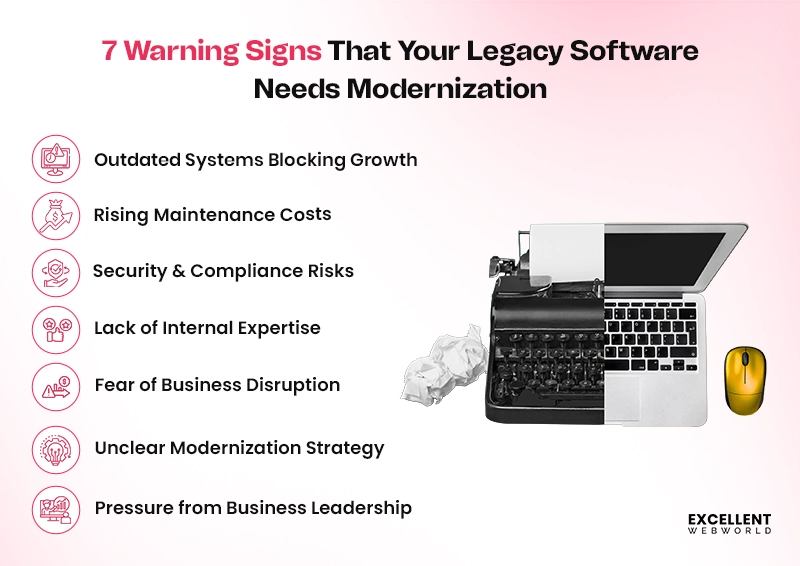
1. Outdated Systems Slow Down Your Business Progress
Any legacy software slows down feature delivery, and in today’s time, where speed is a premium, it can be a real issue for businesses. In addition, legacy software doesn’t allow you to add or integrate anything new and doesn’t support a modern customer experience.
- Delivering new features requires months
- Teams spend time fixing issues instead of building solutions
- Growth and scalability are restricted
Note: Your IT staff can focus on business outcomes by migrating from the legacy system to the new system.
2. Rising Maintenance Costs Draining Your Annual IT Budget
Budgets and staff time are used when outdated systems are maintained. Licenses and specialized skills increase expenses.
When you have to maintain outdated or legacy systems, most of your budget and developers’ time gets invested in such tasks. It increases your software and app maintenance costs and distracts you from focusing on innovation. In addition, licenses and specialized skills increase overall expenses.
- More spending on maintenance than innovation
- ROI is on a downward trend curve year by year
- Maintenance costs don’t allow you sufficient funds for digitalization
Note: Working with top-rated legacy software modernization companies in the USA reduces cost and increases efficiency.
3. Increasing Security and Compliance Risks
If you analyze legacy systems carefully, you will surely find out that these systems don’t have a modern-day security ecosystem or posture. These systems really struggle with any kind of security audits. They lack a comprehensive cybersecurity risk management plan, and can’t fulfil any type of regulatory requirements.
- High chances of security breaches
- Business doesn’t meet compliance requirements
- Reputational and financial damage
Note: If you use legacy modernization software, it will help you boost your security posture and simplify compliance.
4. Lack of Internal Expertise to Support Aging Codebases
When legacy experts leave your organization or retire, it creates a significant knowledge and experience gap. When they are not present in the company, the business risks operational disruption, slows innovation, and increases maintenance costs. That’s why the need for modernization is more now than ever before.
- If legacy experts leave, there’s a high risk of failure in the current system
- Teams struggle to maintain or enhance systems
- Learning curves delay improvements
Note: If you seek assistance with legacy software modernization services in the USA, this will help you navigate these complexities with ease.
5. Fear of Business Disruption And Sudden System Failures
Often, the reason for not pursuing modernization is fear of failure or concern that core business activities won’t run smoothly afterwards. However, in legacy software modernization, an incremental update philosophy is used. As a result, operational risk is minimized, and you can maintain performance and scalability without disrupting core business operations.
- Downtime affects revenue
- Past failed attempts create hesitation
- Not having a clear-cut roadmap leads to cluttered decision-making
Note: If you opt for a phased approach to modernization, it will help you reduce disruption to core business operations and identify blockers.
6. Lack of a Clear Modernization Strategy
Having an “Unclear Modernization Strategy” is a critical sign that your business needs legacy modernization. When a company lacks a modernization strategy, it usually means the underlying software has become so complex or fragile that the team is afraid to touch it. Also, distinguishing between rehosting, restructuring, replatforming, and rebuilding can be difficult for businesses.
- Rarely do roadmaps relate to business results
- Vendors push tools, not solutions
- Without a clear-cut path, you can’t make a good decision
Note: If you align your approach with business outcomes, you can have a greater impact and deliver faster results.
7. Pressure from Business Leadership to Achieve Digital Transformation
The pressure usually arises because of the fundamental difference between where the business wants to be and where the software allows it to go. Every business demands faster delivery. Businesses also seek an architecture that supports cloud computing and delivers improved data analytics.
- IT infrastructure becomes a roadblock rather than a medium for digitalization
- Legacy or outdated systems slow down your response time
- C-level executives desire quick response and high-end performance
Practical advice: In discussions with Paresh (CEO) and Mahil (COO), I often examine the ‘transformation gap’ that emerges when engaging with new clients. Addressing this gap requires aligning digital transformation initiatives with a phased modernization strategy.
Why Most Legacy Improvement Efforts Fail and What Successful Teams Do Differently?
Most legacy system modernization initiatives fail because they allocate resources inefficiently, slow product delivery, and increase the risk of failure. Although you invest all your time and money into this significant project, the core business operations still block your growth, speed, and security
Why Do Most Legacy Improvement Efforts Fail?
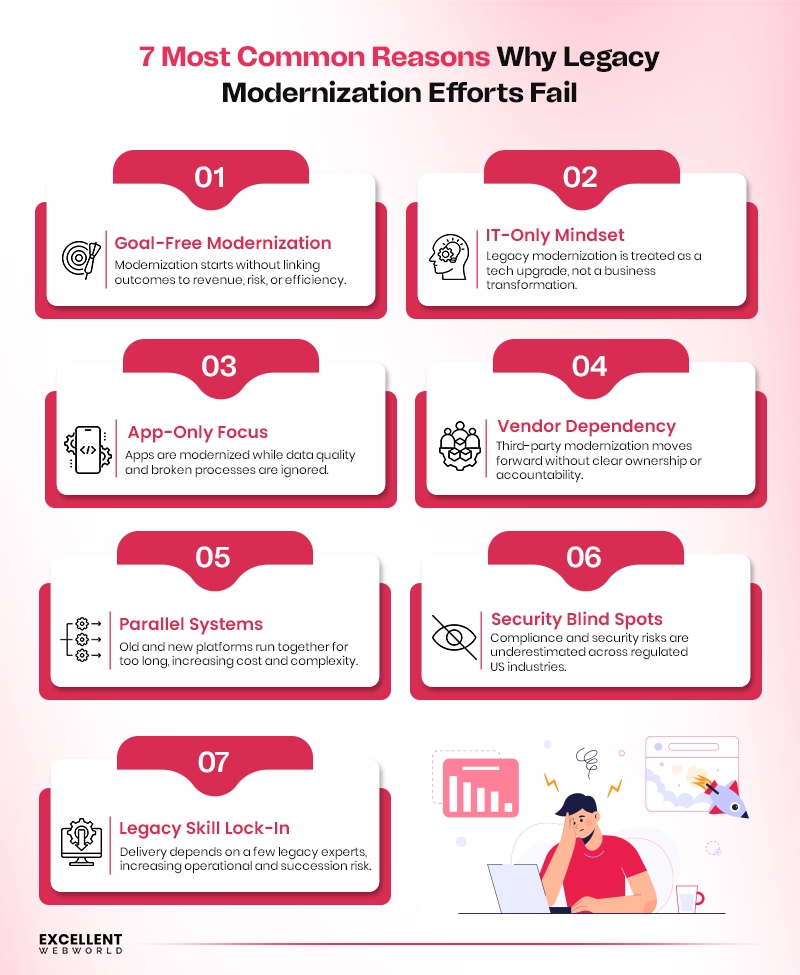
- Most business starts the modernization process without clarifying the business goal, which is tied to revenue, risk, or the total cost of ownership
- You treat legacy software modernization as a technical task rather than understanding that from a business impact perspective
- Modernize any of your existing business applications without taking into account the data quality, process debt, or integration gap
- You blindly accept software modernization services in the USA from a particular vendor without understanding the ownership model
- Many company makes the fatal mistake of running the legacy and new systems together, which doubles the cost and complexity
- Undermining the regulatory and compliance standards of the US government for healthcare, financial services, and government projects
- Overrelying on only a few legacy system experts can risk your delivery process, as they can leave or retire at some point in time
What Successful Teams Do Differently?
- Successful teams clearly define goals and objectives before starting the modernization process, including targets for speed, cost, and uptime.
- The teams that pull off modernization successfully follow a step-by-step software modernization process, and map it with business objectives
- They emphasize modernizing data and integration layers in the initial phases so that they can provide support for AI, GenAI, and cloud
- Successful teams take one-to-one meetings with the leadership group, i.e., CTO, CEO, CFO, CMO, etc., to finalize scope and tradeoffs
- Successful teams avoid compliance risks by choosing, for example, healthcare software modernization to automate regulatory standards within their systems.
- They retire low-value systems instead of modernizing everything
- They choose software modernization companies with proven US regulatory and enterprise delivery experience
What are the Key Approaches to Legacy Software Modernization?
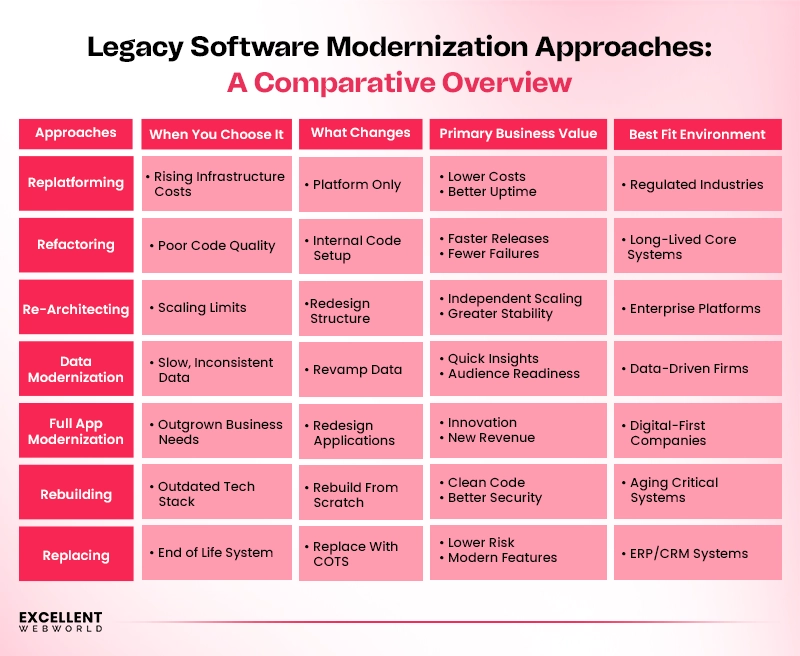
Here are 7 key approaches to legacy software modernization you can choose based on your business impact and desired outcomes.
1. Replatforming
Whenever you feel your legacy system’s core business operations are performing well, but the foundation is becoming more costly and risky, you should consider a re-platforming approach.
What this approach does: Here, you can migrate your legacy or outdated applications to the cloud or modern platforms without changing the core business logic, critical data workflows, or the user experience.
When you should choose this path:
- When the cost of managing and maintaining infrastructure becomes prohibitive.
- Replacing the hardware can consume most of your budget.
- When system downtime is affecting core business processes.
Business value you gain:
- Lower hosting and operations spend.
- Better uptime and recovery.
- Faster environment setup.
Key limitation:
- Technical debt stays.
- Delivery speed stays similar.
This approach often starts a broader software modernization effort inside regulated environments.
2. Refactoring Legacy Code
When your source code is in poor condition, it affects your delivery cycle and increases the risk of failure; you should opt for refactoring.
What this approach does: By opting for refactoring, you aim to enhance source code quality while keeping your core features and output unchanged.
When you should choose this path:
- When you’re missing a release cycle too often without any specific reason.
- Security findings increase each quarter.
- Few engineers understand the system.
Business value you gain:
- Faster enhancements.
- Fewer production failures.
- Lower dependency on rare skills.
Key limitation:
- No new business features.
- All teams must follow a specific routine without exception.
Refactoring helps in modernizing legacy systems without changing core business processes.
3. Re-Architecting
Whenever your current or legacy system becomes a roadblock to business growth and cannot mitigate system failures, it’s time to re-architect it.
What this approach does: During re-architecting, you redesign your applications to be loosely coupled. That means all the parts can scale and fail separately without affecting the entire ecosystem.
When you should choose this path:
- A single point of failure can disrupt the whole system.
- Scaling forces complete redeployment.
- Integrations break often.
Business value you gain:
- Stronger system stability.
- Faster response to change.
- Clear ownership boundaries.
Key limitation:
- Higher planning effort.
- Governance gaps cause sprawl.
Large programs often rely on application modernization software to manage architecture shifts.
4. Data Modernization
If your legacy system cannot provide timely business insights, it can delay your business decisions and affect your time-to-market. At that time, the best option is to pursue data modernization.
What this approach does: In any data modernization exercise, you restructure your architecture, clean up your datasets, and implement data governance rules to ensure secure access and data trustworthiness.
When you should choose this path:
- Generating a detailed report takes a long time.
- There’s a visible data conflict between teams.
- You have to invest months to get an audit report.
Business value you gain:
- With re-architecting, you enable quicker decision-making.
- You can get a cleaner security and compliance report.
- You have established a strong foundation for detailed-level analytics.
Key limitation:
- There’s partial control over the elements, which creates a risk.
- Governance gaps cause exposure.
Data modernization is a force multiplier for modernizing legacy systems across the enterprise.
5. Full Application Transformation
When the existing system is blocking your core business operations, it’s time to opt for a complete application transformation.
What this approach does: During a complete application transformation, you redesign the existing applications to align with the current business model and growth plans.
When you should choose this path:
- When your digital channels feel like an afterthought rather than the original plan.
- When business teams have more control than architectural-level teams.
- When your competitors are getting ahead with fewer applications.
Business value you gain:
- Faster innovation cycles.
- Clear IT and business alignment.
- New revenue paths.
Key limitation:
- You need full support and backing from your top management and executives.
- Here, you can’t rely on partial efforts; it will undoubtedly lead to failure.
This path often includes rewriting legacy applications to remove core constraints.
6. Rebuilding
When you know your business logic is on point, but the current technology stack is dragging down performance, it’s time to rebuild.
What this approach does: You recreate applications using modern stacks while keeping essential behavior.
When you should choose this path:
- Frameworks reached the end of life.
- Changes cost more each year.
- Growth plans exceed system limits.
Business value you gain:
- Clean codebase.
- Better security posture.
- Easier hiring and onboarding.
Key limitation:
- If you run so many systems in parallel, there’s a heavy price you need to pay, although for short periods of time.
- Before adopting this approach, ensure you have a rollback mechanism in place.
In simple terms, rebuilding means you won’t be carrying the burdens of old systems.
7. Replacing
You replace when keeping the system no longer makes sense.
What this approach does: You retire legacy software and adopt modern commercial platforms.
When you should choose this path:
- Your vendor is not providing support for the existing system.
- When any type of customization blocks business growth.
- The total cost of ownership continues to rise.
Business value you gain:
- You can predict the next system upgrade.
- You can access the core features faster than ever.
- You can also reduce operational risk.
Key limitation:
- You need to establish a change management process for success.
- There needs to be a standard development process.
If you want to modernize enterprise software, this approach is a perfect fit.
How You Should Decide the Right Approach
You should decide based on these focus areas:
- Business criticality.
- Regulatory exposure.
- Skill availability.
- Long-term cost curve.
An experienced legacy modernization software developer evaluates these factors first. You modernize to restore confidence, control risk, and regain speed.
Considering Cloud Modernization for Legacy Applications
If your legacy system is limiting delivery speed and business growth, and putting your security at risk, you should consider cloud modernization.
The reason is that, if executed successfully, cloud modernization can help you regain control of your business without disrupting your core operations.
Why cloud modernization matters now?
- It reduces rising maintenance and licensing costs
- It enhances your security, compliance, and audit capabilities
- It enables AI and GenAI adoption without complete rebuilds
- It shortens release cycles and removes IT bottlenecks
You should start with a cloud application migration checklist to prioritise systems based on risk, revenue impact, and downtime tolerance.
Startups should use cloud-based application development to ship customer-facing platforms faster, while relying on cloud native application development services to future-proof core systems and architecture.
Experienced legacy modernization software developers lower the disruption risk. Partner with a trusted legacy software modernization firm that aligns cloud, AI, and governance with real business value.
What are the Legacy Software Modernization Challenges that Disrupt Operations?
Modernizing legacy software affects your day-to-day business operations because you must modify the core components of your existing systems. In addition, there’s a challenge in maintaining system revenue, compliance, and user experience. Also, you have to do this while dealing with expectations from executives and auditors.
Decision Challenge 1: Keeping the Business Running While Change Is Underway
As a business owner, you always worry about downtime because it affects your core operations. One miss here can prove costly in terms of revenue, customers, or brand reputation.
- You must modernize without stopping daily operations
- Downtime tolerance is close to zero in regulated industries
- If you opt for cloud migration and AI integration, it might incur some short-term risk
To address this issue, you should engage an experienced legacy software modernization company in the USA. They will help you plan the modernization process in a step-by-step manner, with rollback plans.
Decision Challenge 2: Balancing Speed of Change Against Long-Term Stability
Any business leader today wants to move quickly; however, in that rush, you may end up with a fragile system.
- Most organizations want to increase delivery speed and an architecture that supports GenAI adoption.
- Businesses want to maintain scalability and performance while keeping costs in check.
- If you take a shortcut today, it might cost you in terms of tech debt tomorrow.
If you map your architectural and technical decisions to business outcomes, partner with an experienced legacy software modernization design consultancy in the USA.
Decision Challenge 3: Managing Knowledge Loss and Team Dependency
You rely on systems that only a few people understand. That is a serious risk.
- Legacy skills are disappearing fast
- Documentation is outdated or missing
- One resignation can stall operations
If you partner with a top-rated legacy software modernization development firm in the USA, it will help you in automation, AI-assisted code analysis, and structured knowledge transfer.
Decision Challenge 4: Meeting Compliance, Security, and Regulatory Expectations
When you’re dealing with industries like healthcare, BFSI, or government projects, you can’t take security, compliance, and regulatory standards lightly.
- Any legacy platform doesn’t have modern-day security controls.
- Real-time auditing provides insights into the robustness of your security posture.
- One breach can cost millions.
Modernization must address compliance, security, and cloud governance from day one.
3-Phase Legacy Software Modernization Process for Safe, Disruption-Free Upgrades
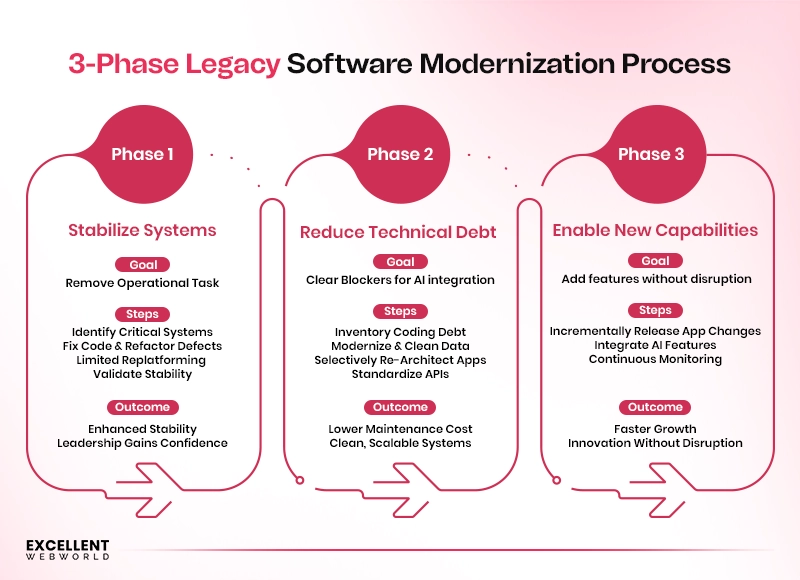
The primary goal of legacy system modernization is to increase system uptime, mitigate risk, and prepare the system for future growth. You need to do all these activities while preparing your company for cloud and AI adoption.
Phase 1: Stabilize Systems and Eliminate Immediate Operational Risk
The first step in the legacy software modernization process is to protect your day-to-day business operations, which drive your revenue.
Goal: Keep the business’s primary functions running while preparing it for modernisation.
Steps Involved:
- Figure out critical systems: Identify applications related to billing, claims, payments, logistics, and reporting.
- Identify immediate risks: Assess areas that create security vulnerabilities, performance degradation, and fragile dependencies.
- Quick refactoring of legacy code: You fix defects causing outages, data errors, and repeat incidents.
- Limited replatforming: You move fragile workloads to supported cloud infrastructure without changing behavior.
- Validate stability: You run regression, load, and failover tests to prevent disruption.
This phase demands a legacy software modernization expert with experience in regulated and high-availability environments.
Outcome: Core systems stay stable. Risk drops. Leadership gains confidence to invest in legacy software modernization development.
Phase 2: Reduce Technical Debt and Create an AI-Ready Foundation
If you want to modernize legacy systems, you need to remove the roadblocks that are the primary drivers of slow product delivery and higher costs.
Goal: Prepare your existing system to support AI integration, automation, and data analytics.
Steps Involved:
- Prioritize technical debt: Identify the source code and architectural components that are causing release delays.
- Data modernization: Clean datasets and implement governance rules to ensure consistent, trustworthy outputs and informed decisions.
- Selective re-architecting: Identify the components most at risk to business growth and redesign them using microservices.
- Standardize APIs and interfaces: By integrating multiple APIs into the ecosystem, you enable cross-platform interoperability.
- Scalability testing: Test your modernized applications under peak traffic and growth scenarios to validate performance.
To execute these steps perfectly, businesses should start by using microservices for legacy software. It will help them make changes to the ecosystem without disrupting the core business operations.
Outcome: At the end of this phase, your system will be cleaned up with reliable datasets. Additionally, maintenance costs will decrease, and the architecture will support scalability.
Phase 3: Enable New Capabilities Without Breaking Existing Systems
In this phase, you shift your focus from controlling risk to delivering significant business impact.
Goal: Here, you aim to add new features to your application without making significant changes to core business activities.
Steps Involved:
- Identify opportunities for new capabilities: You align priorities with automation and decision support.
- Plan incremental changes: Release features in batches so they don’t affect business revenue.
- Application transformation: Focus on modernizing your application workflow to deliver measurable business value.
- Integrate AI features gradually: Use AI development services to incorporate analytics and automation into your governance-built ecosystem.
- Continuous testing and monitoring: Track the performance, security, and reliability of your ecosystem in real time.
Once your datasets, controls, and accountability are mature, you can automate decision-making with agentic AI development services, an approach that’s increasingly common in agentic AI in ERP modernization projects where finance and inventory workflows need autonomous handling. You can also usevibe coding development for workflow prototyping and logic validation before your code reaches the production stage.
Outcome: Innovation cycles speed up. Customer and employee experience improves. Core systems stay intact.
How to Balance Out AI and Human Judgement?
Automation speeds execution. Leadership controls risk.
Where automation accelerates the process
- AI tools speed up code analysis and dependency mapping.
- Automated testing reduces regression risk during refactoring and migration.
- If you’ve established monitoring processes, they’ll catch issues early.
- In a scenario where you’re opting for AI-assisted software development, you can use automation to shorten the delivery cycle.
Where leaders must step in
- You should devise which system can withstand change and which one needs stability.
- Define the boundaries for security, compliance, and data governance.
- When engaging AI agent development services, establish clear governance to manage use cases that affect financial workflows, security, or customer experience.
- You should balance delivery speed with stability when executing legacy application modernization.
How Much Does Legacy Software and Application Modernization Services Cost?
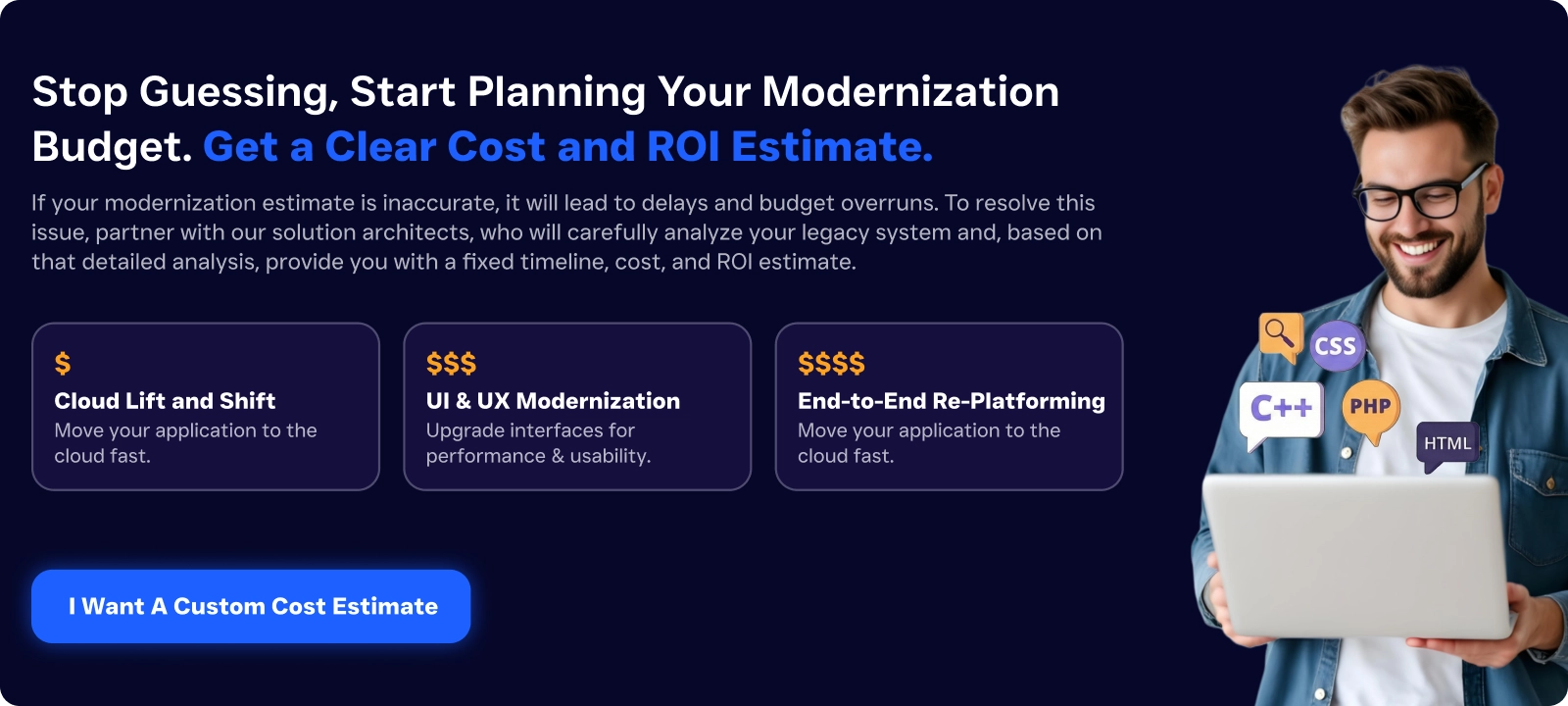
Before investing a penny in the legacy app modernization process, you need to be sure how much to invest and whether it’s worth it. Generally, for an enterprise application, legacy software modernization services in the USA cost $200,000 to $600,000. However, basic cloud rehosting starts around $40,000, and a full-fledged rebuild can cost upto $3 million.
The final cost depends on several factors, including the application scope, security and compliance requirements, data volume, and the modernisation approach. While modernizing involves initial software development costs, investing in the right approach ensures great ROI, lower risk, and long-term business growth.
| Modernization Type | Estimated Cost (USD) | Description |
|---|---|---|
| Rehosting (Lift & Shift) | $40K–$150K | Quick cloud migration, minimal changes |
| Replatforming | $100K–$250K | Optimize apps for cloud services |
| Refactor/Partial Modernization | $200K–$600K | Improve architecture, add AI/GenAI readiness |
| Full Rebuild/Rearchitect | $500K+ | Cloud-native, modern platform |
| Enterprise Portfolio Programs | $1M–$3M+ | Phased modernization across core systems |
Key cost factors you should evaluate:
- Application complexity: Complex legacy systems require more technical work and take longer to deliver.
- Security and compliance: When you modernize legacy systems for highly regulated industries like healthcare and finance, you must comply with SOC 2, PCI, and HIPAA requirements. It means a lot of paperwork and a validation process, which increases the overall cost.
- Data migration and execution: If you opt for a highly experienced, skilled, and knowledgeable partner and use their application migration services, you will achieve a seamless transition to a modern platform without major hiccups.
- Consulting and talent: Partnering with a highly reputable legacy software modernization consultant in the USA can help you reduce errors and shorten the delivery cycle, thereby optimising your budget.
- Modernization strategy: The modernization approach that you opt for, whether it’s rehost, refactor, replatform, or rebuild, will affect your time and budget.
What Are The Top Legacy Modernization Trends For 2026?
Based on our analysis of 2026 industry reports, we have identified a list of legacy software modernization trends. Our internal market team identified these trends by combining proprietary research with technical briefs from Gartner, IDC, and Forrester. These trends are actively influencing how businesses upgrade, scale, and future-proof their systems.
List of Legacy Modernization Trends:
- 65% of American businesses update their outdated systems to cloud or hybrid platforms.
- 80% of the US banks have modernized their legacy payment systems for real-time processing.
- 40% of the world’s legacy system modernization is being conducted in North America.
- If you choose AI-powered solutions for legacy modernization, you can accelerate feature delivery by 20–50%.
- More than 85% of organizations have replaced their monolithic systems with cloud-native initiatives.
- Companies that use DevOps and CI/CD pipelines can release products 60–80% faster than those that stick to traditional approaches.
- If you opt for API-first approaches, it will help you connect your legacy apps with microservices.
- Due to the benefits of scalability and flexibility, the use of microservices and containers has increased by 32%.
- Research has found that using zero-trust frameworks can help reduce security risks.
- 75% of new app builds are supported by low-code/no-code platforms.
- The market for legacy modernization is expected to grow at a 17.92% CAGR, reaching USD 56.87 billion by 2030.
- For seamless, scalable modernisation, 61% of companies worldwide are opting for hybrid cloud.
- The global adoption of microservices has increased by 49%.
- North America will retain a 39–42% share of the modernization market through 2033.
How to Select a Legacy Software Modernization Company?
You choose a modernization partner not to try new things but to lower risk, manage expenses, and unleash growth. The ideal business maintains system stability, safeguards revenue, and produces quantifiable business results.
| Checklist Area | What to Evaluate | Why It Impacts Your Business |
|---|---|---|
| Experience with Critical Systems | Regulated industries, large data volumes, zero-downtime projects | Reduces outage risk in healthcare, BFSI, and government systems |
| Modernization Strategy | Depth Rehosting, refactoring, replatforming, rebuild decisions tied to ROI | Prevents overengineering and wasted cloud spend |
| Risk and Governance | Phased delivery, rollback plans, compliance-first execution | Protects revenue and audit readiness |
| Technology Stack | AI-driven code analysis, cloud-native design, API enablement | Speeds delivery and future-proofs platforms |
| Team & Domain Expertise | Senior architects, industry SMEs, hands-on leadership | Avoids vendor lock-in and poor technical decisions |
| Proven Outcomes | Measurable KPIs, enterprise references, repeat engagements | Confirms execution maturity and delivery discipline |
| Transparency | Transparent pricing, milestones, executive reporting | Builds trust with CXOs and boards |
Note: If you partner with a reputable legacy software modernization firm, it will help you define the optimal business model, security & compliance requirements, and growth goals.
Partnering with Excellent Webworld for Risk-Aware Legacy Modernization
Now, you know the whole process of legacy software modernization. However, without having a knowledgeable and experienced partner, executing this process is complicated and risky. Also, if you delay this process, you’re bound to face challenges, including rising costs, security vulnerabilities, a sluggish pace of innovation, and growing pressure from C-level executives to succeed.
That’s where Excellent Webworld can be your ideal pick for legacy software modernization.
Why do enterprise leaders choose us?
- 15+ years of delivery experience across BFSI, government, logistics, manufacturing, and healthcare software modernization
- 300+ legacy modernization projects successfully delivered for mission-critical systems
- 50+ software architecture experts with specialization in legacy, cloud and enterprise systems
- First-hand experience with legacy modernization approaches like replatforming, re-architecting, refactoring, etc.
- A really good blend of AI/GenAI and human intelligence to avoid any costly system failures
- Highly customizable cloud-first modernization strategies aligned with business goals like security, scalability, and long-term ROI
- Crystal clear roadmap with detailed milestone documentation
Ready to modernize without risk? Talk to our experts and get a clear, board-ready modernization plan.

Article By


Mayur Panchal is the CTO of Excellent Webworld. With his skills and expertise, he stays updated with industry trends and utilizes his technical expertise to address problems faced by entrepreneurs and startup owners.