Why Is This Article On MERN Stack Development Worth Your Attention?
MERN is not just a tech stack; its outcomes make it a user-first stack. Yes, if you see it from user expectations, you will find:
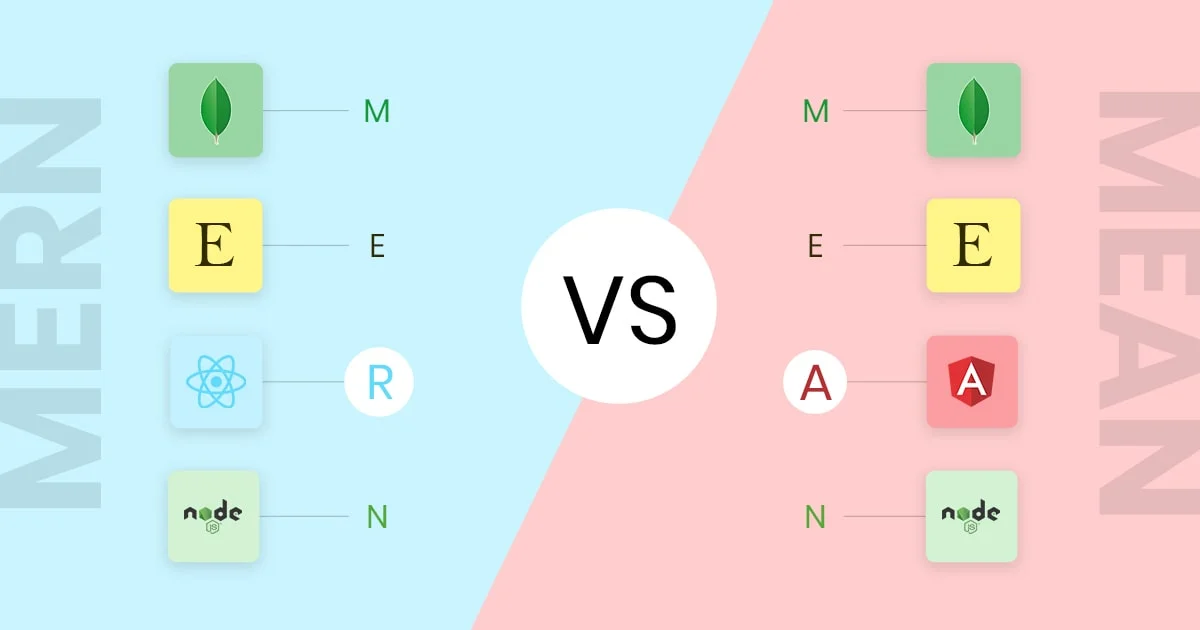
M – MongoDB – Modern experience E – Express.js – Effortless performance R – React – Responsive interface N – Node.js – Next-level scalability
So, in this competitive world, if you want to promise fast, seamless, and reliable web applications to users, then considering MERN stack development is the best thing you can do.
Enterprises invest heavily in digital products, but many fail to achieve good ROI due to slow, fragmented, and poorly scalable platforms. These challenges rise not from budget or team size, but from technology decisions made early in development. Choosing the right tech stack is essential for building fast, scalable, and future-ready web applications. In such scenarios, choosing the MERN stack web development becomes an advantage for organizations that want performance-driven web applications.
MERN stack gives the ability to support rapid iteration, real-time experiences, and long-term scalability, enabling enterprises to turn their web app ideas into reality. That’s why understanding how MERN aligns with modern user expectations and helps enterprise growth models is crucial, not optional. In this blog, we have explained everything regarding the MERN stack development, including architecture, features, use cases, and best practices to implement it.
What Is MERN Stack Development?
The MERN stack development process is the modern approach preferred by web developers to create dynamic full-stack web applications. At its core, it’s a collection of popular JavaScript technologies, including MongoDB, Express.js, React.js, and Node.js, which leads to seamless experiences. The thing that makes the MERN stack valuable among businesses is its ability to support end-to-end web app development (frontend, backend, and database) with a single programming language. This reduces development complexities across teams and systems.
Organizations that struggle to manage large-scale applications efficiently can use the MERN tech stack, which enables faster development cycles, easier maintenance, and seamless collaboration between teams. Most importantly, MERN fulfills modern world requirements like AI-powered real-time performance and rapid feature iteration. Ultimately, it becomes the practical choice for long-term digital products rather than trying it for short-term experiments.
What Are the Core Components of MERN Stack Development?
The key strength of MERN is in how each component plays a different yet tightly connected role within the application ecosystem. Let’s figure out the core components of this stack:
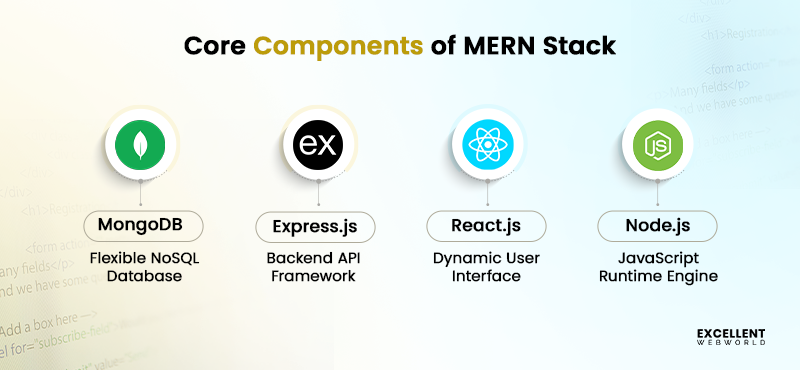
MongoDB (Database)
MongoDB Atlas in the MERN now not limited to storing user profiles only, it has upgraded to native Vector Search capabilities. It allows you to store and query high-dimensional vector embeddings generated by AI models (like OpenAI or Gemini). This makes MERN the ultimate stack for developing context-aware AI apps such as recommendation engines and semantic search tools.
The current latest stable release is MongoDB 8.2.x (with 8.2.3 being a recent patch), while MongoDB 8.0.x is the current major LTS line.
Express.js (Backend Framework)
Express.js is a web development framework for the Node.js programming language that makes building web apps and APIs easy and efficient. Routing, middleware, and other common web app features are handled in a simple and minimalistic way with Express.js.
Express v5 (current stable: 5.2.1) has been officially released after years of development.
React (Frontend Library)
React is a resourceful library for developing user interfaces. With React, you can build components that can be reused and composed to create complex user interfaces. Server Components (RSC) have become a mainstream feature with React 19. It allows certain components to render entirely on the server, fetch data directly, and deliver pre-rendered HTML to the client. For MERN, Next.js is the production React framework.
The latest stable version is React 19.2.1 (released December 2025), with React 19 having launched in December 2024.
Node.js (Runtime Environment)
Node.js is known as a JavaScript runtime that allows you to do server-side JavaScript execution. It excels at managing asynchronous token-streaming. This allows React frontend to display AI responses character-by-character in real-time without freezing the server.
The current Active LTS version is Node.js 24 (latest patch: 24.14.0), and Node.js 22 (‘Jod’) is in Maintenance LTS.
How MERN Stack Architecture Works?
MERN follows a layered and API-driven architecture to be the best tech stack for web applications, which leads to scalability and performance. Here’s the MERN architecture for you to better understand the contribution of each component.
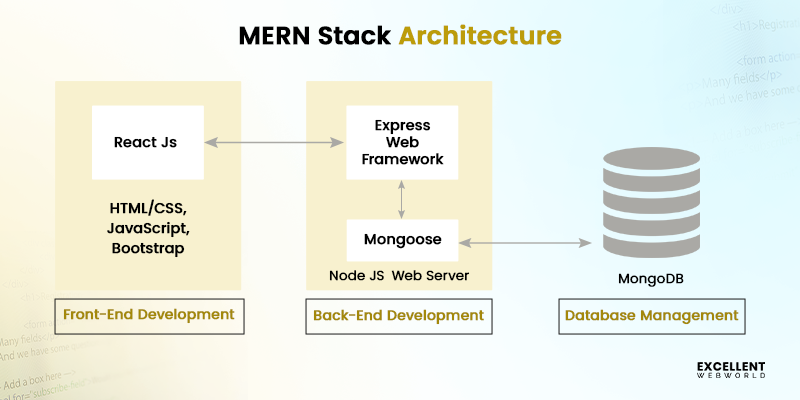
- The React frontend is responsible for handling user interactions and delivering the dynamic and responsive user interfaces.
- All the client-side actions trigger API requests and send them securely to the backend layer.
- MERN Stack API development acts as a bridge between the frontend and the backend. Using Express.js on top of Node.js, the RESTful or GraphQL APIs are created that handle client requests, business logic, and communicate with the MongoDB database.
- APIs manage secure data exchange, modular development, and allow frontends built with React to update data in real time.
- Next.js collapses the React + Node.js layers into one unified full-stack framework in modern MERN setups.
- Node.js, one of the best web development languages, executes server-side logic and efficiently manages MERN application workflows.
- Express.js processes requests, applies middleware, and gives routes to data in an efficient way.
- The core business logic and validations are handled before the data operations are executed in the web app.
- MongoDB database stores, retrieves, and scales application data with flexible schemas.
- With the help of APIs, the backend returns processed data to the frontend system.
- React updates the user interface in real time as per the responses received from the users.
- Each layer works independently and allows a scalable plus modular system growth.
MERN Stack Development Process in 8 Easy Steps
Building a MERN stack application requires a structured and iterative workflow. As MERN is about an end-to-end development, its steps should connect the frontend, backend, and database layers while keeping scalability and performance in consideration. Let’s start discussing each step with the key necessity.
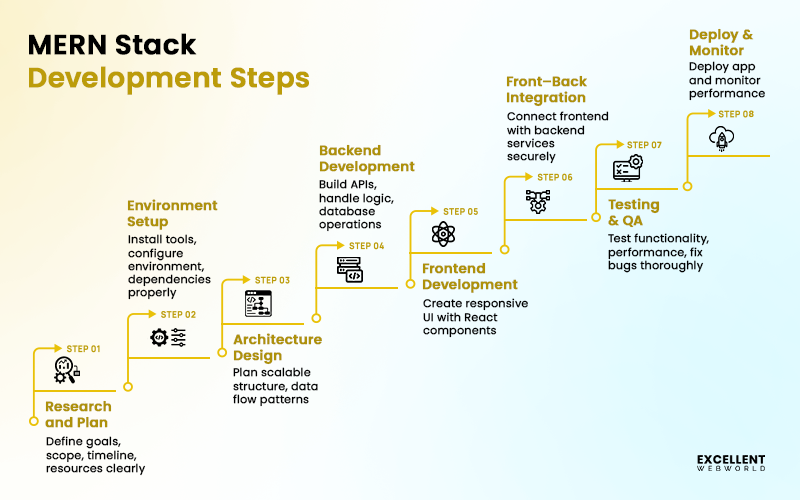
Step 1: Requirement Analysis & Project Planning
The first step in full stack development with MERN is about understanding what the web application needs to achieve for businesses as well as users. In this phase, you should identify the target audience, define user journeys, list core features, and decide the app scope. The team of MERN stack developers also evaluates whether the project should start with MVP development or a full-scale solution.
Technical points like third-party integrations, data flow, scalability needs, and security expectations are also researched and finalized during the planning phase. Clear documentation of every research and decision taken at this stage helps in avoiding costly rework later in development.
- The research results in prioritizing key features and the roadmap.
- Find answers to APIs and database requirements.
- Research according to high-level application architecture.
Step 2: Setting Up the Development Environment
Once you find out the project requirements based on the research conclusion, a full-stack developer has to set up a structured development environment. This is to ensure smooth collaboration and consistency across teams. Here are the steps to set up the perfect development environment.
- Securely install and configure Node.js and npm for backend dependency management.
- With a scalable folder structure, initialize Express.js.
- Locally or through cloud databases, connect to MongoDB.
- Set up the React framework with a proper component and state management conventions.
- Configure different variables of the environment and get version control.
A well-organized development environment leads to a decrease in debugging time and improves development speed throughout the project lifecycle.
Step 3: Designing the Application Architecture
Before engaging your MERN stack developer in writing business logic, you need to define precisely how the frontend, backend, and database layers will interact with each other. This MERN architecture planning makes sure smooth data flow and prevents performance obstacles when the web application scales. Check which technologies play a role and what responsibilities they have for which layer.
| Layer | Technology | Responsibility |
|---|---|---|
| Frontend | React | It manages the user interface and client-side logic in the MERN architecture. |
| Backend | Express in Node.js | Best in API handling and ensuring the working of real business logic. |
| Database | MongoDB | Meant for secure data storage and retrieval. |
Designing a MERN architecture with proper planning makes your web application maintainable, testable, and extendable easily in the future.
Step 4: Backend Development (APIs & Business Logic)
Backend development creates the core module of a MERN stack application. In this stage of MERN stack development, the development team creates RESTful APIs to manage data exchange between the frontend and the database. For this, Express.js is used to define routes, and Node.js is responsible for handling the server-side execution.
The Role of Modern API
In today’s market, backend API development in MERN is not just about collecting data from a database. It’s about playing a secure gateway to third-party AI models and cloud microservices. Because the heavy calculations of training models are handled by Python. Express.js acts as the high-speed orchestration layer, securely handling API keys, managing rate limits, and formatting JSON data from AI endpoints before delivering it to the user interface.
- API development and documentation.
- Integrating authentication and authorization.
- Design database schema and relationships.
- Managing security and handling errors.
Type-Safe APIs with tRPC in MERN Stack
tRPC is a TypeScript-first API layer that directly allows your MERN frontend and backend to share types automatically. This makes sure that any changes to the backend side are instantly reflected in the frontend without any mismatches or bugs.
With tRPC, you can build end-to-end type-safe APIs without requiring any separate schemas or manual type definitions. Key benefits of using tRPC include:
- End-to-end type safety.
- No need for Swagger or manual API contracts.
- Auto-completion leads to faster development.
- Runtime errors get reduced.
- Enables seamless integration with TypeScript.
Step 5: Frontend Development with React
Frontend development technologies in the MERN stack focus on creating an interactive and responsive user interface. Developers can build reusable components with the help of React to make applications faster and easier to maintain. State management makes sure data updates are reflected in real time without even reloading the page. Check what to cover in frontend development with React tech.
- UI development based on different components.
- Managing the state and application’s lifecycle.
- API integration and data rendering.
- Optimizing the user interface and checking responsiveness.
Step 6: Frontend and Backend Integration
This step is to make sure that all the components of the MERN stack work together as a unified system. So, once both frontend and backend modules are created in the MERN stack development, they need to integrate with each other for seamless communication. However, combining React with Node.js offers several benefits for MERN stack web development, including smoother data exchange, faster API responses, and more.
API endpoints need to be tested to ensure accuracy, response time, and error handling. Additionally, data consistency between MongoDB and React views must be validated every time to prevent any type of mismatches.
Step 7: Testing & Quality Assurance
To make sure that the MERN stack web application performs perfectly under real-world scenarios, it is crucial to conduct thorough testing and quality assurance. For modern enterprise projects, integrating AI in web development process helps teams automate all the test cases, identify possible bugs in the early stage, and predict performance issues before final deployment.
AI-powered testing tools accurately analyze application behavior, API responses, and user interactions to detect any errors or anomalies that can possibly be missed by traditional testing methods. This way, you can improve code quality, reduce manual efforts for testing, and enhance release cycles, while also maintaining application stability as well as security.
Pro Tip: To create production-ready MERN applications, you can adopt modern testing tools such as Vitest and Playwright.
Step 8: Deployment & Post-Launch Monitoring
The final MERN stack development phase includes deploying the MERN application on the production servers. With the proper environment configuration, the frontend and backend services are hosted on cloud platforms. Following CI/CD pipelines for MERN web apps automates builds and updates, which leads to achieving faster releases.
After the final deployment of MERN web applications, taking help from monitoring tools can help track performance, uptime, and error logs. Continuous monitoring is great because it helps web development teams to identify issues early and optimize the application over time.
Here are the deployment model examples with key tool suggestions:
| Deployment Model | Best For | Key Tools |
|---|---|---|
| Cloud VM + Docker | Full control, predictable traffic | AWS EC2, Azure App Service |
| Kubernetes | Enterprise scale, high availability | AWS EKS, GKE, AKS |
| Serverless | Variable traffic, cost optimization | AWS Lambda, AWS Amplify, Vercel, Netlify |
| Managed PaaS | MVPs, fast go-to-market | Render, Railway, Heroku |
Why MERN is the Go-To Stack for AI Integration & Cloud-Native Apps
The other traditional stacks struggle with the speed and data structures of modern cloud computing and artificial intelligence, but here MERN outperform. The gap between complex backend intelligence and rapid user experiences are fulfilled by the MERN stack.
1. Seamless AI Application Orchestration
The MERN stack does not act as a replacement of the Python for training AI models. Instead, it performs the perfect orchestration layer for deploying AI-powered features.
The JSON Synergy: AI models have capabilities to communicate natively through JSON. MongoDB stores data as BSON (binary JSON), Node processes it as JavaScript objects and React renders it. This way, it eliminates data translation overhead and speeds up the response timing.
Real-Time Streaming: Node.js manages asynchronous I/O perfectly. This allows you to stream AI responses like ChatGPT-style chat windows to React frontends smoothly and without any disruptions and lag.
Vector Search Ready: You can develop Retrieval-Augmented Generation (RAG) applications directly inside your primary database with the help of MongoDB Atlas Vector Search. Clearly, not needing a separate standalone vector database.
2. Developed for Cloud-Native Scalability
MERN aligns perfectly with modern DevOps and cloud infrastructure, including AWS, Google Cloud, and Azure. If you go through the cloud-native app development guide, you will find that the components of building cloud-native apps are perfectly aligned with the MERN stack.
Serverless & Microservices Friendly: The Node.js in MERN is lightweight with incredibly fast startup times. Ultimately, this makes Express APIs perfect for breaking down into serverless functions like AWS Lambda and minimizing cloud computing costs.
Horizontal Database Sharding: Different from traditional SQL databases that used to scale by requiring larger and expensive cloud servers, the MongoDB scales horizontally. It distributes data throughout the clusters effortlessly to manage massive traffic spikes.
Unified Deployment Pipelines: The CI/CD pipelines are simplified because of the frontend (React/Next.js) and backend (Node.js) in JavaScript. It enables shipping features to cloud faster.
What is the Role of MERN in the AI Age? (Building AI-Powered Apps)
If you are building a modern web application that uses AI like connecting to OpenAI, Gemini, or a private LLM via APIs, Node.js and React are highly dominant. This is why so many organizations prefer to leverage AI integration services while building an App with MERN stack.
Easy AI API Integration: Most leading AI providers offer official JavaScript and TypeScript SDKs, making it simple for Node.js applications to connect with AI models without additional complexity.
Excellent for Real-Time AI Responses: Node.js is designed to handle asynchronous operations efficiently. It can process AI requests, stream responses in real time, and support chatbots or AI assistants without slowing down your application.
JSON-Native Data Flow: AI models typically return data in JSON format. Since MongoDB stores data as BSON (Binary JSON), information moves smoothly between your AI model, backend, database, and frontend with minimal conversion. This is one of the biggest advantages of implementing AI Integration in Software Development using the MERN stack.
Why MERN Works So Well with Cloud-Native Development
As MERN stack’s architecture aligns perfectly with the cloud-native development practices, it becomes the natural fit for modern cloud applications. The cloud-native app development services providers can leverage the best of MERN stack while building an app that matches today’s requirements.
Built for Serverless and Microservices: Node.js applications are lightweight and start quickly. This makes them ideal for AWS Lambda, Google Cloud Functions, and other serverless environments. Express APIs can also be split into smaller microservices as your application grows.
One Language Across the Entire Stack: Both the frontend (React) and backend (Node.js/Express) use JavaScript or TypeScript. Ultimately, this allows your hired team to build, deploy, and maintain the entire application more efficiently across AWS, Azure, or Google Cloud.
Easy Horizontal Scaling: MongoDB was designed with cloud scalability in mind. Instead of having dependencies on larger servers, it can distribute data throughout multiple servers via sharding. This helps applications to manage increasing traffic and data more effectively.
What Are the Advantages and Disadvantages of MERN Stack Development?
MERN stack is adopted by businesses on a global scale for building modern full-stack web applications, but like every other technology, it also has its own strengths and weaknesses. Understanding the pros and cons of the MERN stack helps entrepreneurs like you to decide whether investing in it is the right choice for your project requirements or not.
| Advantages of MERN Stack | Disadvantages of MERN Stack |
|---|---|
| Only a single JavaScript programming language is required across frontend and backend development. | A strong JavaScript expertise is a must; it can’t be compromised. |
| The reusable React components in the MERN stack enable faster development. | For large applications with advanced features, it requires careful MERN architecture planning. |
| Delivers high performance with Node.js and React 19. | In case of poor optimizations, the web app performance can drop. |
| Scales well with futuristic tech trends for modern web applications. | Application scaling requires efforts from experienced web developers. |
| Its open-source stack characteristic reduces the web app development cost. | Possibilities of getting high infrastructure and scaling costs. |
| The JavaScript-based ecosystem of MERN makes integration with AI in web development easy. | MERN apps require high-quality data and performance monitoring for advanced AI features integrations. |
What Are the Use Cases & Applications Built Using the MERN Stack? (with Real-World Examples)
For developing scalable and high-performance web applications, the MERN stack is widely adopted by various industries. Let’s explore key segments that have adopted MERN stack development in the real world.
1. SaaS Platforms
Scalability and modular architecture of the MERN stack make it a perfect technology solution for building Software-as-a-Service platforms.
2. E-commerce Applications
The eCommerce industry leverages MERN to build fast and responsive platforms with its key features and functionalities, such as product catalogs, shopping carts, payment gateways, and order management systems.
3. Social Networking Apps
MERN stack development gives real-time capabilities with a scalable backend, which is great for building social media applications.
4. Enterprise Dashboards
An enterprise-level internal dashboard is developed with MERN as it manages analytics, reporting, CRM, and workflow efficiently.
5. Real-Time Applications
In most cases, MERN is used for real-time applications like chat apps, live tracking systems, and collaborative tools as it enables instant data updates and maintains an interactive user experience.
What Is the Cost of MERN Stack Development?
The MERN stack development cost ranges from USD 15,000 to 200,000+, based on various factors including app complexity, features, developer rates, and more. Here’s the table for you to estimate MERN stack app development cost depending on complexity levels.
| Web App Type | Estimated Cost Range | Estimated Timeline |
|---|---|---|
| MVP MERN Application | USD 15,000 to 25,000 | 6 to 8 Weeks |
| Basic MERN Web Application | USD 20,000 to 45,000 | 8 to 12 Weeks |
| Mid-Scale Web Application | USD 45,000 to 75,000 | 12 to 16 Weeks |
| Enterprise MERN Application | USD 75,000 to 150,000+ | 16 to 24+ Weeks |
| AI-Enabled MERN Application | USD 90,000 to 200,000+ | 18 to 28+ Weeks |
What Are the Best Practices for MERN Stack Development?
Now, you may have a complete understanding of the MERN stack development process, but do you know how to implement it in the best possible way? Let’s explore best practices to integrate the MERN stack.
- Code Structuring: Prefer a modular and feature-based structure to organize frontend and backend code, which improves readability and maintainability.
- Security Practices: Make sure your web development team is implementing authentication, authorization, and data validation to prevent the web app from any kind of cyber attack or vulnerabilities.
- Performance Optimization: Regularly optimize queries occurring in the database, use caching, and minimize API response time, so the web app can perform fast.
- Scalability Planning: Design app architecture considering scalability in advance, make sure your MERN app can manage increased user flow and data volume seamlessly.
- TypeScript Integration: An efficient TypeScript integration in MERN stack development completely transforms standard JavaScript development into a type-safe environment. Ultimately, it reduces runtime errors and improves code maintainability.
- JWT Authentication: Implement secure authentication with the help of JSON Web Tokens (JWT) to access and refresh tokens, proper expiration handling, and secure storage (HTTP-only cookies) to prevent XSS and session hijacking.
However, the best implementation practices and architecture are all different in MERN than in MEAN. Check next to know the key differences between the MERN and MEAN stacks.
MERN vs. MEAN: What’s the Difference?
Here’s the quick comparison table for you to understand the core differences between the MERN stack and the MEAN stack. For a detailed understanding of how both tech stacks differ, you can check our latest blog on MERN and MEAN.
| MERN | MEAN |
|---|---|
| Uses React for frontend technology. | Uses Angular for frontend technology. |
| It comes under the library-based category, which is more flexible. | It comes under a full-fledged framework, which is highly structured. |
| Prefers one-way data binding. | Works on two-way data binding. |
| Follows a component-based architectural style. | The architectural style is MVC (Model-View-Controller). |
| Easier and quicker to learn. | The learning curve is complex and steeper. |
| Flexibility is high. | Less flexible than MERN. |
| Best for dynamic, interactive UI apps. | Best for large-scale enterprise apps. |
Wrapping Up!
MERN stack development is the best and most liked choice by entrepreneurs to build modern, scalable, as well as a high-performing web applications. By combining the top technologies MongoDB, Express.js, React, and Node.js, businesses can develop flexible architectures for their web applications. This leads to rapid development, seamless app integrations, and future scalability. MERN gives speed and efficiency to web applications of various segments, including eCommerce, SaaS, and real-time systems. Undoubtedly, it is well-suited for rising business requirements and ensuring long-term growth.
For businesses that want reliable digital products, it will be beneficial for them if they partner with the right web development services provider. A leading web development company, Excellent Webworld, provides MERN stack development services to help businesses build scalable, secure, and high-quality web applications. With a strong focus on performance and modern technologies, we support end-to-end web development, including planning, deployment, and ongoing maintenance.
FAQs: MERN Stack Development
MERN stack architecture needs a complete JavaScript for development, which enables faster development, allows flexibility, and provides seamless integration between frontend and backend for modern web applications.
Yes, MERN stack technology is compatible with high performance and supports scalability. If you build with proper architecture, do database optimization, and integrate cloud-ready infrastructure, then it leads to scalable, large-scale applications.
The MERN stack development timeline generally ranges from 6 weeks to several months based on various factors such as application complexity, features, and integrations.
Yes, if you implement it with the best practices like authentication, data encryption, and integrating API security measures properly, then you will get a highly secure MERN stack architecture.
Yes, enterprises can create dashboards, SaaS platforms, and internal systems that majorly need scalability, security, and high performance by using the MERN stack.
Web developers need expertise in the JavaScript programming language, as well as skills in React, Node.js, Express.js, MongoDB, API development, and modern web security practices, are needed to build a reliable web application.

Article By


Mahil Jasani began his career as a developer and progressed to become the COO of Excellent Webworld. He uses his technical experience to tackle any challenge that arises in any department, be it development, management, operations, or finance.