If you’re looking for a fashion ecommerce app development guide to help you scale your business for better profit, visibility, and sustainability, you’re in the right place.
Whether you’re a scaling DTC brand, B2B wholesaler, resale/rental shop owner, boutique chain owner, a startup aspirant, or a serial entrepreneur, knowing how to develop a fashion ecommerce app would help you make better decisions.
When you’re building a fashion app, you need to ensure that it’s simple, fast, and has a comfortable interface and navigation that keeps users moving without friction. That’s why you need to know dos, don’ts, and how-tos of fashion app development so you can select the right approach, tech stack, and more that appeals to your fashion app users without draining your budget or risking your project.
Excellent Webworld is a globally acclaimed, leading mobile app development company with over 15 years of experience in ecommerce app development. We’ve been rated as the best fashion ecommerce app development partner for some of the highest-rated fashion apps on the App Store & Play Store. Our team has used our years of expertise in this blog to help you better understand the process of fashion ecommerce app development.
What is Fashion E-commerce App Development?
The process of creating mobile apps specifically for fashion that help people browse and shop. You can consider this app as a wardrobe on mobile, which can be accessed by the user. Users can explore outfits and get style suggestions. to buy in a very short time.
This fashion app development process covers everything from designing a smooth shopping UI to secure payments, live video shopping, and AI styling tools. In short, fashion ecommerce app development makes the fashion business a fast, modern, mobile shopping experience.
Whether you’re building a trend-driven boutique app or a full ecommerce fashion app development platform, the goal is simple: make fashion easy, fun, and personalized.
This entire process is basically what we call fashion app development — taking fashion, tech, and user experience and weaving them into one seamless digital product.
Benefits of Fashion Apps & How They Make Money
Fashion apps make the overall shopping experience smooth for both users and brands. Users get clothing ideas according to their style, easy browsing & checkout. On the other hand, brands get more customers, understand what people like, and increase sales.
- Easy target audience—Fashion app development helps you target clients easily based on age, state, and gender.
- User Review—Fashion apps are always open for users’ review, whether it is product quality or trends. It increases user engagement and satisfaction.
- Inventory Management—Online fashion solutions help businesses with problems like stockout and overstocking. You can manage the stock according to the demand and styling trends.
- Reduce Competition—As the fashion app increases the brand’s visibility and awareness, it reduces user distraction and competition.
How Do Fashion Apps Make Money?
Most fashion apps earn money in a handful of pretty straightforward ways, and honestly, none of this is surprising anymore. These methods have become kind of the default across the fashion industry.
- Commission per sale Commission per sale is the big one. Every time a shopper buys something, the app earns a small cut from the seller.
- In-app advertising In-app ads are another steady income stream; brands pay to show their promotions right inside your app.
- Subscription model Some platforms also use subscription models, offering early access, VIP perks, or premium features for a monthly fee.
- Delivery or service fees Then you’ve got delivery or service charges, which cover things like faster shipping or convenience add-ons.
- Affiliate marketing collaborations You promote partner products and earn whenever users buy through your links—a classic move in modern fashion app development.
What Kinds of Fashion Shopping Apps Are Out There?
Not every fashion app works the same, and honestly, they shouldn’t. The whole fashion eCommerce app development process shifts a lot depending on who you’re selling to and how your business actually runs.
These differences come down to the eCommerce business models you choose. This is because it decides how products are sold, who is responsible for managing the inventory, and how transactions will be carried out on the platform.
1. Single-Vendor Apps
Single-vendor apps are the simplest. Great for a brand or boutique that wants to build an eCommerce fashion app just for its own products. Clean, direct, no noise.
2. Multi-Vendor Marketplaces
Then you’ve got multi-vendor marketplaces—think ASOS, Shein, and Zalando. This fashion app development model brings tons of sellers into one place, giving shoppers variety while vendors get way more visibility.
3. B2B Fashion Apps
B2B fashion apps are a different world. They’re mostly for wholesale, catalogs, and inventory management, helping manufacturers and retailers handle huge orders without the headache.
4. C2C & Social Commerce Apps
And lastly, C2C or social commerce apps. Community-driven spaces where people resell outfits, swap ideas, and mix social media vibes with fashion eCommerce app development to make things feel more fun and interactive.
How to Develop a Fashion eCommerce Mobile App – A Simple Step-by-Step Walkthrough
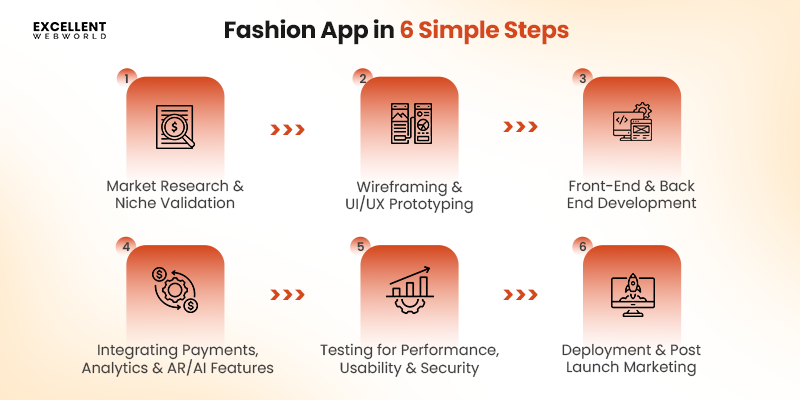 Building a fashion eCommerce app is really about making shopping feel smooth, modern, and honestly a bit stylish too. Here’s the simplest way to think about how everything comes together.
1. Market Research & Niche Validation
Start with your audience. What kind of styles are they into? How do they behave when they shop online? Take a good look at your competitors too — sometimes the biggest opportunities come from the things they forgot to do. A clear niche is your secret weapon. It makes your app easier to position and way more relevant.
Checklist
Pro Tip: Run direct interviews with ten to fifteen shoppers. Ask them what they dislike in current fashion apps. Use their answers to shape your niche. Keep notes in a single document so you can track patterns.
2. Wireframing & UI/UX Prototyping
Before you jump into development, sketch things out. Literally. Wireframe every major screen, from product listings all the way to checkout.
Test these early prototypes. See if the flow feels natural. Fashion apps should look good, yes, but they also need to feel effortless. Sometimes a single change in the layout can shift everything.
Checklist
Pro Tip: Record your test sessions. Review them with your designer and developer. You will see places where users pause or hesitate. Fix those areas before you move to polished design.
3. Front-End & Back-End Development
This is where the real implementation begins. Designers have wrapped up, and now we gotta actually code the working product from their visuals.
The front-end handles everything the user sees and touches. The screen stuff.
The back-end? That’s the engine. It runs the logic: inventory, order processing, account management—the serious, heavy-lifting stuff. Don’t mess this up. Furthermore, choose a tech stack that can scale easily. You don’t want to rebuild when you suddenly get big!
Checklist
Pro Tip: Host a weekly technical review with your full team. Walk through the current build on a shared screen. Fix small issues before they become bigger problems. Keep the backlog clean and updated.
4. Integrating Payments, Analytics & AR/AI Features
Secure payment gateways & analytics tools are essential, because you’ll need to understand what users are doing inside the app.
And adding AR for virtual try-ons can level up the personalized recommendations. These aren’t just “nice-to-have” features anymore—shoppers expect interactive, personalized experiences.
Checklist
Pro Tip: Start with one payment method and expand after launch. This reduces early bugs. Add analytics goals inside your dashboard so you always see the metrics that matter, for example checkout drop offs and repeat orders.
5. Testing for Performance, Usability & Security
Test everything. Then test it again: performance, loading time, checkout flow, data protection—all of it matters. If your app crashes during checkout or loads too slowly, people won’t come back. A reliable, stable app builds trust, and trust is basically currency in the fashion world.
Checklist
Pro Tip: Run a closed beta with fifteen to twenty users. Ask them to perform tasks, for example browse, search, and pay. Offer them a small reward for honest feedback. Their issues will guide your final fixes.
6. Deployment & Post-Launch Marketing
Once everything’s tested and stable, you push it live on the App Store and Google Play. But launching isn’t the end. It’s barely the beginning. You’ve gotta promote it through social media, influencers, and smart push notifications. Keep polishing features, fixing the rough edges, and actually listening to what users say.
Checklist
Pro Tip: Plan your first three post launch updates before you go live. This gives you a clear roadmap and helps you respond fast to user feedback. Promote these updates so users know you are improving the app.
What Tech Stack Actually Powers a Modern Fashion App?
A modern fashion shopping app can’t run on guesswork—it needs a solid, flexible tech stack behind the scenes. And honestly, the tech stack is a huge part of what makes fashion app development feel smooth for users.
| Front-End |
|
| BackEnd | Node.js, Laravel, or Python |
| Database | MongoDB or Firebase |
| AI & AR | AI and AR. TensorFlow, Vuforia, and ARKit |
| Payment Integration | Stripe, PayPal, or Razorpay |
| Analytics | Firebase, Mixpanel |
What Trending Features Make a Fashion App Successful?
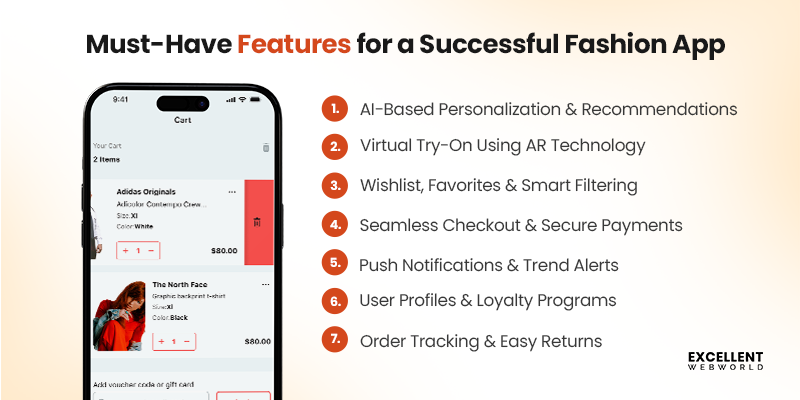
What makes apps stand out in the crowded fashion industry isn’t just trendy collections; it’s smart features designed to keep users engaged, inspired, and coming back. Let’s break down the core features every successful fashion eCommerce app development project should include.
1. AI-Based Personalization & Recommendations
AI tailors the entire shopping experience, from showing personalized product feeds to suggesting outfits based on user behavior. Zara’s AI-powered stock prediction system ensures products match real-time demand, reducing overstock. This is one of the most significant benefits of AI in eCommerce that helps brands deliver precision-driven shopping experiences.
2. Virtual Try-On Using AR Technology
Virtual try-on tech has honestly changed the game, especially when paired with efforts to build a smart visual search engine that makes product discovery even smoother. Using AR, shoppers can “try” shoes, jackets, and even accessories without touching them. Brands like Gucci and Nike jumped on this early, and it’s helped people feel more confident about buying—plus fewer returns to deal with.
3. Wishlist, Favorites & Smart Filtering
Shoppers also expect flexibility now. Wishlists, favorites, and smart filters based on color, fit, or occasion make browsing way smoother. Apps like ASOS and H&M rely on these little details to keep people coming back.
4. Seamless Checkout & Secure Payments
Most fashion app development platforms already support secure gateways like Stripe, PayPal, and Apple Pay, so the whole thing feels quick instead of stressful. Buy Now, Pay Later (BNPL) is now becoming a leading payment option for high-value fashion purchases, as this feature helps reduce drop-offs and drive conversions. Hence, businesses are looking to create a BNPL solution alongside their payment gateway integrations to provide consumers the freedom to complete purchases without payment hesitation.
5. Push Notifications & Trend Alerts
Push notifications also do more than just ping your phone. Trend alerts, discount reminders, and restock updates—they’re a big part of how Shein drives those impulse purchases we swear we’re not making.
6. User Profiles & Loyalty Programs
User profiles and loyalty features add another layer. Personalized dashboards with style preferences and history encourage repeat buying, which the fashion app development world treats almost like gold.
7. Order Tracking & Easy Returns
Order tracking and simple returns matter too. They make life easier after the purchase, especially when you’re trying to build an eCommerce fashion app that can truly scale.
Together with AI in retail powering insights in the background, these features are what make modern fashion app development so effective today.
What Makes Fashion App Design Stand Out in 2026?
Design is honestly what separates a “normal” shopping app from one people actually enjoy. In fashion eCommerce app development, the look and feel of the app often decides whether someone keeps browsing or closes it in thirty seconds.
1. Intuitive UI/UX for Fashion Discovery
A smooth, intuitive UI/UX is where it all starts. When the navigation feels logical, filters don’t overwhelm you, and everything loads fast, users stay longer without even thinking about it. Most fashion app development platforms obsess over this part because it has a direct impact on conversions.
2. Visual Storytelling Through Product Photography & Motion Design
Visual storytelling matters just as much. In the fashion industry, images basically sell the product. Sharp photos, 360° views, quick motion effects—they help people imagine the outfit on themselves. Zara and ASOS use this trick beautifully, turning simple product pages into mini lookbooks.
3. Dark Mode, Accessibility & Mobile-First Responsiveness
After that you’ve got the quiet essentials: dark mode, bigger text options, voice search, and proper mobile responsiveness. Shoppers jump between screens all day, so your app has to adapt without breaking the flow.
4. Color Psychology & Minimal Layouts in 2026 Design Trends
Color psychology also plays a bigger role than most people admit. Neutrals feel luxe, brighter tones feel energetic, and 2026 trends lean toward clean, minimal layouts. If you plan to build an eCommerce fashion app that looks “premium,” this stuff matters.
At the end of the day, great fashion app development blends creativity with practical design—and it all comes down to how the user feels inside the app.
SEE ALSO: Magento Vs WooCommerce
How Much Does a Fashion eCommerce App Cost in 2026?
The cost to build a fashion e-commerce platform in 2026 isn’t some fixed number—it shifts a lot depending on who’s building it, how fancy you want the features to be, and the tech stack you end up picking. Most fashion eCommerce app development projects fall somewhere between 20k and 150k+ USD, though some can push higher if you go all-in on custom stuff.
If you hire a team in the U.S., expect the eCommerce mobile app development cost to land on the higher end. Europe usually lands somewhere in the middle—not too pricey, not too cheap. India, though, tends to be far more budget-friendly while still shipping solid quality.
Design plays a bigger role than most founders realize. Clean UI? Price rises. Add AR try-ons, personalization, or a native tech stack? It climbs even more.
But you don’t have to build the whole thing at once.
A simple MVP with only the essentials can bring your fashion app development cost way down. Build the core first, skip the fancy stuff for later. Using Flutter or React Native also speeds things up and keeps everything running pretty smooth. And honestly, not draining your budget on day one just feels smart.
In short, start lean. Improve later. Your users will care more about the experience than the size of your development bill.
What Challenges Do Teams Face in Fashion App Development?
Building a fashion shopping app sounds exciting on paper, but once you dive in, you realize there are a bunch of challenges hiding under the surface. It’s all part of modern fashion e-commerce app development, though—every brand goes through it.
- Managing large SKUs & inventory updates For starters, managing massive SKUs is tough. Fashion moves fast. New drops, sold-outs, and random restocks can happen in one day, and keeping inventory updated in real time is harder than it looks.
- Handling returns and size variations Returns are another headache. People often order multiple sizes or send things back when the fit isn’t right. Handling all that without hurting customer satisfaction is a constant balancing act.
- Ensuring app security and payment compliance (GDPR, PCI DSS) Security adds another layer. You’ve got to meet standards like GDPR and PCI DSS because payments and personal data aren’t things you can mess up.
- Retaining users amidst heavy competition (Shein, Temu, Zara) And then there’s the competition—Shein, Temu, Zara. Retaining users means strong UX, smart features, and steady improvements, which is basically the core of long-term fashion app development and ecommerce fashion app development success.
Why Choose Excellent Webworld for the Best Order Management Software Solutions?
When you start building a fashion eCommerce app, the tech partner you pick kinda decides how the whole story goes. It’s not just about making everything look stylish on the screen.
It’s the behind-the-scenes stuff—clean inventory updates, payment flows that don’t glitch, pages that load now, not later. All the things shoppers never see but definitely feel. And here’s the tricky part: if the foundation’s shaky, the cost and chaos pile up way quicker than most people expect. So getting it right from day one really matters.
At Excellent Webworld, we’ve spent more than a decade helping fashion brands go digital with confidence. As a seasoned fashion ecommerce app development company, we test every feature thoroughly, make sure your infrastructure stays secure and scalable, and build with the future in mind.
Across 13+ years and 900+ successful projects, our team has delivered high-performance fashion apps packed with AI-driven recommendations, AR try-ons, and smart product discovery tools—stuff that really moves the needle for modern shoppers.
Got a fashion app idea? Let’s turn it into something your customers will love—book your free consultation today.
Frequently Asked Questions (FAQs)
A solid fashion app starts with the simple stuff—easy browsing, a search bar that actually works, clear size guides, and secure payments. Then comes the fun part: wishlists, AR try-ons, and those almost-too-accurate AI recommendations.
It’s hard to pin down an exact number because every brand wants something different, and factors similar to the cost of building a marketplace website also apply here. Still, most fashion apps usually fall somewhere between 20k and 150k+ USD.
Usually it takes 3 to 6 months, which depends on app’s complexity and the size of the development team.
Most teams use Flutter or React Native on the frontend. The backend could be Node.js, Laravel, or Python—it’s kind of preference plus your app’s needs. For databases, Firebase or MongoDB are pretty common. And yeah, AI and AR integrations are becoming almost standard now.
AI just makes the whole experience feel a little sharper. It tweaks what users see, guesses what they might like next, fixes those messy search results, and even handles the virtual try-ons so people aren’t blindly hoping an outfit will look good.
A fashion app lets you reach way more shoppers and gives them a reason to return, which naturally boosts sales and strengthens your digital presence. And honestly, if you’re chasing real growth, it’s one of the smartest moves you can make.

Article By


Paresh Sagar is the CEO of Excellent Webworld. He firmly believes in using technology to solve challenges. His dedication and attention to detail make him an expert in helping startups in different industries digitalize their businesses globally.