Did you lose patients just because your medical delivery was too slow?
Does manually managing prescriptions and inventory seem like a hurdle to grow and scale?
Do you have a business idea for the healthcare space and don’t know where to start?
You are not alone in this situation. More importantly, you are not too late as well.
Demands for medicine delivery is rising at a fast pace. Patients now expect to receive care and medication at their doorstep. This is the reason behind the huge investment seen from startups and enterprises in medicine delivery app development.
You are not building an app. You are building an ecosystem where everything from prescription to last-mile delivery is carried out without chaos. However, building it the right way is far from simple.
So let’s help you understand how to plan, build, and launch your medicine delivery platform.
What is a Medicine Delivery App?
A medicine delivery app is a platform (web or mobile) that makes it easier for users to order prescription and OTC drugs online. You get your prescribed medicines delivered at your doorstep within minutes. Here is what the app consists of:
Leaders like Capsule Pharmacy and 1mg are staying ahead by focusing more on these functionalities. If you look at the other side of the healthcare ecosystem, medical apps for doctors are now transforming how physicians manage precipitation and communication digitally.
Now, let’s have a look at some of the most popular medicine delivery apps.
Top Medicine Delivery Apps & Use Case Example
Several medicine delivery apps dominate the market, but the field remains under-competitive compared to its rapid evolution. Let’s check out the ones that are leading.
| App Name | Key Features | Unique Strength |
|---|---|---|
| CVS Pharmacy | Its Extracare+ members’ benefits with on-demand drug delivery advantage make it stand out from others | |
| Capsule Pharmacy | The platform is ideal for providing same-day delivery and 24/7 access to pharmacists | |
| 1mg | It’s a widely used healthcare platform providing instant and cost-efficient medications | |
| NowRx | The app is recognised for its robotic dispensing and dedicated last-mile delivery. | |
| PillPack | Its reliable service with complete coordination across pharmacy, insurance, and medication is remarkable |
Now that you have all the required knowledge of what a medicine delivery app is, let’s look into the process of how these apps work.
How Medicine Delivery Apps Work
Medicine delivery apps work by connecting a wide network of licensed pharmacies. It digitizes the traditional pharmacy workflows by getting the patient’s prescription in the portal and delivering the prescribed medication to their doorstep. These apps function by partnering with local pharmacies or shipping directly through a central warehouse.
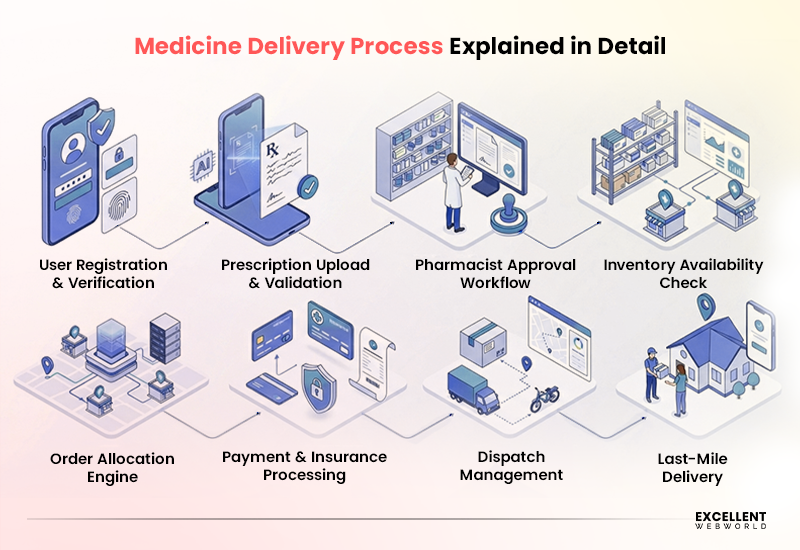
1. Registration & Profile Setup
The first step ensures safe access to the app and protection of your medical information. An account is created by the patient with the necessary personal details and ID verification.
2. Prescription Upload & Validation
Medical prescriptions of the patients are uploaded to the app. Reviewed by the licensed pharmacists. And if any discrepancies are present, the automation validation logic flags them. This prevents errors or misuse, showing how AI in healthcare app development is worth investing in.
3. Verification & Pharmacist Approval
The prescriptions are verifiedby the pharmacists. They check the dosage instructions and approve the order for fulfillment so that the patient gets the right medication at the right time.
4. Inventory Check Across the Network
Availability of the stocks is checked across the pharmacies in the network. The system identifies the nearest location with the required medicines to avoid delays in delivery.
5. Automated Order Allocation
Post verification, the app assigns the order to the pharmacy as well as the delivery agent, depending on the location, stock, and delivery capacity.
6. Payment & Insurance Processing
There are several gateways and insurance claims available based on the app you are using. Both are processed automatically to maintain transparency and convenience.
7. Order Preparation & Management
An order is prepared for delivery, where the system generates live updates for the delivery agent to ensure tracking of the order remains accurate.
8. Last-mile Delivery
The route is analyzed and tracked by the delivery agent, and simultaneously, updates are provided to the patients. Depending on the traffic and logistical changes, the estimated delivery times are adjusted automatically.
After the delivery, make sure you are not missing suit logging and compliance storage. Every activity carried out in the process, whether it is prescription verification or delivery confirmation, is logged securely for compliance audits and reporting purposes. The process shows why medicine delivery apps are more reliable than the legacy pharmacy delivery services you preferred.
9-Step Medicine Delivery App Development Process
When you think of developing a medicine delivery app, it’s one of the best healthcare business ideas you can think of. The important part here is to understand what your users require and what the rules are that govern medicine delivery. Let’s discuss each step in detail.
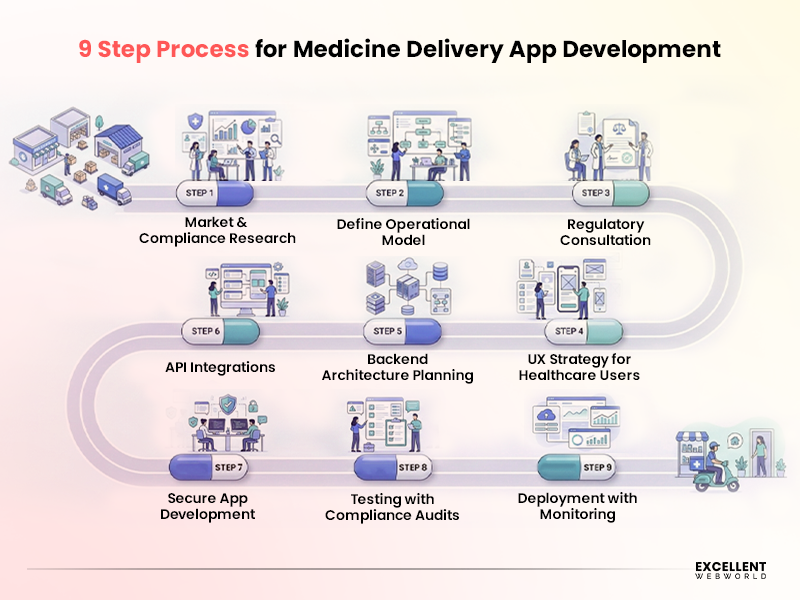
Step 1. Study Consumer Demand and Pharmacy Regulations
Identifying who your users are and what they are demanding is the best approach to start your app development process. Make sure to stick to these factors when identifying demand:
A complete analysis of the competitors’ apps is an advantage. You get to know which medicine delivery app features drive engagement and which are the gaps that your app can fill. Such a indetpth research addresses real user requirements and positions your platform differently from the low competing platforms in the market.
Along with the audience, the most important aspect is compliance. Your app must adhere to strict healthcare and pharmacy regulations, which is why HIPAA-compliant app development has becomes non negotiable for healthcare platforms that operate in the USA. Let’s check all the compliance you need to consider.
Make sure these compliances are taken into consideration before moving to selecting the business or fulfillment model.
Step 2. Define the Right Business & Fulfillment Model
To have a successful medicine delivery app, you need to explore all of the following models and choose the right one as per your criteria.
Along with these business models, there are the fulfillment models, which you need to consider when developing your medicine delivery app.
Sticking to the right model makes it easier to ensure your app serves patients efficiently while remaining financially sustainable.
Step 3. Secure Licences and Compliance Approvals
Driving a car without a license is exactly the same as launching a medicine delivery app without approvals. For a while, it may work, but it’s risky and unsustainable.
Let’s imagine a scenario where you onboard multiple pharmacies and start taking orders. Suddenly, an audit is carried out, and you see that one pharmacy’s licence expired. Your app is flagged for violating local e-prescription laws. This leads you to halt operations and damange trust of the users.
You can prevent this by ensuring all legal and regulatory boxes are marked correctly. Make sure you are sticking to this complaince areas.
1. Pharmacy and Business Licenses
Make sure pharmacies in your network have a valid license to sell medicines. Also, make sure the business is registered properly to operate in various regions.
2. Prescription and Data Regulations
Ensure to follow e-prescription laws so that the uploaded prescription is legally processed and no issues are faced. Adhere strictly to HIPAA or GDPR, whichever is mandatory as per your operating region.
3. Quality and Safety Standards
As per the local guidelines, make sure to store, manage, and deliver medicines in an efficient way, even for temperature-sensitive drugs. Even maintain secure audit trails to have every transaction and action in record.
If your licenses are secure first and approvals are in place, your app avoids the pitfalls and builds credibility with users as well as pharmacies.
Step 4. Design Workflows for Patients, Pharmacists & Delivery Agents
A smooth workflow for patients, pharmacists, and delivery agents succeeds your medicine delivery application. Check out what steps are required for each identity and what it offers.
| User Type | Workflow Steps | Key Benefit |
|---|---|---|
| Patient | Search medicines / Upload prescriptions → Prescription verification → Choose delivery slot → Payment | Firstly, ordering is simplified a lot, and clarity is observed at every step |
| Pharmacist | Order queue → Stock verification → Prescription approval → Packaging → Dispatch | Manual errors are reduced at a good level, and processing also becomes faster |
| Delivery Agent | Receive assigned deliveries → Optimized route → Real-time updates → Confirm delivery | Ensures punctuality, reliability, and accountability |
In this step, what you can do is to explore the latest healthcare UX/UI design trends to improve your user experience. When designing the above workflows with the latest trend in mind, your app stands out and shows operational efficiency along with a better user experience.
Step 5. Plan a Secure and Scalable Backend Architecture
Backend acts as an invisible engine for your app. Imagine a scenario where hundreds of patients place orders, and at the same time, update stocks, and even delivery agents track packages. All of this at once can only be managed with a strong backend.
Your backend must process prescriptions and order tracking instantly. A single lag leads to delayed deliveries and a breakdown in patient as well as pharmacies’ trust. Encrypt all the sensitive information. Also, make sure your system scales easily as your user base grows or during peak demand periods.
Ensure easy connectivity with the payment gateways, associated insurance verification systems, and pharmacy inventories. If you are ready with such a strong backend architecture, your app transforms from a simple ordering tool to a professional healthcare platform.
Step 6. Synchronize External Systems for Easy & Smooth Operations
Syncronization of your app with multiple systems is a must. Pharmacy inventory systems. Payment gateways. Insurance networks. Logistics platforms. With systems not synchronized, orders get delayed, and patients faces frustraiton to use the app.
Here is how your synchronization should work:
With all these systems integrated, your medicine delivery app creates an automated workflow. Seamless coordination is observed, patients get their prescribed medications on time, and errors related to orders are reduced at a significant level.
Step 7. Develop Core and Advanced Features and Functionalities
Now you are at a stage where user experience matters a lot. It makes or breaks your application. If you are tight on budget and timeline, your first preference would be to develop an MVP with core features. Here are some of the medicine delivery app features and functionalities you can consider.
| Patients (Core) | Pharmacies (Core) | Delivery Agents (Core) | Admin (Core) |
|---|---|---|---|
| Registration & Secure Login | Registration & Verification | Registration & KYC | Secure Admin Login |
| Profile Management | License & Compliance Management | Profile Management | User & Role Management |
| Medicine Search & Filters | Inventory Management | Order Assignment View | Pharmacy Onboarding Control |
| Prescription Upload | Prescription Verification | Order Status Update | Order Monitoring Dashboard |
| Add to Cart & Checkout | Order Processing Dashboard | Route Navigation Integration | Commission & Pricing Control |
| Digital Payments | Payment Settlement Tracking | Proof of Delivery Upload | Compliance Monitoring |
| Order Tracking | Stock Availability Updates | — | Reports & System Logs |
| Notifications & Alerts | Notifications & Alerts | — | — |
If you are going for MVP development, then make sure to consider these core features, and if you are going for a full-fledged application, then consider the following features and functionalities.
| Patients (Advanced) | Pharmacies (Advanced) | Delivery Agents (Advanced) | Admin (Advanced) |
|---|---|---|---|
| Refill Reminders for Chronic Medicines | Demand Forecasting Tools | AI-Based Route Optimization | Business Intelligence Dashboard |
| Medicine Subscription Plans | Auto Stock Replenishment Alerts | Performance Analytics | Revenue & Margin Analytics |
| AI-Based Medicine Recommendations | Dynamic Pricing Controls | Incentive & Bonus Tracking | Fraud Detection System |
| In-App Teleconsultation Integration | Sales & Customer Insights Dashboard | Heatmap-Based Delivery Optimization | Predictive Demand Analysis |
| Digital Health Records Storage | Expiry & Batch Tracking Automation | — | Automated Compliance Reporting |
| Multi-Profile Family Management | CRM & Loyalty Program Tools | — | Role-Based Access Control (RBAC) |
Adhering to such functionalities makes sure your application performs at its peak and leads the market with a competitive edge.
Step 8. Test for Security, Accuracy, and Compliance
The testing phase is one of the most important parts of the app development lifecycle. A small bug or compliance gap leads you to face data breaches or penalties related to regulatory compliance. Here are some of the tests that a healthcare app development company follows.
When combining automated and manual testing, your efficiency and accuracy remain at their peak. The tested app provides patients and pharmacies with reliable and safe services.
Pro Tip: You can maintain a record of all the snapshots of test results and logs to help you refine your app in the future as well. Even having a historical record of these tests and problems faced saves time during audits or troubleshooting.
Step 9. Release the Platform with Live Monitoring in Place
With the launch of your app, the next important task is to monitor it constantly. Here are some of the steps you can follow.
This way, your app adapts quickly to unexpected challenges and provides a consistent experience to all your users.
Pro Tip: As chatbots in the healthcare industry are at peak demand, you can also integrate HIPAA compliant chatbot early in your launch phase. It’s one of the fastest ways to collect real user feedback while freeing your support team.
Why Medicine Delivery App Development is a Hot Business Opportunity Right Now?
Nowadays, patients’ preference is more inclined towards the convenience of ordering medicines online. With the increase in consumer demand, pharmacies are also heavily investing in medicine delivery apps. Here is what’s making pharmacies invest more in on-demand medicine delivery app development.
Market Growth & Revenue Generation
If you look into the latest report of RXNT, the global online pharmacy industry market is projected to cross $280 billion by 2029. It’s growing with a nearly 17% CAGR. Even a graph showed that users are spending 40% more than traditional walk-in customers.
Soaring Consumer Demand & Convenience
Doorstep delivery of medicines has now become a priority, or let’s say a necessity, for users. The reports even show that 55% of patients prefer using mobile apps for healthcare, which again shows the increase in the demand for healthcare app development.
Shift in Consumer Behavior
The increase in digital adoption is constantly growing along with the busy schedules and lifestyles, as well, leading patients to get prescribed medications at home with a single click.
Rise of e-Pharmacy Platforms
If you are aware of the current medicine delivery market, there are top leading apps like 1mg and Capsule Pharmacy. These apps highlight the efficiency and customer loyalty generated by digital services and solutions.
A new patient-centric model is seen with pharmacies investing more in medicine delivery apps. An easy path is created for users that focuses on convenience, reliability, and compliance.
Technology Stack for Medicine Delivery App Development
The focus of what the platform does to how the platform is built is shifted with the choice of tech stack. Let’s check out what technologies are required to build your custom medicine app development.
| Component | Recommended Technologies | Purpose / Benefit |
|---|---|---|
| Frontend (Patient App) | Cross-platform mobile development Smooth user experience | |
| Frontend (Pharmacy & Admin Panel) | Intuitive dashboards Real-time updates | |
| Backend | Handles order processing Prescription verification Real-time updates | |
| Database | Secure storage of patient data, orders, and inventory | |
| Cloud Hosting | Scalable infrastructure High availability Strong security | |
| Payment Gateway Integration | Error-free online payments Insurance processing | |
| Delivery & Logistics Integration | Route optimization Route tracking Dispatch management | |
| Security & Compliance | Sensitive patient data protection Regulatory compliance | |
| Analytics & Reporting | Track orders App performance Operational insights |
Medicine Delivery App Development Cost & Timeline
Don’t you think that building a medicine delivery app today is totally different from what it was 4-5 years ago? The reason? Artificial intelligence? Yes, with AI-assisted software development being a part of the equation, dev cost and time are both optimized at their best. Nowadays, AI developer takes less time but would be a bit expensive at times.
| Developer Type | Hourly Rates | Timeline |
|---|---|---|
| Traditional Developer | $40 – $120/hr | Standard timeline |
| AI-Assisted Developer | $80 – $150/hr | 30-40% faster delivery |
If you are building an MVP, then the cost to create a medicine delivery app ranges from $25,000 – $40,000 with a timeline estimated to be around 15 weeks. With MVP, you do not need to wait for so long.
And let’s say if you want to build a fully-fledged medicine delivery app, then the cost estimation is around $50,000 – $80,000 with a timeline estimated to be around 4 months+, still depending on various factors like
Let’s help you get an estimated cost of the additional services you might require, even after you have built your medicine delivery app.
| Component | Estimated Cost | Timeline | Notes |
|---|---|---|---|
| Advanced AI Features | $20,000 – $35,000 | 6 – 10 weeks | AI-powered recommendations, subscription orders, and analytics dashboard |
| Compliance & Security Implementation | $5,000 – $10,000 | 3 – 5 weeks | HIPAA/GDPR adherence, secure authentication, and audit trails |
| Maintenance & Updates | $1,000 – $3,000/month | Ongoing | Bug fixes, new feature updates, and server scaling |
Challenges with On-Demand Medicine Delivery App Development
Studying the challenges is very important as it impacts people’s well-being and legal standing. Let’s get you to explore common challenges you can avoid with your on-demand medicine delivery app development.
1. Lack of Secure Prescription Verification Mechanisms
In the hurry to build an app faster without a reliable system to verify prescriptions, businesses face risks with the app processing invalid orders or violating regulations. This is what results in patient safety issues and legal penalties. In some cases, user retention is also affected by this.
How to Avoid It
The best approach is to integrate two step or multi-step verification, which includes approval from a pharmacist and digital prescription validation. Another step is to invest in AI or OCR-based tools to detect inconsistencies or fake prescriptions.
2. Inability to Maintain Live Inventory Accuracy
During peak traffic, there are cases where incorrect stock information is received, which leads to either the cancellation of orders or the frustration of patients. Even with a wide network of pharmacies, the challenge becomes more visible with the inventory management.
How to Avoid It
Tools that track inventories in real time across all pharmacy partners need to be integrated into the platform. Include automation in places like stock updates when orders are processed or delivered.
3. Lack of Reliable and Controlled Last Mile Delivery
With the increase in consumer demands, an app with just core features integrated leads to concerns like misplaced packages or untracked deliveries. This is something that is important for medicine delivery and leads to harm trust as well as reduce app credibility. At times, managing several delivery agents with diverse orders also adds to the complexity.
How to Avoid It
What you can do is to use GPS-based tracking or tools that offer such services for delivery agents. Also, assign deliveries dynamically based on the proximity and availability of the delivery agents by considering everything, their leaves, health, and all.
Why Partner with an Experienced Medicine Delivery App Development Company
Launching a medicine delivery app adds everything from adhering to regulatory compliance to easy and safe delivery management. The toughest task is to choose a reliable team or a recognized healthcare app development partner who can help you out with the customization your required for your medicine delivery app.
If you do not want to waste time, then reach out to us. Excellent Webworld ensures your vision becomes a reality and serves patients with the utmost services. With decades of experience in healthcare and pharmacy app development, our team’s focus is on secure and scalable solutions from virtual health assistance to pharmacy delivery apps.
Ready to bring your medicine delivery app to life? Let’s collaborate and coordinate to build an app that ensures your healthcare and pharmacy audience is served with the right digital solution.
FAQs on Medicine Delivery App Development
Here are the monetization strategies businesses can consider for medicine delivery apps.
Healthcare startups and new ventures compete by including AI technologies into their system, making it way more advanced for personalized care. Also, upcoming businesses invest more into telehealth with direct-to-patient (DTP) fulfillment.
Definitely, selling medicines online is legal. However, apps are required to adhere to specific federal and state healthcare and pharmacy regulations. Even for specific drugs, users are allowed to provide a valid prescription, and the drug is delivered after complete verification only.
Here are the steps you need to consider to build an app like 1mg.
It’s a multistep process where the user first uploads a clear photo of the medication prescribed. The associated pharmacy reviews the prescription and then provides approval before dispensing. In some apps, there is an e-signature integrated for digital signature verification.

Article By


Mahil Jasani began his career as a developer and progressed to become the COO of Excellent Webworld. He uses his technical experience to tackle any challenge that arises in any department, be it development, management, operations, or finance.