MEAN stack has become the first choice for startups and enterprises around the world. One of the USPs of MEAN stack is that it provides you with speed, scalability, and a unified JavaScript-only workflow, right from real-time SaaS platforms to enterprise-grade web applications.
Wondering the reason? Keep reading the blog till the end, and you will be an instant expert in all aspects of MEAN stack Development.
What Is MEAN Stack Development?
MEAN is a stack of dynamic JavaScript frameworks used to build flexible and reliable web applications. This open-source package has combined the best four web development elements. All four of these offer a Full Stack Development environment for developers.

1. MongoDB
MongoDB is a NoSQL database that uses JSON-style documents for data representation. In simple words, MongoDB stores the database of the application. Moreover, MongoDB scales productivity with its flexible document model.
Firstly, it was designed to store big data and queries for social media applications. However, due to its versatility, it can be used for almost any scale of data storage.
2. ExpressJS
ExpressJS is an HTTP Server Framework that provides useful modules and components for web applications. It provides a simple interface that allows the developer to make simple endpoints and cookie handling. In easy terms, Express.js adds robust features to the application.
It is used to build web apps based on servers that respond to the client’s request for any input or connection.
3. Angular (formerly AngularJS)
Google actively maintains Angular (formerly known as AngularJS), and it is a TypeScript-based, component-driven, front-end framework. You can use this to develop single-page applications (SPAs) using component-based architecture. It also provides you with built-in tools for form handling, state management, and routing.
Note: Originally, A in the MEAN acronym was for AngularJS. However, it reached end-of-life in December 2021. Modern-day MEAN stack projects use Angular (v17+), which is a complete revamp of AngularJS with TypeScript support and improved performance. So, when you’re evaluating MEAN stack developers or projects in today’s time, Angular and not AngularJS should be your reference point.
4. Node.js
Node.js is an open-source, cross-platform JavaScript runtime built on Chrome’s V8 engine, used for building robust and scalable web applications.
It compiles JavaScript code for server-side execution and is designed around an event-driven, non-blocking I/O model. The support for rich JavaScript modules and libraries makes it suitable for real-time applications.
A MEAN Stack developer is a programmer with deep knowledge and experience in all the elements of Angular, MongoDB, ExpressJS, and Node.js.
Furthermore, in the development process, each one of the above technologies has a significant role. Let’s have a look at how MEAN stack development services take place.

Although the image above is self-explanatory, let’s understand it with an example.
For instance, a client needs data of a user from their web application. The client adds the username and password in the UI, and a request is sent to the server using Angular. The Node.js server parses the request and checks the login details before forwarding it to ExpressJS. ExpressJS then searches for the details in the MongoDB database.
MongoDB looks for the matching set of login credentials and transfers the required details back to ExpressJS. Express returns the database output to the Node.js server, which processes the request and sends it to Angular. Finally, Angular displays the response to the client.
The Future Scope of MEAN Stack Development
MEAN stack continues to be a strong choice for building web and mobile applications at scale. What has made MEAN stack a preferred choice for large-scale structured applications is Angular’s enterprise-grade architecture and TypeScript support. This matters a lot in sectors where team scalability and code maintainability are non-negotiable.
Industries actively using MEAN stack for production applications include:
- Education App Development
- Small Business Website Development
- Hospitality Application Development
- Finance App Development
- eCommerce Development Solutions
- Media & Entertainment App Development
- Real-time collaboration tools and project management platforms
- Enterprise resource planning (ERP) and CRM systems
World’s leading brands are relying on MEAN Stack:
- Trello (Atlasian) uses Node.js as the core technology with Express, MongoDB, and Redis for scalability and event-driven, real-time task management.
- PayPal uses Angular for data-heavy and dynamic front-end rendering in payment dashboards.
- Google Cloud Console and Microsoft Office Online use Angular for large-scale, enterprise applications with complex state management.
- IBM powers analytical dashboards with a full MEAN stack for maintainable codebases.
4 Benefits Of Choosing MEAN Stack Services
Wondering why use the MEAN stack for your project? Here is the list of benefits provided by a MEAN Stack Development Company:
1. Support of MVC Architecture
MEAN stack provides the support of Model View Controller architecture to make the development process hassle-free. MVC architecture integrates with the JavaScript framework to support asynchronous techniques, allowing developers to build applications that load faster.
2. Isomorphic Code
MEAN-based apps are very flexible to code because of the same JavaScript across the entire application. Moving code from Node.js to Angular is very easy using MEAN. Additionally, you don’t have to hire specialists in front-end, backend, and other languages — a single JavaScript developer can successfully handle the entire project.
3. Cloud Compatibility
MongoDB implements cloud functionalities within the app, and the M in MEAN reduces the cost of disk space. MongoDB spreads across a cluster of client-servers and offers failure support and automatic replication. It allows easy development, hosting, and testing of apps on the cloud.
4. JSON for the Entire Development Process
All four components of the MEAN stack use JSON. As a result, data flows neatly among all the layers with no rewriting or reformatting. The same JSON format is used for data on the client side as well as on the backend side, making the process significantly smoother.
8 Best Features Of MEAN Stack Technology
- End-to-end development based on JavaScript — frontend, backend, and database all in one language
- Single-page application (SPA) development with Angular’s component-based architecture
- Code reusability and a flexible development environment
- Built-in tools for both front-end and back-end data processing
- Extensive library ecosystem and strong developer community support
- Event-driven and non-blocking scalable architecture
- Free, open-source, and reliable framework for web and app development
- TypeScript support via Angular – improves code quality, early error detection, and long-term maintainability
Popular Comparisons: MEAN Stack vs Other Stacks
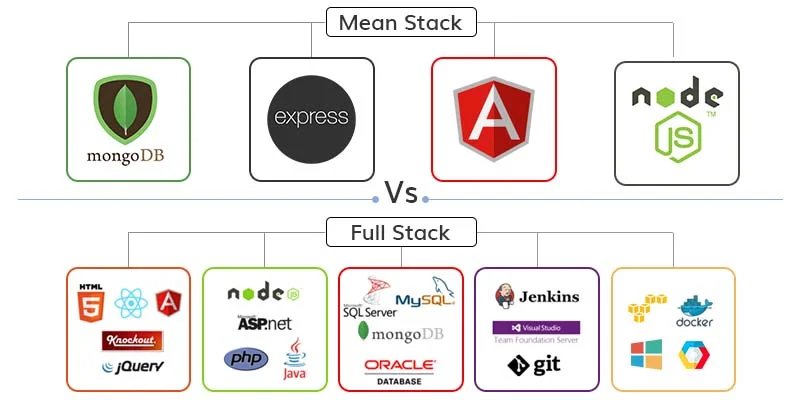
Full Stack vs MEAN Stack
Instead of writing a long thesis, the image below explains the difference visually:
MEAN Stack vs LAMP Stack
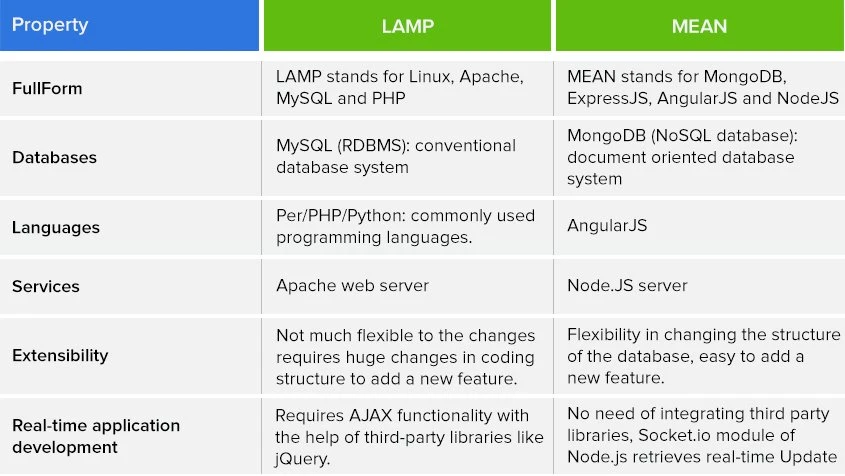
A comparison of LAMP and MEAN stack will clear your mind about making the right choice for your web app. The difference will support your thoughts on MEAN for web application development.
MEAN Stack vs MERN Stack
One of the questions that tech decision-makers and developers face in 2026 is whether to choose the MEAN stack or the MERN stack.
The common thing about both is that they’re full-stack JavaScript solutions and have three components (MongoDB, Express.js, Node.js) in common. However, the major difference is in front-end frameworks, Angular (MEAN Stack) and React (MERN Stack).
Here’s a factor-based comparison that will help you to decide the best possible option:
| Factor | MEAN (Angular) | MERN (React) |
|---|---|---|
| Frontend Framework | Angular (TypeScript) | React (JavaScript/JSX) |
| Learning Curve | Steep, as you need to know TypeScript to deal with Angular | Easy, as React is more flexible for newbies |
| Best For | Enterprise apps, ERP, large structured codebases | Startups, SPAs, fast-moving product teams |
| Architecture | Opinionated – Angular has a strict structure that scales really well with large teams | Flexible – React allows developers to make architectural decisions |
| TypeScript Support | Built-in (Angular is TypeScript-first) | Optional (React supports TypeScript, but doesn’t need it) |
| Community & Ecosystem | Strong in the enterprise and government sectors | Larger community, dominant in the startup and SaaS space |
| Who Uses It | Google, PayPal, The Guardian | Facebook, Netflix, Airbnb |
Bottom line:
You should choose:
- MEAN stack if you need an enterprise-ready and structured architecture from day one with TypeScript support.
- MERN stack if you need faster time-to-market, UI flexibility, and React ecosystem access.
What to Look for in a MEAN Stack Developer — Skill Sets?
Check out some of the must-have qualities of a MEAN Stack Developer:
- Have a good understanding of JavaScript and TypeScript
- First-hand experience with Angular (v15+) – routing, services, components, and modules
- Deep understanding of Node.js and ExpressJS for server-side development
- Expertise in MongoDB – indexing, schema design, and aggregation pipelines
- Awareness of Agile or Scrum development methodologies
- Exposure to tools like Git, GitHub, JIRA, etc.
- Experience in building responsive single-page applications
- Defined experience in multi-tiered development from front-end to backend
- Knows the ins and outs of RESTful API design and integration
- Deep-level understanding of cloud deployment, i.e., Azure, AWS, or GCP, for hosting MEAN stack applications
MEAN Stack Interview Questions for Hiring Managers
This section is for readers who want to hire MEAN Stack developers, as well as for MEAN Stack developers preparing for interviews. Here are a few MEAN stack interview questions:
What is Express.js?
ExpressJS is a minimal and flexible Node.js web application framework. It provides routing, middleware support, and simplified handling of HTTP requests and responses, making it the standard choice for building APIs and server-side logic in MEAN applications.
What are the best features of Node.js?
Node.js uses JavaScript as its scripting language and is built on Chrome’s V8 engine. It is highly scalable, uses an asynchronous, event-driven, non-blocking I/O model, and is ideal for real-time applications that need to handle many simultaneous connections.
What is the key difference between Angular and AngularJS?
The major difference between AngularJS and Angular is that AngularJS (Angular 1.x) was released in 2010 and was a JavaScript-based MVC framework. It was officially deprecated in December 2021.
On the other hand, Angular (V2 and above) is a complete rewrite of the previous version. It is basically a TypeScript-based framework that prefers component-driven architecture and delivers better performance and scalability than previous versions. Most of the Modern MEAN stack uses Angular and not AngularJS.
How to differentiate between Node.js, AJAX, and jQuery?
These three technologies are all implementations of JavaScript, but they serve different purposes. Node.js runs JavaScript on the server side. AJAX enables asynchronous client-server communication without full page reloads. jQuery is a client-side library that simplifies DOM manipulation and event handling.
What is Event-Driven Programming?
It is a programming paradigm in which the flow of the program is controlled by events — such as user interactions, messages from other programs, or API responses. It is separated into two parts: event selection and event handling. Node.js is built on this model, which is why it handles concurrent connections efficiently.
What is a callback in Node.js?
A callback in Node.js is a function called upon the completion of a given task. It allows other code to keep running without blocking. Node.js depends on callbacks (and more recently Promises and async/await) to handle asynchronous operations across its APIs.
What is the role of TypeScript in a modern MEAN stack?
TypeScript is the fundamental language for Angular development. What TypeScript does is that it improves code quality for team-based codebases by adding compile-time error checking, static typing, and interfaces to JavaScript. So, modern-day MEAN stack developers need to be proficient with both TypeScript and JavaScript while working with Angular.
How Can You Hire Offshore MEAN Stack Developers?
Offshore MEAN stack development can consume a lot of your time. The process of hiring MEAN stack developers and programmers can be structured into five major steps:
These five steps will help you find the right MEAN stack developer. One major decision is where to hire from. If you have time, you can research on Google and various freelancing platforms. But if you want your project completed on time with a team that already has a delivery track record, you can evaluate our MEAN Stack Developers directly — interview multiple candidates and choose based on your specific requirements.
Why Choose Us For MEAN Stack Development Services?
- Evaluate the developer before hiring — no lock-in until you are ready
- Engagement models starting from $30/hr — hourly, weekly, or monthly retainers
- Rapid and continuous communication throughout the project lifecycle
- Committed developers working exclusively on your project
- Flexible payment options
- Adaptable hiring models: Hourly / Weekly / Monthly
- MEAN Stack developers with 3+ years of production experience in Angular, Node.js, MongoDB, and ExpressJS
- Client testimonials and references provided on request
After reading this blog, you are clear with everything about MEAN stack — its benefits, components, real-world examples, the Angular vs AngularJS distinction, MEAN vs MERN comparison, skill sets, and interview questions to find the right developer.
Frequently Asked Questions About MEAN Stack
The simple answer is YES. MEAN stack is still one of the most preferred choices for enterprise web app development. Due to Angular’s TypeScript-first architecture, MongoDB’s flexibility, and Node.js’s performance, the MEAN stack is ideal for large-scale structured applications. While MERN has made its name in startup-based applications, MEAN is still the no.1 choice for enterprise, government, and financial sector projects.
The major difference between MEAN and MERN stacks is in the frontend framework. While MEAN uses Angular, which is enterprise-grade, opinionated, and TypeScript-based, MEAN uses React, which has a component library, is widely used by startups, and is flexible. However, the final call always depends on your project’s architecture needs and team expertise.
The modern-day MEAN Stack uses Angular (v17+) as AngularJS has been deprecated in December 2021. Post December 2021, AngularJS became Angular (v2), and then, over the years, it has reached v17.
If you want to build a basic MEAN stack-based web application with authentication, a dashboard, and CRUD operations, it generally takes around 6-12 weeks to complete. On the other hand, if you want to develop an enterprise-grade application with role-based access, complex integrations, and high availability infrastructure, it can take around 4-9 months.
There is no one-size-fits-all kind of approach for cost. It varies according to project complexity, the developer’s location, engagement model, type of features, and more. For building an MVP, you need to pay $15,000-$50,000; for mid-size applications, you need to pay $50,000 – $150,000; and for complex, enterprise-level applications, you need to pay $150,000-$300,000+.

Article By


Paresh Sagar is the CEO of Excellent Webworld. He firmly believes in using technology to solve challenges. His dedication and attention to detail make him an expert in helping startups in different industries digitalize their businesses globally.

