If you think mobile app development platforms have no connection to your revenue or customer experience, then you are wrong. Whether you’re looking to boost sales, gain customer loyalty, or streamline operations, the right app can make a measurable impact. But how is that “right app” actually built? That’s where app development platforms come in.
However, not all application platforms are created equal, and choosing the wrong one can cost you time, money, and missed opportunities. Some platforms prioritize speed and ease of use, while others offer customization and control. But with countless platforms available, which one should be considered the best choice? As each of them provides unique features, pricing models, and technical capabilities. You may have many queries in your mind regarding platform choice.
To resolve your confusion, we have created a full-package solution guide on the best mobile app development platforms for 2026. We will compare strengths, limitations, and ideal use cases to determine the top pick. By the end, you will not only understand which platform is going to perform best for your business but also how to leverage it for growth, engagement & revenue.
Mobile App Development Platforms vs. Technology: Understand the Core Difference
You might get confused between a mobile app development platform and technology, as many of the people show the same example for mobile app platforms and technologies. Here’s the fact for you to understand the difference between a platform and the technology required to build a mobile app.
| Feature | Mobile App Development Platforms | Mobile App Development Technology |
|---|---|---|
| Definition | A comprehensive environment/OS or an ecosystem where apps will run (e.g., iOS, Android, Web). | The languages, frameworks, and tools used to develop the mobile application. |
| Intention | Meant to decide where the app runs. | Meant to identify how it is built. |
| Focus | Efficiency, app deployment, and backend integration. | The development code, UI rendering, and hardware performance. |
| Key Decision | Choosing the target audience from Apple, Google, or both. | Performance, Time, Budget. |
| Dependency | Highly dependent on hardware system capabilities. | Completely dependent on the developer’s expertise. |
| Approach | Finalizing iOS, Android, or a cross-platform development environment. | Native or Cross-platform (completely code-based). |
| Benefits | Faster development cycle and easy maintenance across different OS. | High performance and gives full hardware access. |
| Scope | Made to manage the lifecycle. | Helps in managing implementation. |
| Examples | The best mobile development platforms are iOS, Android, Microsoft Power Apps, and OutSystems. | Popular mobile app development technologies include Kotlin, Swift, Java, JavaScript, and Dart. |
Which Ones Are the Dominant OS Platforms? (The Target Environments)
When we talk about mobile app development, the operating system (OS) platform you select for your product will determine your application’s reach, user experience, & revenue potential. Right now, there are two dominant heroes in the market: iOS & iPadOS (Apple) and Android (Google). Each one of them offers unique benefits, serves different audiences, and comes with its own development needs.
As per the latest market research by Statcounter, iOS shares 31.48% of dominance worldwide, while Android shares 68.24% of the global market of mobile operating systems. Let’s understand both in detail, so you can have a better idea regarding platform selection that aligns with your business goals, target audience, and long-term strategy.
iOS & iPadOS (Apple)
Apple’s iOS and iPadOS are made to power up the iPhone and iPad and are popular for serving a seamless user experience, high security standards, and a premium user base. Collaborating with iOS app development service providers can help you better leverage the iOS platform to launch a revenue-generating app.
Key Points to Consider About iOS & iPadOS:
Android (Google)
Android dominates worldwide as it has a broader device ecosystem. This makes Android a go-to platform for apps that want mass adoption and scalability. You can collaborate with a leading Android app development firm to leverage the best of the Android OS for your mobile app.
Key Points to Consider About Android:
What Are Low-Code & No-Code Platforms (MADP)?
Low-code and no-code (LCNC) platforms boost the app creation process using visual drag-and-drop tools and pre-built components, which reduces the need for traditional manual coding. By leveraging LCNC, you can enable faster deployment and lower development costs. Moreover, non-technical users can also build mobile applications. Let’s explore the top examples of Low-code and no-code platforms:
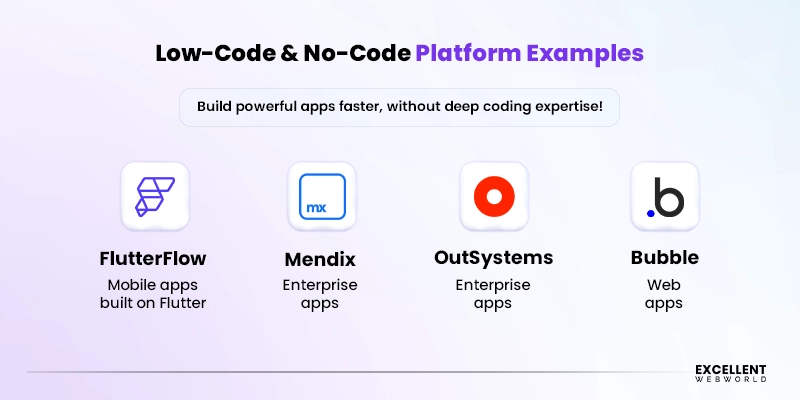
FlutterFlow (Best for Native Mobile Apps, MVPs)
FlutterFlow is known as the visual app builder, used by entrepreneurs for native mobile app development (iOS and Android) without deep expertise in coding. It gives an intuitive drag-and-drop interface that allows you to design eye-catching UIs and integrate Firebase for backend services.
In fact, you can export your project as Flutter code for future customization. If you are looking for MVP app development or a prototype, then FlutterFlow is perfect.
Mendix (Best for Enterprise & Cross-Functional Teams)
Mendix is an enterprise-grade low-code platform that helps businesses build scalable, efficient, and custom applications. Most of the large organizations use it to automate their workflows, integrate with legacy systems, and streamline complex operations.
It also offers advanced features such as AI-assisted development, real-time collaboration, and seamless integration with ERP or CRM systems. The Mendix app development platform is best for enterprises that need secure and high-performance mobile applications.
OutSystems (Best for Enterprise-Grade Legacy Modernization)
OutSystems is one of the leading low-code mobile app development platforms, best for enterprises that want highly customizable and scalable digital solutions. Most entrepreneurs like it because of its robust architecture that supports everything from simple, low-feature mobile applications to complex enterprise-level systems.
It excels in rapid application development (RAD) and allows businesses to test and iterate fast to deploy applications across web, mobile, and desktop platforms.
Bubble (Best for Complex Web Apps & MVPs)
Bubble is a no-code platform that helps you build a complete, fully functional web application without writing a single line of code. It is best for startups and entrepreneurs who want SaaS application development, marketplaces, or internal tools quickly and in an affordable way.
By leveraging Bubble’s visual editor, you can design complex workflows, manage databases, and even integrate third-party APIs, all just by a drag-and-drop interface.
What Are Backend-as-a-Service (BaaS) Platforms?
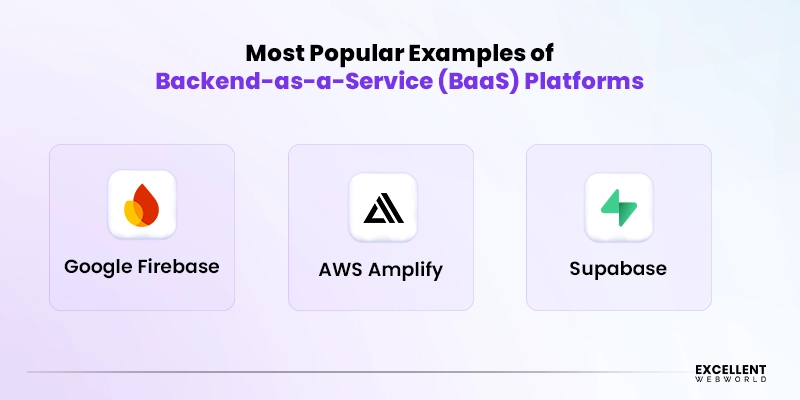
Launching mobile or web applications needs more than just a great user interface. It also requires reliable backend development to manage data, authentication, storage, and real-time updates. Backend-as-a-Service (BaaS) platforms are meant to eliminate the complexity of server setup, databases, and APIs, so you can focus on crafting exceptional user experiences. Let’s explore three of the most popular BaaS platform options:
Google Firebase
Google Firebase is an established giant in the Backend-as-a-Service platforms. Firebase provides multiple tools for efficient mobile and web app development, including Authentication, Cloud Messaging, and Hosting.
It works on architecture that is fully-managed, proprietary, and tied to Google Cloud. For those applications that require rapid and real-time data syncs, such as chat apps or mobile games, Firebase’s NoSQL database is best for them. If you really want to leverage all the benefits of implementing Google Firebase, then you must partner with a reputable Firebase development services provider.
AWS Amplify
AWS Amplify is a full-stack development platform that gives a streamlined path to frontend developers for building scalable mobile & web applications within the Amazon Web Services ecosystem.
It abstracts complex AWS services, such as DynamoDB (NoSQL), AppSync (GraphQL), and S3, that offer a powerful CLI and UI component library for rapid development. This makes it the best choice for enterprise-grade applications that are already using AWS.
Supabase
Supabase mostly markets itself as an open-source alternative to Google Firebase. It is a self-hostable option, built on top of a full PostgreSQL database, best for those who prefer SQL and relational data models.
Adapting the Supabase BaaS platform enables features like real-time subscriptions, authentication, Edge Functions, and storage. It offers more control and flexibility to manage complex data relationships.
What Are the Distribution & Management Platforms? (Launch, Test, and Manage Your App)
Launching an app is not an end; in fact, it’s just a beginning. Effective distribution, testing, and management ensure long-term app success. Whether you are releasing a new mobile app, collecting user feedback, or maintaining updates, the right distribution and management platforms can streamline the process and boost your app’s performance.
App Store Connect & Google Play Console
App Store Connect (for iOS) and Google Play Console (for Android) are the gateways where you can publish your app on the world’s largest app marketplaces. With the help of these platforms, you can upload your app, manage metadata, track performance, and engage with users, all in one common dashboard.
Beta Testing Platforms
Beta testing is one of the most important steps that ensures your app is polished, user-friendly, and bug-free before its official release. With the help of beta testing platforms, you can distribute pre-release versions of your app to a selected group of users and collect feedback from them to make necessary improvements.
Mobile Application Management (MAM)
Mobile Application Management (MAM) is crucial for enterprises and organizations that need to deploy, secure, and manage apps throughout multiple devices. MAM platforms provide tools to perform app distribution, security policies, and remote management. This way, you can ensure that your app is used safely and efficiently within an organization.
Summary Table for Best Mobile App Development Platforms (Choose Your Ecosystem)
Here is a sorted summary table of various enterprise mobile app development platforms that help in choosing an ecosystem for your project.
| Category | Key Platforms | Best For | Ideal Use Case |
|---|---|---|---|
| Dominant OS Platforms | iOS (Apple), Android (Google) | Apps looking for premium markets (iOS) or global scalability (Android). | |
| Low-Code/No-Code Platforms | FlutterFlow, Mendix, OutSystems, Bubble | Quick prototyping, MVP development, and web-based applications. | |
| Backend-as-a-Service (BaaS) | Google Firebase, AWS Amplify, Supabase | Apps needing quick backend development setup and real-time features. | |
| Distribution & Management | App Store Connect, Google Play Console, TestFlight, Microsoft Intune | Launching public mobile apps, collecting feedback, and managing enterprise-grade applications. |
How to Make the Final Call? (Choosing the Right Mobile App Platforms)
Selecting the best platform for mobile app development can feel overwhelming, but asking the right questions one by one will filter options for you and help make your selection process easy. Here’s how to evaluate your needs and choose the best mobile application development platforms for your app’s success:
1. Where Is My Audience?
2. What Features Do I Need?
3. What Is My Timeline?
4. What Is My Budget?
Final Thoughts
Overall, choosing the best mobile app development platform is dependent on your project requirements. Considering your business goals, budget planning, development timeline, target audience, feature requirements, and many other factors, you can decide the right platform for your mobile or web app. Make sure your chosen platform will offer scalability and performance to launch a successful app that meets user expectations and drives growth + revenue.
For businesses that want to prioritize and maximize their app’s potential, partnering with a leading app development company like Excellent Webworld can make all the difference. With multiple expertise in native, cross-platform, and low-code/no-code development, we help entrepreneurs like you to launch high-performing, scalable apps. Let’s build something extraordinary together!
Frequently Asked Questions (FAQs)
A mobile app platform is the foundational environment where your app runs, like iOS, Android, or a low-code platform. On the other hand, a tech stack is the combination of programming languages, frameworks, tools, and services used to develop your app.
Yes, if your app needs data storage, user authentication, or real-time updates, you’ll need a backend platform. BaaS platforms such as Firebase, AWS Amplify, or Supabase manage servers, databases, and APIs, so you don’t have to build them from scratch.
Yes, but it can be highly challenging and costly for you to switch to an already built platform. Switching platforms mostly requires rewriting code, redesigning features, and migrating data.
Native platform is about developing an app only for one platform, iOS or Android. In which you have to write separate code for both iOS and Android, but it gives high performance and scalability. On the other hand, cross-platform development is a single codebase, where only one code is written for both iOS and Android platforms; it’s a cost-effective approach.
Leveraging AI for mobile app development platforms will lead to reducing development time, improving app intelligence, and enabling hyper-personalization, which makes it a must-have for competitive mobile apps.

Article By


Paresh Sagar is the CEO of Excellent Webworld. He firmly believes in using technology to solve challenges. His dedication and attention to detail make him an expert in helping startups in different industries digitalize their businesses globally.