Businesses these days have no choice but to go digital based on the current situation. In fact, some entrepreneurs think to first set up their business online and then go for an offline one.
The path of choosing the right technology has now become a hurdle for many businesses. There are myriads of technology available, and searching for an ideal is like banging your head against a brick wall.
Two such technologies are trending among businesses. – Laravel or ASP.NET both come with an ample base.
Although a never-ending argument about choosing an ideal one from the Laravel vs ASP.NET framework keeps going. Both these technologies have emerged as powerful and give a nip and tuck competition to each other.
In this article we’ll evaluate these dominating technologies to choose the best one for your application development.
Though, before going to the comparison, let’s first understand both the technologies individually.
Laravel vs ASP.NET Framework – A Brief Overview
Here is the quick comparison breakdown of Laravel vs ASP.NET based on different parameters.
| Parameter | Laravel | ASP.NET Core |
|---|---|---|
| Language | PHP 8.2+ | C#, VB.NET, F# |
| Architecture | MVC (Model-View-Controller) | MVC & Component-based |
| Latest Version | Laravel 12 (Feb 2025) | .NET 9 / ASP.NET Core 9 (Nov 2024) |
| Platform | Cross-platform (Linux, macOS, Windows) | Cross-platform (Linux, macOS, Windows) |
| License | Open-source (MIT) | Open-source (MIT) |
| Learning Curve | Gentle; easier for beginners | Steeper; requires deeper technical knowledge |
| Performance | High with PHP 8.x + Octane; excellent for API/web workloads | Industry-leading; ~20% faster in .NET 9 vs .NET 8 |
| Security | Built-in (CSRF, Hashing, Encryption) | Robust (XSS, SQL injection, MS-backed) |
| Scalability | Strong horizontal scaling (Laravel Cloud, Octane, Vapor (serverless)) | Strong vertical and horizontal scaling (.NET Aspire, Azure-native microservices) |
| AI Integration | OpenAI/Claude API via Packages; AI debugging tools | ML.NET, Azure OpenAI, Semantic Kernel (native Microsoft stack) |
| Frontend Integration | React, Vue, Svelte, Livewire starters in Laravel 12 | Blazor, Razor Pages, HTMX, full SPA support |
| Community | 1.5M+ websites; 120K+ Discord members; very active OSS | Large enterprise base; Microsoft-backed; Stack Overflow top framework |
| Cost | Free; open-source | Licensing/Hosting fees can apply (Azure/Windows) |
| Ideal For | Startups, SMBs & SaaS eCommerce MVPs Content platforms | Enterprise apps Financial systems Complex legacy systems Azure-hosted large-scale solutions |
Now that you have a concise but valuable overview of both frameworks, let’s get into a more detailed comparison.
Understanding Laravel
More than 1.5 million websites around the world run on Laravel, and the figure keeps growing. Laravel accounts for approximately 35% of the PHP framework space, securing its position as a market leader. It is one of the most standard PHP Frameworks that offers numerous functionalities to developers.
One of the reasons for the popularity of Laravel developers is that it offers tools that improve the website’s speed and web applications. Besides that, Laravel is a stable and easy-to-handle PHP framework.
In order to grow the performance of your website, Laravel helps you make your speed optimization techniques seamless and easy to implement. A few popular Laravel websites are 9GAG, BBC, Watchseries.cr, and so on.
If selecting PHP frameworks is on your list, then considering the CodeIgniter vs Laravel comparison is a must. This comparison will help you understand how Laravel stacks up against other popular PHP frameworks.
Latest Updates About Laravel
- Laravel 12 was officially released on February 24, 2025.
- It requires PHP 8.2+ and introduces new starter kits for React, Svelte, Vue, and Livewire.
- These starter kits make front-end integration faster and cleaner than it was earlier.
- Most applications can upgrade with minimal code changes.
- This is because Laravel 12 focuses on stability, developer experience, and performance instead of breaking changes.
Understanding ASP.NET
ASP.NET is a web-development framework by Microsoft that works on unquestionable rules, like a managed code framework to rule over the run time of the code execution. It is an open-source framework that is used to build robust and scalable websites and web applications using C#.
To better understand the evolution of Microsoft’s web framework, what you can do is to compare ASP.NET Core vs .NET Framework. The best thing about ASP.NET is that it does not stick to a single language; you can use.NETous .Net languages like J#, C#, VB, etc. It lets you build complete applications with the help of Visual Studio and amazing ASP.NET.
ASP.NET development lets you reduce the lines of code for large applications and dynamic pages. A point to note here, ASP.NET is a server-side web technology; therefore, any code is first processed on the Windows server and then sent to the web browser. Some of the best web applications built with ASP.NET are GoDaddy, Stack Overflow, Dell, and many more.
Latest Updates About ASP.NET
ASP.NET Core 9 was released in November 2024. It brings major performance improvements:
- Kestrel processes HTTP/2 and HTTP/3 requests up to 20% faster
- Memory allocation in Minimal APIs has been reduced by up to 93%
- Startup times are ~15% faster
Let’s say you are looking for a detailed technical breakdown. So the next step you can take is to check out Microsoft’s official .NET 9 announcement. .NET 9 adds native OpenAPI support and upgrades its AOT compilation capabilities. Alongside this, it introduces .NET Aspire for building scalable and observable cloud-native applications.
For a broader comparison at the language level, you might find the PHP vs ASP.NET comparison helpful as well. Now, as you have gone through an overview of the PHP, Laravel, and ASP.NET, let’s nosedive into their differences.
Laravel vs ASP.NET – Points of Difference
To give you a brief idea of the points of comparison between Laravel and ASP.NET Framework, we have explained each point separately. All the key aspects of comparisons are mentioned here for you.
We will begin by peeping into Google Trends. You must check out the things trending on Google.
If you look at the insights of 2025, Laravel graph seems to be constantly on a steady rise. It records a 46% rise in active domains year over year. Enterprises relying more on Microsoft Azure and Windows Server infrastructure prefer ASP.NET for their development needs.

Another image shows the popularity of a particular technology in various regions. (This could help you to decide on the region to hire dedicated developers.)

After briefing you on the trend, now let’s move towards the real point of comparison.
ASP.NET vs. Laravel – Compatibility & Scalability
When it comes to compatibility, we can say that Laravel is favorable for small businesses, while building large and complex applications, ASP.NET is more scalable.
Although both these languages are highly scalable for web applications. Another point to take into consideration here is that ASP.NET is compatible with more languages than Laravel. Again, in terms of a wide range of parameters, Laravel wins the race.
Improvement in Laravel is seen in terms of scalability with the release of Laravel Octane (backed by support for Swoole and RoadRunner), as well as the addition of Laravel Cloud. With the 2025 release of a unified platform, scaling Laravel apps in cloud environments has become more straightforward. .NET Aspire improves ASP.NET Core 9 by supporting containerised microservices on Kubernetes and Azure.
Laravel, being new to the tech field, comes with more flexibility than ASP.NET development.
2. Performance
ASP.NET Core has long led PHP-based frameworks when it comes to raw performance benchmarks. However, the gap has narrowed a lot. ASP.NET Core consistently ranks among the fastest web frameworks on a global basis. With the support of PHP 8.x and Laravel Octane, Laravel can handle CRUD-heavy and API workloads with performance similar to compiled frameworks.
Benchmark results for .NET 9 show Kestrel managing requests 20% faster and lowering average latency by 25% over .NET 8. The inclusion of automatic eager loading in v12.8 and native health checks helps Laravel 12 handle high-traffic applications.
3. Security
Both frameworks are built by considering security at a high level. On one side of the coin, Laravel handles high security risks like SQL injection, CSRF, and XSS via its integrated security features and functionalities.
On the other side of the coin, ASP.NET Core, which is backed by Microsoft, includes features like Windows Authentication and built-in data protection APIs. Along with that, it also offers tight integrations with Azure Active Directory.
ASP.NET Core 9 now supports Pushed Authorization Requests, which is a newer OAuth approach that improves security by using back-channel communication. The release of Laravel 12 introduces stricter SVG validation by default and improves validation through the secureValidate() method.
ASP.NET vs. Laravel – Cost
It is an area wherein Laravel development comes with distinct advantages. It is like Laravel is an open-source framework, while ASP.NET comes with a hosting fee. Thus, in a way, we can say that ASP.NET development is costlier than developing a web application with Laravel.
Besides that, the cost even depends on the web development company you hire, your requirements, and the size of the project.
If we talk about the current situation, you will find that hiring Laravel developers is generally lower than ASP.NET developers and that too in outsourcing markets in South Asia and Eastern Europe. However, for enterprises already running a Microsoft stack (Azure, SQL Server, Active Directory), ASP.NET can reduce overall TCO (Total Cost of Ownership) by simplifying integration.
5. Community and Ecosystem
Laravel leads in terms of community size and open source activity. The community remains highly active, with 120,000+ Discord members, 10,000+ monthly forum discussions, and 15,000+ Laracon attendees. Both frameworks consistently rank highly in the Stack Overflow Developer Survey for developer satisfaction and adoption.
Backed by Microsoft, ASP.NET has a well-established developer base and is widely used in enterprise systems. Laravel’s ecosystem has also expanded significantly:
- Laravel Cloud (2025)
- Laravel Forge
- Laravel Vapor (serverless)
- Livewire 3
- Inertia 2.0
- Laravel Nova
This ecosystem makes it a complete full-stack ecosystem. ASP.NET Core’s ecosystem similarly grew with .NET Aspire, Blazor enhancements, and the new HybridCache API in .NET 9.
So, these are the major points of difference between Laravel and ASP.NET Framework. Except for the aforementioned, there are many small and big differences showcased in the image below.
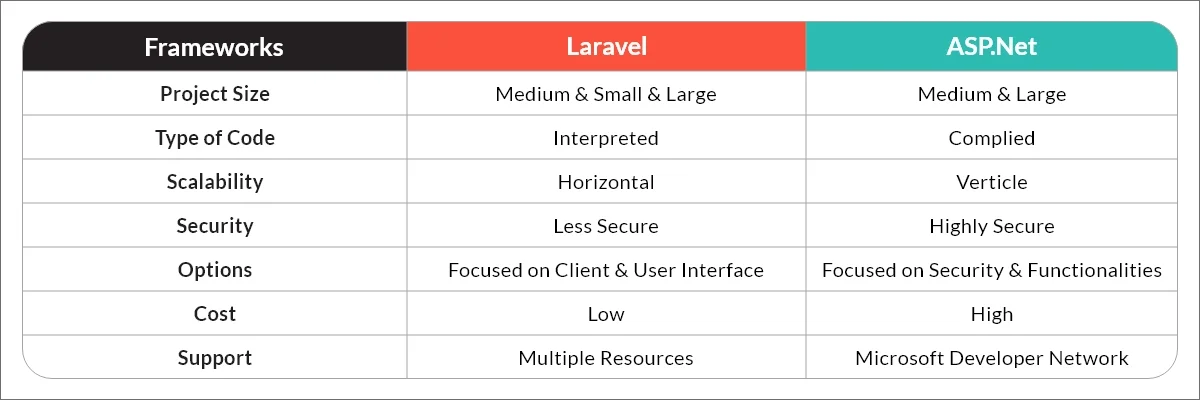
Bonus Point: Do you know why developing your web application in Laravel is beneficial in comparison to ASP.NET?
Laravel is the latest technology that is compatible with almost all types of JS, whereas you cannot get this facility with ASP.NET. Besides that, the cost to hire Laravel developers is less when compared with ASP.NET developers. Meet our experts to know more benefits of Laravel development.
We offer reliable PHP development services where you are assigned with a dedicated team that helps you leverage Laravel’s full potential for your project.
Laravel vs. ASP.NET in the Age of AI and Modern Web Development (2026)
If you look deeply into both the frameworks, you will find that they both have begun to embrace AI-assisted development trends:
- Laravel 12 contributes to improved development with AI-assisted debugging options and more capable Artisan CLI commands. With its flexible architecture, Laravel integrates easily with leading AI APIs for feature development.
- ASP.NET Core and .NET 9 supports AI functionality via ML.NET and tight integration with Azure AI and Azure OpenAI. They also support Semantic Kernel, Microsoft’s SDK for developing AI-powered applications using large language models.
In most cases, the choice comes down to ecosystem fit
- Laravel with OpenAI APIs
- ASP.NET Core with Azure AI services.
When to Choose Laravel vs ASP.NET in 2026
Here is a practical decision guide based on your project type:
Choose Laravel if you are:
- A startup, SMB, or SaaS company looking to ship quickly with minimal cost.
- A team with PHP or JavaScript expertise.
- One who needs rapid MVP development with a rich ecosystem of ready packages.
- Building eCommerce platforms, content-driven websites, or API backends.
- Prioritizing flexibility in hosting (Laravel runs on nearly any Linux-based host).
Choose ASP.NET Core if you are:
- A large enterprise already running a Microsoft infrastructure stack (Azure, SQL Server, Active Directory).
- Building an application that demands maximum performance under high concurrent load.
- In need of deep AI integration via Azure OpenAI or Semantic Kernel.
- Developing in regulated industries (banking, healthcare) where Microsoft’s enterprise security and compliance features are critical.
- A team that is proficient in C# and .NET.
Which One to Choose? – Laravel vs ASP.NET
We cannot choose an appropriate framework for you without knowing your business requirements. In a few cases, Laravel development is an ideal choice, whereas for other .Net development would be more suitable.
As we said, the battle between Laravel and ASP.NET is never-ending. However, you can take the help of a Laravel or ASP.NET development company to know about the technology that will best suit your project.
We have expertise in delivering reliable website development services and custom software development services. Our team will help you to decide the best tech stack for the project. Let’s have a word to take your project idea to its first step of development. Get in touch with us and share your project ideas.
Frequently Asked Questions
ASP.NET is a stronger choice for enterprise applications due to its structured architecture and smooth integration with Azure and Active Directory. Laravel supports enterprise projects as well, but it is more often selected for applications where flexibility and faster development cycles are more important.
Laravel usually allows faster development because of its clean syntax and a wide range of pre-built packages that reduce manual effort. ASP.NET requires more initial setup and architectural planning, which can slow early development.
ASP.NET provides strong built-in security features. Some of which include role-based access control and protection against common vulnerabilities. Something that makes it a reliable option for secure applications. Laravel also offers solid security tools like CSRF protection and secure authentication. So in practice, security depends more on implementation quality than the framework itself.
Laravel is generally more cost-effective because it is open source. You get benefits from a large developer pool, which reduces hiring and infrastructure costs. ASP.NET may involve higher costs in certain cases due to enterprise tooling and specialized developer requirements.
Laravel is well-suited for building APIs quickly with its simple routing system and built-in tools for authentication, such as Sanctum and Passport, which streamline development. ASP.NET, particularly ASP.NET Core, offers high performance, strong typing, and scalability, making it ideal for building complex and high-performance APIs.
Laravel is easier for beginners, particularly for those familiar with PHP, as it offers straightforward syntax and well-structured documentation that speeds up learning. ASP.NET has a steeper learning curve due to its reliance on C# and the broader .NET ecosystem, but it provides a more structured development approach once mastered.

Article By


Paresh Sagar is the CEO of Excellent Webworld. He firmly believes in using technology to solve challenges. His dedication and attention to detail make him an expert in helping startups in different industries digitalize their businesses globally.