Python and JavaScript are the most popular programming languages serving the development community for a long time. But when you’re deciding which one, between Python vs JavaScript, might serve your development needs best, it’s important to know that they have quite distinct primary use cases.
Python is a general-purpose, high-level programming language known for its versatility and strong data processing capabilities. It’s widely used for data science, artificial intelligence, machine learning, backend API development, and automation. The extensive ecosystem of Python makes it the most preferred language for developing AI-powered systems and managing complex data workflows.
JavaScript, on the other hand, was originally designed to create interactive web pages for browsers. However, it has evolved as a full-stack development powerhouse that enables developers to develop complete apps via a single language throughout the stack. It is widely used for backend development using Node.js, mobile app development using React Native, frontend development, and desktop app development using Electron.
Choosing the wrong tech stack between the two would not only slow down your development cycle, but also increase overhead & hiring complexity and severely limit your product’s scalability.
For example, if you’re developing an AI-driven platform, a data analytics solution, or an automation-heavy system, the mature data & AI ecosystem of Python makes it the right technology choice for you. Whereas, if you’re creating a web or mobile app, fast is your priority, then JavaScript is the best choice because of its full-stack capabilities. So, you see, picking one of the two isn’t an easy task unless you have complete knowledge of the two.
My team of experienced engineers at Excellent Webworld has helped 600+ businesses select the right technology stack for rapid MVP launches, scaling backend systems, and managing complex data workflows. This guide reflects on . aspects that are drawn from our hands-on, real-world experience to help founders make the right decision.
Python vs JavaScript: A Detailed Comparison with Code Example
Read the table to get quick comparison points to save your time.
| Criteria | Python | JavaScript |
|---|---|---|
| Language Type | High-level, interpreted | High-level, interpreted |
| Primary Use | Backend logic, data processing, automation | Frontend interaction, full-stack development |
| Execution Environment | Server side | Browser and server-side |
| Learning Curve | Beginner-friendly and readable | Moderate due to asynchronous patterns |
| Performance Style | Optimized for computation and logic | Optimized for event-driven execution |
| Use in Products | Data-heavy systems, APIs, and internal tools | Interactive apps, real-time systems |
| Full Stack Capability | Backend focused | Native full-stack support |
| Community and Ecosystem | Strong in data and backend domains | Dominant in web and UI driven products |
This table is not meant to declare a winner. It highlights how each language approaches problem-solving differently. Here is an example of both languages’ code to show how they both differ.
The example of a simple user greeting app that shows:
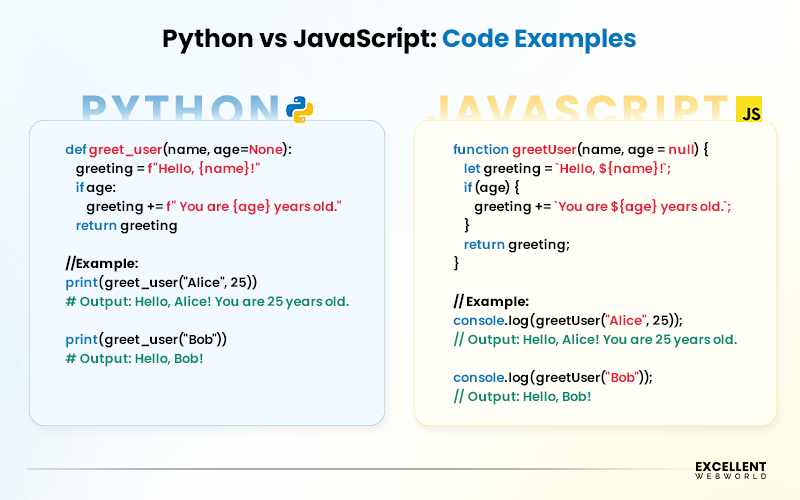
With Python, you do not have to spend extra mental energy to understand the code. The need to analyze the syntax structure is not the case; you can understand what the function does. The simplicity becomes more valuable over large codebases. Businesses even hire AI developers with Python expertise to ensure the architecture of the app they are building remains stable as the models evolve.
And, with JavaScript, the syntax might be concise, but the real value lies in connecting logic to browser interactions and server-side API calls. Businesses that are looking to build apps also prefer to hire JavaScript developers experienced in managing interactive interfaces and live behaviors.
An In-depth Side-by-Side Comparison of Python vs JavaScript
Comparing both programming languages is less about who leads and more about which is the right one for your requirements. So let’s understand how Python and JavaScript differ at the core level.
Performance and Speed
Python: It follows a sequential model when executing tasks. It also relies on optimized external libraries for carrying out heavy processing. Such a pattern fits perfectly when you have backend tasks and data processing that follow a consistent flow.
JavaScript: It relies on a non-blocking execution model where it processes parallel requests without wasting time for each task to finish.
The performance of an app is put into consideration by how efficiently it responds during high usage. Both languages, Python and JavaScript, manage performance in a totally different way.
For applications that require live interaction, choosing JavaScript won’t regret you. The asynchronous execution model makes it easier for JavaScript to manage quick responses with multiple users.
Scalability and Growth Handling
Python: When it comes to organized backend systems where logic as well as data pipelines grow in a totally controlled way, Python scales efficiently without any doubt. These characteristics of Python help teams manage chunks of codebases as they grow.
JavaScript: It positions well in places where an application is driven by user interactions and live communication. Particularly, this is carried out when the same language is used across the frontend and backend layers.
Scalability in coding is something that is beyond handling more users. It’s more about how the system reacts in a positive way with increased data volume and complexity. Again, both languages play a different role here as well.
JavaScript comes with a slight advantage in scalability for the latest and most advanced web products. The support you receive by combining full-stack development with concurrency handling makes it easier to scale as demand increases.
Learning Curve and Developer Productivity
Python: This language is written in a way similar to how plain language is written. What reduces cognitive load during development is its syntax, which is consistent and forgiving. Less time is invested in how the code works, and more time is invested in how logic is implemented.
JavaScript: Early introduction to asynchronous execution and callbacks is done with JavaScript. This is something that can slow down onboarding and increase debugging for beginners or less experienced developers. Sometimes, teams evaluate TypeScript vs JavaScript comparison when the requirement is around stronger typing and better maintainability for growing codebases.
The learning curve directly affects:
With a lower entry barrier, Python wins in the learning curve and developer productivity. This is what makes it easier for teams to grow code-based without slowing the pace of development.
Ecosystems, Libraries, and Frameworks
Python: When we talk about Python’s ecosystem, it is deeply rooted in backend development and intelligent systems. The language supports mature libraries for analytics, automation, and API development.
JavaScript: When we talk about JavaScript’s ecosystem, it has widely grown around technologies focused on browsers and the web. The language dominates frontend development and supports full-stack development with a good collection of libraries and best JavaScript frameworks that simplify architecture.
The maturity and reliability that Python’s libraries provide put it at the top of this race. If your team is building systems where logic and data complexity are central, then you can benefit from Python’s stable ecosystem.
Numeric Types and Data Handling
Python: The language natively supports diverse numeric types. These types include floats, integers, and complex numbers as well. Python’s control over numeric calculations makes it suitable for applications where accuracy and consistency matter, let’s say when it’s all about data processing or financial logic.
JavaScript: JavaScript deals with this in a different way, where it relies on a single numeric type to perform most of the calculations. This increases the risk of precision errors. There is no doubt that workarounds exist, but still, managing numeric precision in JavaScript needs extra care.
As you can see, how Python clearly wins. Its numeric capabilities and support for data tooling make it a safer choice for businesses.
Inheritance and Programming Model
Python: This programming language relies on a class-based inheritance model that is easy to trace. Teams easily understand relationships between the components as classes, methods, and inheritance chains are clearly defined.
JavaScript: Instead of classes, inheritance in JavaScript is based on prototypes. Although it’s powerful, teams working on traditional object-oriented patterns find it less appealing to choose. Modern syntax of JavaScript improves readability. However, inheritance behavior heavily requires language knowledge.
Isn’t it clear? Python leads when it comes to inheritance and programming model. Its class-based model makes complex systems easier to design and maintain with the growing codebases.
Web, Backend, and Mobile Development
Python: It is known for backend development. Though it does not execute directly in web browsers, it is effective when we talk about server-side logic and APIs. Also, it operates behind the scenes when used for frontend and mobile experiences.
JavaScript: When it comes to backend vs frontend, JavaScript supports all types of development across frontend, backend, and mobile layers. It runs in the browser. It supports backend services through server-side runtimes. It allows mobile development using shared logic. This makes it a reliable choice to create a end to edn product.
For sure, JavaScript wins due to its native presence on all platforms. What makes it different is the ability to support full-stack and cross-platform development. Its a ideal choice for products that prioritize user experience and multi-platform reach.
When to Choose Python and JavaScript?
The decision entirely depends on your project goals. Still, if you want to have an idea about when these languages are most suitable, here are those scenarios.
When to Choose Python?
In a way, Python becomes even more relevant to you. Why? Because many of the best AI frameworks are built around its ecosystem, which makes experimentation and deployment more structured.
When to Choose JavaScript?
Apart from JavaScript, in scenarios where the business needs a short path to manage everything. They prefer Node.js development services just to maintain consistency at server side as well as the browser environment
Pros and Cons of Python and JavaScript Programming Languages
JavaScript and Python has its own strengths and limitations suited to different solutions and goals. Ultimately, the best choice depends on what your specific goal is. So, let’s help you clear out each of the advantages and limitations of these popular programming languages.
Advantages and Limitations of the Python Programming Language
Let’s check out each of the benefits and limitations associated with the popular programming language, Python. Each benefit here will help you in different scenarios, in different requirements, and in different goals.
| Python Advantages | Python Limitations |
|---|---|
| The language is easy to read, which makes it easier for developers to build an app | The involvement of GIL restricts multi-core CPU usage in threaded apps |
| Access to pre-built libraries that support development in AI and data-based projects | It’s less suitable for systems with restricted resources because of heavy memory usage |
| With minimal changes, the code runs easily across diverse operating systems | Comes with limited adoption and tooling in native mobile app development |
| Just a few lines of code lead to rapid programming compared to other languages | The risk of runtime bugs in large codebases is increased with dynamic typing |
| Its a open source language with a huge and active developer community | Database access frameworks are less standardized when compared to Java JDBC |
| Easy integration with C, C++, and Java simplifies the development phase | – |
Advantages and Limitations of the JavaScript Programming Language
Similar to the advantages & limitations of Python, JavaScript comes with diverse benefits and drawbacks that might be experienced when building an application. Let’s read each one out in detail.
| JavaScript Advantages | JavaScript Limitations |
|---|---|
| The language runs on both the frontend and backend to build mobile or desktop apps | Executes one command at a time, which can block the UI during heavy tasks |
| Includes a wide range of libraries and mature frameworks like React and Angular | When compared to compiled languages, JavaScript’s execution speed is generally slow |
| It reduces the processing load on the server by executing directly in the browser | If you are on the client side, you cannot directly read or write local files |
| Supports interactive user interface elements, like animations, dropdowns, and live updates | Differences in browser engines like V8 and SpideyMonkey leads to inconsistent behavior |
| Increases developer productivity by offering concise one-liners, such as array handling and arrow functions | The debugging tools JavaScript offers are not as advanced as those of other programming languages |
| Run consistently across all the modern web browsers | – |
Use Cases of Python and JavaScript
Python is favourable in conditions where an application prioritizes logic and data processing. Let’s understand where this language is applicable.
Businesses also investing in AI development services in most of the cases rely on Python for building and training data-intensive models. Now that you have enough information about the application of Python. Let’s look into the JavaScript. This language is preferred when responsiveness and UI plays central role.Here are the use cases of the JavaScript language.
JavaScript fits products where the most prioritised thing is to expect a live response. Both languages are growing at a fast pace. So, let’s look into the upcoming scenarios of the lagnauges.
Future Outlook of Python and JavaScript
With the changing requirements, Python and JavaScript still stand strong and continue to rank among the best web development languages. There are teams that might be exploring alternatives due to technical limitations or some other specific reason. Python is for sure expected to be the leading choice for systems requiring data handling and backend stability. Here’s what you will see in the future for the Python language.
As more businesses evaluate intelligent applications like AI native apps, Python will continue to gain preference over other languages. Let’s say you are in a situation where you need to switch your programming language to build an app. Here are some of the alternatives you can consider for Python.
When to consider these alternatives? When development speed is less prioritized than system control or performance. Now, let’s look into how JavaScript is contributing to its presence in the future.
Even in this case, if you are looking for alternative languages used in place of JavaScript, here are a few.
All the alternatives explored for JavaScript are priorities when teams look for structure or stricter compile-time checks.
Python Vs JavaScript: Cost of Development
The estimated cost to build an application with Python would be around $40 – $100, and for JavaScript, it’s around $35 – $90. This is just an estimation; the exact cost range varies depending on project needs, expertise of the team, and so on. Even with each phase of product development, the cost is influenced.
Instead of considering development speeds or hourly rates, the comparison shows how cost is built over time, even after the launch of your product.
| Cost Dimension | Python | JavaScript |
|---|---|---|
| Team Composition Cost | For smaller backend teams that work with pace, but some roles, like data or AI engineers, increase the cost. | Teams are large but come with flexibility, where the frontend and backend are covered with less cost. |
| Scaling Cost Over Time | Cost increases with the scaling of backend systems, where more compute resources are required as traffic increases. | Reduction in infrastructure cost is seen when scaling more efficiently for concurrent user requests. |
| Maintenance and Refactoring Effort | Includes predictable code flow, which leads to easier refactoring and maintenance. | An increase in the maintenance costs is seen as the application grows with frequent framework updates. |
| Feature Expansion Cost | Functionality related to data-driven or automation contributes to lower cost. | Adding new user-facing features is usually faster and less expensive. |
The budget depends on various factors, as seen above, where even hiring a dedicated developer or maintaining your application leads to a cost increase. Let’s say you want to develop a product that balances data-driven processing with rich user experience, treating these programming languages as complementary leads to better decisions.
Choose the Right Programming Language for Your Web Development?
Python is a popular language that is more suitable for products with backend logic and readable code. JavaScript is the language that is more suitable for Python fits products where interactivity and live resposes is prioritized. Again, it depends on your requirements, which is the right choice for your project.
Are you still evaluating how this choice aligns with your product roadmap? Selecting the right language is only one part of the technology stack for web application development. Don’t waste time and just reach out to the right development partner.
As an experienced team offering software, app, and website development services, we help you choose and implement the right tech stack for your application development. We are here. Our team understands your requirements and coordinates with you to design and develop your app.
FAQs
No, instead of replacing JavaScript, Python fills a different role. Both programming lanauges serves different purposes but complement each other. JavaScript runs natively in browsers, whereas Python, on the other hand, is used for backend logic.
Neither Python nor JavaScript is dying. Both stand still to rank among the most popular and widely used programming languages. Both receive strong adoption as well as community support.
Yes, Python can be used alongside JavaScript. However, JavaScript runs on the client side, and Python runs on the server side. Also, integrating both requires specific tools and techniques to be carried out.
The clear syntax and readable structure are something that makes Python easier for beginners. JavaScript is valuable and offers strong web development capabilities, but its language rules can be harder for beginners.

Article By


Mayur Panchal is the CTO of Excellent Webworld. With his skills and expertise, He stays updated with industry trends and utilizes his technical expertise to address problems faced by entrepreneurs and startup owners.