The hot battle continues over which technology works best for iOS mobile app development.
React Native vs Swift has been a topic of perplexity among clients. The only aim of choosing the right technology stack is to make the app stand out in the market.
Understanding the tech stack and ensuring future proof solution for your iOS app is crucial. This is where you can look to hire React Native developers or Swift developers for that matter to build future-ready solutions.
So, if you are still in a quandary for your iOS mobile app development, hang on; the blog would throw light on which technology can work like a boon for your project. Let’s talk about the strengths and weakness of React Native and Swift.
What is Swift Programming?
Swift programming language is backed up by the most influential tech companies, i.e., Apple. The language was launched in 2014, and it’s a compiled programming language for iOS, macOS, watchOS, tvOS, Linux, and (experimentally) Windows applications.
Surprisingly, Swift language was primarily designed to replace Objective C, which was earlier developed in the 1980s. App development with Swift gave the developers the option of a much more powerful language to develop iOS applications.
Moreover, Swift gave developers the confidence that the newly launched language is safe, fast, and more expressive. Swift has, in total, 10.7k forks and 69.9k stars on GitHub.
With Swift 6 fully available by April 2026, you will see enhancements like cross-platform support, concurrency safety, and server-side development, thereby establishing itself as a mature, production-grade language.
What is React Native?
React Native is a popular open-source framework created Meta (formerly Facebook) around 2015. The brownie point of creating a React Native app is that it offers extensive documentation and strong tech support.
According to Statista, 35% of professional developers use React Native, making it one of the leading cross-platform mobile frameworks.
React Native is solely used for building native mobile applications using JavaScript. Though the application is new in the market, it has become renowned for its speedy development in a very brief period.
The fantastic thing about React Native is that one can even reuse the mobile application codes for your desktop application and web applications.
Now, let’s look at some use cases of React Native and Swift. Hence, this would give you a better understanding of their concept.
Use Cases – Swift vs. React Native
Swift App Development for iOS Platform
React Native App Development for iOS Platform
This is how to choose between the technology according to the iOS app categories. However, there are a few drawbacks you should be aware of, so let’s quickly discuss the pros and cons of each technology.
Pros and Cons of React Native vs Swift
Analysis of the pros and cons will further aid us in knowing the Swift vs React Native comparison better.
Pros of React Native:-
The fabulous thing about React Native is that it provides the user with the option of reusing codes. For example, if you use React Native for iOS mobile app development and later wish to develop the same application for iOS, it won’t consume much time. Simply the developers can use 90% of the codes for Android app development.
In React Native, it’s much easier to make changes in the application. Well, the reloading time is the bare minimum. So if you need to add something to the application, you can do it without much delay.
Many of the clients like the easy reloading characteristic of the application. Hence, this makes them choose React Native for iOS app development.
As one uses the framework of React Native, one needs a small group of developers to develop the ios application. Therefore, this reduces the overall cost of your project. Moreover, when one decides to develop an application for Android in the future, the codes are reusable, resulting in significantly less development cost.
Want to provide users with an uncomplicated mobile user interface? We bet that there is no better choice than choosing React Native. Undoubtedly, developers can make an appropriate sequence of creating apps and seamless UX that take less time to load.
React Native again offers simplified data binding of the parent and child data. So, if there are any changes, react-native simply makes systematic updates in all the components.
It makes it much easier for the developers as it gives them the confidence that the new changes made in the document are done accurately.
Cons of React Native:-
React Native has evolved rapidly over the last few years, and its latest architectural update means you need to audit third-party libraries for compatibility regularly. The reason is that not all community packages have yet migrated to the new architecture, which can cause integration and compatibility issues.
Unfortunately, when your iOS app development demands many features, choosing React Native wouldn’t be a wise choice as the app may not support those heavy features. Definitely, the app wouldn’t fail, but you can think of getting into other options.
At times there are components that demand creating a custom wrapper. As a matter of fact, there are some instances where the App store rejects react-native used libraries that dynamically update native code. Hence, it is better to avoid such scenarios.
Well, this was all about React Native. Now let’s jump to the advantages and disadvantages for Swift.
Pros of Swift
With regards to React Native, the Swift language is easier to learn. So, many developers are encouraged to learn the Swift language. Moreover, an easy understanding of the language makes it error-free.
As the name says, the technology is created like a swift. The Swift mobile app is tested on multiple yardsticks by the developers. Without a doubt, the technology is much faster and performs far better than Objective-C.
As observed by the developers, there is a faster development because the coding is way too transparent. Also, if you are making a long-term investment, then going for Swift is the best option to choose.
SwiftUI is Apple’s declarative UI framework that matured in 2026, with its adoption rate rising to approximately 65%. Developers who use SwiftUI have reported a reduction in code writing, 2x-3x faster shipping times, and a 30-50% reduction in development timelines.
In addition to all these, SwiftUI supports iOS, macOS, watchOS, tvOS, and visionOS from a single codebase, thereby establishing itself as a preferred tool for Apple developers.
Cons of Swift
Swift has matured significantly with SwiftUI now becoming production-ready. However, as the language continues to evolve, major changes will require you to adapt quickly. For example, Swift 6 introduced major concurrency changes, which means the learning curve would be steeper for developers today.
As Swift is popularly known for iOS development, some clients blindly trust this technology for the development process. Therefore, they blindly ask the mobile app development company to choose Swift technology. Sometimes, this results in problems as specific applications might not gel well with Swift technology.
Read More: Best Mobile App Development Technology
React Native Vs Swift – Application Architecture
All About React Native:
There has been a paradigm shift in the React Native architecture as the old architecture was completely overhauled in 2025. The bridge model used in previous versions to serialize data between JavaScript and native threads asynchronously is permanently retired in React Native 0.82.
The new architecture is basically built on four major pillars:
Due to these elements, React Native performance has come closer to Swift in real-world scenarios.
All About Swift:
Swift supports multiple architectural patterns: MVVM, MVC, Clean, and VIPER. In 2025, SwiftUI paired with the MVVM architecture pattern is one of the most popular combos for new projects. The reason is that it provides clear separation of concerns and excellent testability. But for large-scale applications that require strict module boundaries, VIPER remains the preferred choice.
When we talk about Swift architecture that is used in Swift, they are as follows:-
When we talk about choosing clean architecture, it uses the Xcode templates for generating components. Interestingly, these Xcodes work beautifully in the long run, as it becomes easier for the developer to make changes in the future.
When we talk about MVC, it lacks coding, making it challenging to write and maintain the application.
Lastly, Viper with Swift UI aids in separating functions; this makes it easier for the developers to test and maintain the application. Moreover, Viper aids in making faster app development.
We hope you got a basic idea about the system architecture of both technologies. But the question again stands: in react native vs. swift, which technology will work best for your iOS app development, let’s take a look at some applications built with React Native and Swift.
Read More: Is React Native Good For Mobile App Development?
SwiftUI vs React Native: UI Development in 2026
React Native uses JSX, which is JavaScript/TypeScript syntax for declaring UI components. On the other hand, SwiftUI uses Swift’s declarative syntax. The good thing about both UI is that they follow the “describe what the UI should look like” philosophy.
However, the key difference between the two UIs is that SwiftUI compiles to the native platform with zero abstraction overhead. On the other hand, React Native renders native views via JSI. For standard components, there is not much difference in render speed. However, for 120Hz animations, complex Core Graphics drawing, or visionOS experiences, SwiftUI has a massive edge over React Native.
React Native UI Strength:
The advantage of React Native UI is that you can use a single codebase for both iOS and Android. It is also backed by Expo, which is the official way to start new React Native projects. As a result, React Native UI provides a streamlined developer experience, a rich library ecosystem, and OTA updates.
SwiftUI Strength:
SwiftUI has deep integration with the Apple ecosystem, including Apple Intelligence APIs, Dynamic Island, Widgets, VoiceOver, and Live Activities, all of which are SwiftUI-first. Nowadays, Hybrid UIKit and SwiftUI apps are the new norm for large enterprise codebases.
Popular Applications built with React Native and Swift
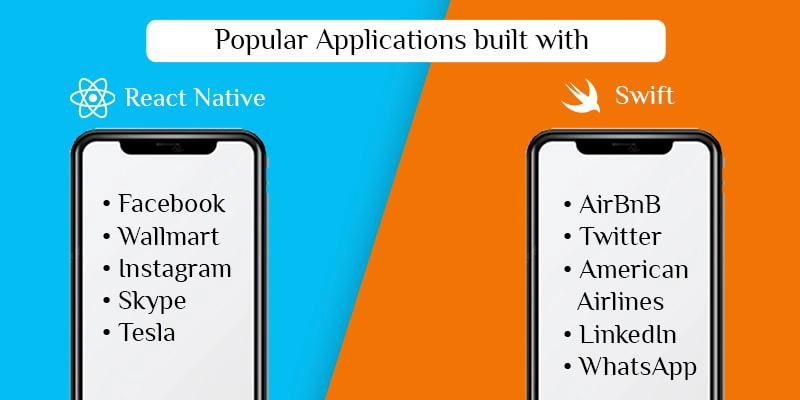
This was all about the apps that have used the respective platforms. However, the question stands as to which platform will benefit your application.
Which Is Better: React Native or iOS Swift?
To better understand this, let’s get an idea about how the application works in different parameters.
1. Complexity
Complexity tests a framework’s depth for demanding apps—think AR, ML, or hardware-intensive UIs. React Native handles most via abstractions, but Swift excels in low-level Apple optimizations, ensuring safety and speed.
You can trust React Native for building iOS applications, including moderately complex ones. With the new architecture, the gap between React Native and native Swift has narrowed considerably for most use cases. However, for apps requiring direct access to low-level Apple hardware APIs, complex graphics pipelines, or AR/ML features, native Swift remains the stronger choice.
Need to develop a complex application? Without doubt, Swift is one of the best choices for such app building. Swift guarantees performance and Safety, and gives more benefits for complex, Apple-platform-exclusive apps.
2. Community
Vibrant communities drive long-term framework success through packages, talent pools, and enterprise adoption. React Native’s JS roots fuel massive scale, while Swift’s Apple-centric evolution boosts admiration, critical for hiring and maintaining apps in competitive markets.
Launched in 2015, React Native has built a massive global ecosystem with over 33,000 packages. Shopify, Microsoft, Meta, and many other Fortune 500 companies use React Native in production.
Swift has become the dominant programming language for iOS app development. With the release of Swift 6, Swift has expanded its footprint in server-side development (Swift on Server) and even Android (Swift Android SDK preview), growing its scope. According to the Stack Overflow Developer Survey 2025, Swift is admired by 51.9% of developers, and 5.9% of people plan to use it in the near future.
3. Performance
Performance defines cross-platform viability, especially for CPU-heavy apps like automotive UIs or data-intensive dashboards. React Native’s Fabric/JSI upgrades narrow the gap with native, but Swift dominates Apple-optimized workloads.
With the new architecture that uses JSI and Fabric, React Native no longer uses the old bridge-based components. As a result, it shows 39% faster rendering compared to the legacy architecture on the iPhone 12 Pro with 5000 view components.
With this new architecture, React Native has come close to Swift for generic app development use cases. It has also become more memory-efficient for older devices. However, when it comes to CPU-intensive tasks such as processing large-scale datasets or heavy graphics, Swift wins the race.
Swift delivers best-in-class CPU performance on Apple hardware because it compiles directly to machine code. Also, Swift is 2.6x faster than Objective-C and excels in applications that require complex graphics, processing large datasets, or leveraging Apple’s ML frameworks. However, there are some scenarios where React Native can be more memory-efficient.
4. User Experience
Both React Native and Swift prioritize intuitive, high-performance interfaces, but differ in rendering efficiency, native integration, and customization speed, key to engaging users across iOS ecosystems.
The user experience of React Native is improving daily. With the new architecture’s Fabric renderer, UI components are rendered more consistently and smoothly. Components like activity indicators, snap carousels, and scroll views with fixed headers contribute to a better user experience.
Native tools and APIs can be easily integrated into a Swift app, delivering a seamless user experience. Additional features can also be integrated, making it much easier and faster to deploy the application.
5. Hiring Developers
Finding the right developer depends on your tech stack, budget, and project needs. Rates vary significantly by region and expertise level, making it essential to balance cost with quality when choosing between React Native and Swift talent.
Want to hire react native developers? Well, different React Native app development companies provide good developers. However, development costs vary from country to country.
In the USA, the hourly rate to hire expert React Native developers typically ranges from $80 to $170/hour, while in Europe it’s around $50 to $120/hour, and in India it’s around $15-$50/hour.
In the USA, the hourly rate to hire a Swift developer typically ranges from $55 to $80/hour, while in Europe it is around $70 to $150/hour, and in India, the cost to hire iPhone app developers is around $15 to $50/hour.
When to Choose: React Native vs Swift
Choose React Native If:-

A complete understanding of the factors that are affected while developing an app.

Cost Comparison of iOS Swift vs React Native
The cost of developing a basic React Native application would totally depend on the features you ask the app development company to add. Similarly, the development cost of an application in Swift would also depend on its features.
In 2026, a basic React Native app development may cost between $15,000 and $40,000, and a basic Swift app development may cost between $50,000 and $100,000.
Final Words: React Native vs Swift
Well, React Native and Swift are both in demand. So, developing an application by choosing either of the platforms might make your app stand out in the market.
You need to connect with a company providing iPhone application development services and ask them to develop your application. They would have experts who can study your application and guide you through the development process.
Is developing an iOS app on your mind? We provide the best iOS app development services!
FAQs on Swift vs React Native
Now, there can be one fixed answer to this question. You can look at speed from various perspectives. In terms of development speed, React Native can be faster as you can build for Android and iOS simultaneously. However, in terms of runtime performance, Swift outperforms React Native because Swift compiles to native code.
These days the demand for React Native apps is high in the market. On the other hand, Swift is also here to stay for a long time as the dominant language for native iOS development. Learning either of these will prove valuable – React Native if you want cross-platform versatility, Swift if you want deep iOS/Apple platform expertise.
No, one does not need to learn Swift for React Native. Both are different languages and they are not interdependent.
Well, React Native is a framework of Javascript. On the other hand, Swift is a language developed to replace Objective C. Hence, there might not be any similarities between these two languages.
As of 2026, Swift is still the default and most recommended language for native iOS development, and SwiftUI is the preferred UI framework. For legacy codebases, Objective-C remains the default choice. In addition to that, you can also use cross-platform frameworks like React Native, Expo, and Flutter.
React Native uses JavaScript to render native components. Flutter uses Dart with its own rendering engine (Skia). Swift is Apple’s native language for iOS/macOS only. React Native and Flutter are cross-platform; Swift is platform-specific.

Article By


Mayur Panchal is the CTO of Excellent Webworld. With his skills and expertise, He stays updated with industry trends and utilizes his technical expertise to address problems faced by entrepreneurs and startup owners.