Doesn’t matter which industry you belong to or what type of software you are going to build. When you are invested in creating a digital solution, you must follow the latest software development trends.
Because now, software is not something that works as a support function. It directly impacts revenue growth, valuation multiples, efficiency in operations, and competitive advantage. For investors, founders, and business sponsors, the real question is not “Should we build software?” It is “Are we building the right type of software that actually aligns with where the market is heading?”
You won’t believe it, but AI transformation is at its peak; the number tells the story. The generative AI tool has reached 800M weekly active users, which is almost 10% of the planet’s population. It’s very clear that adapting top tech trends is worth your efforts and investment. In this blog, we will break down 7 software development trends 2026 that are not just beneficial in a technical way, but also financially strategic and valuation-driven.
Trend 1: AI-Native Software is Becoming a Core Driver of Revenue, Not Just a Feature
In 2023 and 2024, people were crazy about integrating “AI features,” but now this shift has completely transformed to “AI-first” engineering. AI-native software is about applications, SaaS products, platforms, and systems fully designed and developed with artificial intelligence as a core.
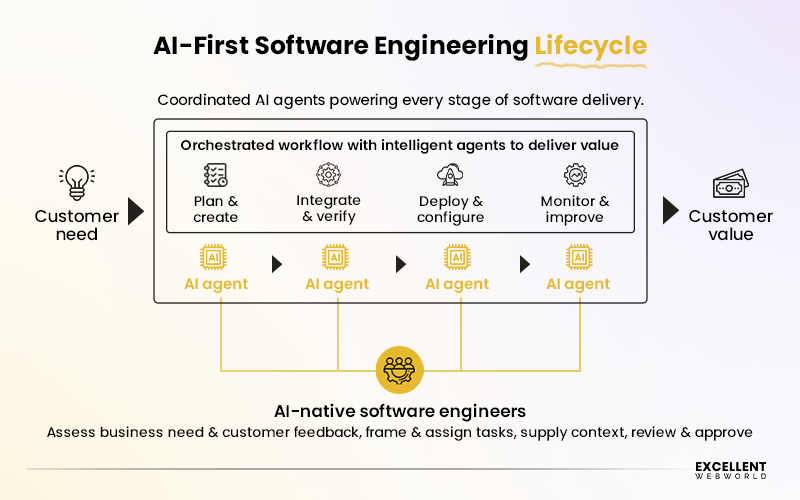
This AI software development trend in 2026 makes solutions that consistently learns, work in real-time, and automate complex tasks with integrated intelligence. AI-native software development process steps around models, automation, and data intelligence from day one. Ultimately, it replaces the entire SDLC, instead of putting efforts into enhancing workflows.
One of the popular examples is Harvey (Legal AI),
It is a complete AI-native platform built for lawyers to automate legal research, analysis, and contract drafting.
With an AI-native approach, it has achieved a significant annual recurring revenue (ARR) of around USD 100 million in early 2026 by cutting billable hours. Also, it hit a valuation of USD 5 billion as an enterprise business.
Business Impact of AI-Native Software Trend For Founders
Find out how AI-native software development can impact your business in a profitable way. Moreover, you can leverage AI-native benefits listed below seamlessly, just by hiring a leading AI development company for your project.
Trend 2: Software That Replaces Ongoing Headcount Is Outperforming the Market
Building software that doesn’t need a number of operators is winning in 2026. The stronger software is the one that is replacing the ongoing labor costs for businesses. When doing software development for startups, adapting this emerging trend can save a lot.
Companies are generally under pressure to reduce hiring, control payroll expenses, as well as improving productivity per employee. Keep in mind that software is built to reduce operational roles and replace repetitive tasks, growing faster.
Take an example of Klarna, a customer service and finance firm, which built an in-house software using OpenAI, i.e., AI customer service agents.
Its AI assistant handles the workload of 853 full-time agents. Maintaining a high score in customer service satisfaction. Due to this, the company has reduced its workforce from 5,000 employees to 3,800, while managing great efficiency.
Business Impact For Founders With Software That Replaces Headcount
Instead of software that simply helps employees to work a little better, solutions that replace the headcount are actually leading the market. Let’s see how one of these AI-driven software development trends helps businesses.
Trend 3: Vertical AI Software Is Consistently Outperforming General-Purpose AI Solutions
We can say that vertical AI is one of the software development industry growth trends for 2026, as it focuses on serving only one industry and solving specific problems associated with it.
Vertical AI is made to understand industry-specific information that general models may easily miss. This software uses proprietary datasets that give higher accuracy and minimal errors as compared to models that are set to process public data.
Business Impact of Vertical AI Trend for Founders
Check how adapting an industry-specific software development can benefit businesses more than general solutions.
Trend 4: Agentic Software Workflows Are Using Multi-Agent Systems to Deliver Higher ROI
One of the biggest and latest trends in software development is agentic software. Instead of relying on only one AI system or a single agent, agentic software adapts multiple AI agents that work together to complete workflows.
Most enterprises prefer a multi-agent framework like AutoGen, CrewAI, and LangGraph. In which specialized agents, such as a researcher, writer, and validator, collaborate with each other to solve problems and perform multi-step tasks. This way, it reduces process latency by 28-60% and overcomes manual oversight by 50-70%.
You can hire trusted AI agent development services providers to implement agentic software workflows in your operations. Collaborating with technology experts makes your work easier and delivers real value to your business.
Grubhub is a popular example who gain 836% increase in ROI with an agentic software approach.
It has launched a Grubhub Campus program, but it is getting low student adoption. Many students fail to complete key steps in the onboarding process. They miss linking their campus card or forget to activate their Grubhub+ Student subscription.
As the solution to it, adapting an agentic software approach by using Braze not only increases ROI by 836%. But also boosts overall orders by 20% and raises Grubhub+ Student signups by 188%.
Business Impact of Agentic Software Workflows for Founders
Let’s understand how multi-agent systems impact enterprise workflows as one of the best outsourcing software development trends:
You May Want to Check On: Best AI Agents Examples
Trend 5: AI-Assisted Software Teams Are Building Products With Lower Capital Costs
AI-assisted software development helps businesses to reach significant revenue even with a smaller team size. Popular platforms like GitHub and Replit help developers to do efficient development in a short time and at a cheaper rate.
By leveraging such AI tools and “pair programming,” developers can write code faster, detect errors automatically while writing code, and launch products more quickly in the market. Ultimately, this reduces the cost and time required to build software.
If you are a non-technical decision-maker or a new entrepreneur in the AI-assisted era, and don’t know how to build a cost-efficient AI-assisted software team. Then, check our latest article on “How to Hire AI-assisted Developers.” This guide leads you to faster software delivery with lower capital costs.
Perplexity’s CEO said, our engineers have mandated the use of AI coding assistants such as Cursor and GitHub Copilot. By doing this, we have reduced the prototype features time from several days to only one hour.
Business Impact of AI-Assisted Software Teams for Founders
Here’s the key advantage of adapting to the latest market trends in software development. Check how building AI-assisted software teams for your business benefits in real terms.
Trend 6: The Software Subscription Economy 2.0 is Winning on Predictability and Valuation
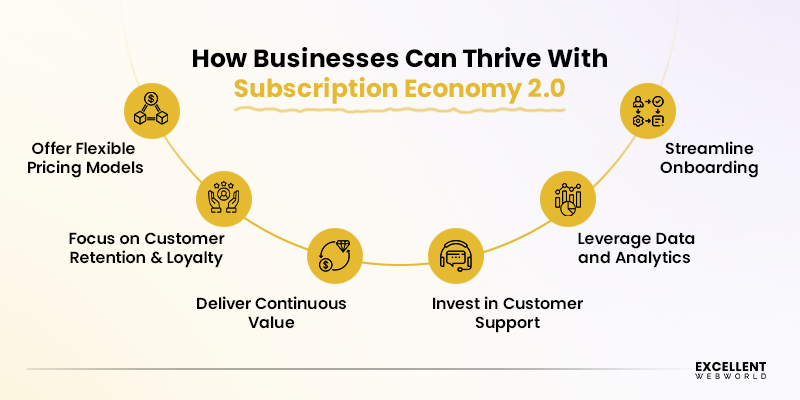
One of the most revenue-generating US software development industry trends 2026 is the software subscription economy 2.0. This represents the transformation from a simple payment model to personalized, value-driven, and community-focused solutions. It changes the “growth at all costs” mentality of past days.
SaaS application development with a subscription-based economy leads to long-term customer relationships and always-on access. In place of one-time transactions, adapting this software development trend shift focuses on predictable revenue, efficient growth, and AI-driven value.
An example of a leading SaaS, Adobe explains how the transition from perpetual licenses to Creative Cloud subscription changed the growth numbers.
Adobe’s market capitalization rose from USD 15 billion in 2012 to over USD 200 billion today. Having a revenue growth at a CAGR of 20%.
Business Impact of Software Subscription Economy 2.0 for Founders
Check the adaptation of subscription-based software development benefits in what terms.
Trend 7: Cloud Security Has Become a Core Buying Decision in Modern Software Development
Last but not least in our list of top 7 software development trends 2026 is Cloud Security. This trend rises from a secondary checkbox to a core compliance requirement. Cloud security becomes a strategic buying decision for every software development, because security is not something that can be discussed after purchase.
For modern software purchase, customers now want to know about so many security aspects, such as:
Popular cloud providers such as Amazon Web Services and Microsoft Azure have increased enterprise-grade security standards. Even Google Cloud agreed to deal with Palo Alto Networks, with investment approaching $10 billion for many years, to focus on cloud security services. These kinds of steps by top cloud computing leaders have raised expectations for all software vendors.
Business Impact of Cloud Security for Founders
Let’s see how utilizing the cloud security software development trend can impact businesses.
Key Takeaways From 2026’s Software Development Trends
Software development trends will never fade, they will evolve continuously. But the economics behind building a profitable software remain constant. In 2026, the trend, or we can say the technological shift, is clear: software development cost becomes cheaper, yet more valuable to own when architected strategically and aligns with the market.
Businesses that align perfectly with the trends mentioned in this guide will definitely gain leverage. Those that aren’t pay the Legacy tax, such as higher operating costs, slower delivery cycles, reduced margins, and systems that depreciate instead of rising.
At Excellent Webworld, a forward-thinking software development company, we develop secure and scalable solutions that generate long-term value. If you want clarity on whether your software solution project is going to compound or cost you, connect with us. Book a Profit Architecture Audit with our experts and find out.
FAQs: Top Questions People Asked About Software Development Trends
AI-native software, solutions that replace employees, vertical AI software, agentic software workflows, AI-assisted software teams, subscription economy 2.0, and cloud security are leading 2026 software development outsourcing trends.
No. AI is not meant to replace software developers, in fact, it is made to assist them. AI helps developers by automating repetitive tasks, and with human expertise, businesses can plan architecture, do problem-solving, and build a strategy.
AI acts as a ‘secret weapon’ for offshore software development. An AI trend accelerates the project delivery, coding & testing automation reduces costs, and enables high-quality for complex requirements.
Because nowadays, security is not something that can be compromised or considered after buying software. It plays a role in core buying decisions, and integrating it early in software development reduces risk, cost, and compliance issues.
Current trends in software development 2026 reduce development costs, improve software scalability, increase the potential of recurring revenue, and lower the long-term technical debt. All these factors directly impact the business’s profitability and boost margins.
According to the latest report of Precedence Research, the global software development market size is projected to reach USD 921.14 billion in 2026 and approximately hit USD 2,468.93 billion by 2035, with a CAGR of 11.60% (2026-2035).
FinTech, HealthTech, cybersecurity, logistics, automotive, real estate, and enterprise automation sectors are expected to grow fastest with AI integration in software development.

Article By


Mahil Jasani began his career as a developer and progressed to become the COO of Excellent Webworld. He uses his technical experience to tackle any challenge that arises in any department, be it development, management, operations, or finance.