We understand that many of the readers may not be as technically experienced as usual developers; hence we have created this blog in such a way that it will be beneficial for the technical as well as non-technical readers.
What is the main aim of a client, or the business person who is financing the web development project? That the product works seamlessly for any number of users across any vertical. However, the solution to this response is not very simple. Hence, we have decided to help you out in selecting the perfect technology stack.
How To Choose Web Application Development Technology Stacks?
Before answering that question, we need to understand what web application technology stacks are and how they work. So, we can bifurcate the entire web development process into 2 parts:
Client Side Programming
The client side, also known as the frontend technologies of web application development, is the part that the user sees and interacts with. For instance, the website on which you are reading this blog.
Everything that you see right now from the text, images, spacing, and that small notification button in the bottom right corner; everything comes in the front end.
Every technology that makes this happen is the technology stack of a website.
When people talk about front-end technology stacks, you must have heard terms like HTML 5 and CSS 3. So, what are those? HTML (HyperText Markup Language) and CSS (Cascading Style Sheets) make the objects on the screen look the way they appear.
HTML helps the browser in displaying the content of the webpage as it is designed, and CSS styles the content of the page. Today’s projects generally use CSS frameworks such as Tailwind CSS or Bootstrap to speed up styling and maintain design consistency.
JavaScript is another key front-end development technology for web and mobile apps. If you are considering developing a web or mobile app, you will use JavaScript frameworks for highly functional UI in both cases. TypeScript is a superset of JavaScript. It has become the de facto standard for large-scale frontend projects. It can also help you to reduce runtime errors and improve developer experience.
Server-Side Programming
Server-Side Programming Languages
The server side has a programming language based on which the whole back-end technology stack is chosen, and websites and web applications are developed. So, some of the top programming languages that you can choose from are:

Server Side Frameworks
The frameworks are tools that help developers code the backend in a specific programming language. Hence, different frameworks are used for different languages and development needs. So, some of the top backend frameworks that you can choose from are:
Node.JS is a JavaScript runtime that is widely used for backend programming. In recent years, Bun.js has emerged as a strong alternative to Node.js, offering faster time-to-market and built-in bundling, which is essential for performance-sensitive projects.
Most Common Databases for Web Development
The storage unit for all the data on your website is a database. Hence, all the information that the users request for is stored using a database. So, to store all the data you may choose from the most commonly used databases: Relational Database (RDB) and Non-Relational Database (NRDB).
Relational databases represent and store data just like a spreadsheet, in rows and tables. Further, this database is based on relational algebra. However, on the other hand non-relational database stores data in subsections, so not the whole file but only a part of the database is called when requested.
Some of the top Databases for Web Developers:
Best Open Source Web Servers
The server side is nothing without the servers. In short, it is the system that handles client requests from websites and applications.
Some of the top open-source web servers that you can choose from are:
Choose From Technology Stacks
Some projects need quite more than just a single technology or a small set of stacks. You may lack the knowledge of customizing your own technology stack; hence we are mentioning the most popular web technology stacks used by developers worldwide. When you need such “bulk” of technologies, you can opt from any of the following web development stacks.
1. LAMP Stack

LAMP was one of the earliest stacks to get popular amongst developers. It is made up of open-source software with the key stacks being:
The LAMP stack works seamlessly for websites as well as web applications. Being open source, this stack can be used in combination with other software development stacks of open-source nature. A detailed look at LAMP stack shows you that the OS Linux is very stable, secure and free being open source.
You can also interchange the PHP programming language with Perl or Python.
There are other variations of LAMP stack such as:
2. MEAN Stack

MEAN stack offers the following technologies:
MEAN stack is a collection of open-source technologies primarily based on JavaScript. MongoDB makes it simpler to send and receive data between the client and server-side by saving data in a binary JSON format.
Express.JS was inspired by a one-time popular Ruby framework, Sinatra. It assists developers in building software using JavaScript on the server side. Angular’s modern architecture comprises signals for state management, standalone components, and improved CLI tools, helping you reduce time-to-market while providing enterprise-grade architecture. Angular is also capable of running on smartphones, tablets, laptops, desktops, and even smart TVs. Finally, Node.JS offers a lightweight and efficient runtime environment because it works on Chrome V8 JS engine.
There is an alternative to the MEAN stack in MERN (MongoDB/Express.JS/React.JS/Node.JS). If your developers are experts in the MEAN stack, they are full-stack developers, as they can single-handedly build your web app’s client and server sides. However, you require a structured web development team for design, development, and testing.
3. MERN Stack
The MERN stack (MongoDB, Express.js, React, Node.js) is one of the most widely adopted full-stack JavaScript environments for building modern web applications. The backend for MERN is the same as MEAN, but in the frontend, Angular is replaced with React, which provides a component-driven, flexible UI layer.
When you talk about SPAs (Single Page Applications), SaaS products, and real-time applications (chat, dashboards), MERN should be your preferred choice. This shift towards serverless deployments, i.e., running a Node.js backend as Google Cloud Functions or AWS Lambda, has increased their popularity for cost-effective, scalable architectures.
4. Python-Django Stack

This duo technology stack is formed on the base of the Python programming language. Here the language used is Python and the framework chosen is Django (also written in Python). This stack provides an Apache or Nginx web server with PostgreSQL or MySQL for its database use.
The benefit of using the Python-Django stack is that it offers very rapid development while maintaining quality. It is the perfect choice of web development stack when you need to create an MVP of your web application or build web software in a limited timeframe. In the year 2026, Django’s value has increased further as it empowers AI-integrated web applications due to its native interoperability with Python’s ML ecosystem (TensorFlow, PyTorch, Hugging Face). With these capabilities, Django has become one of the go-to frameworks for web applications that require running machine learning models.
FastAPI, another Python framework, is also worth noticing. While Django focuses on full-featured batteries-included functionalities, FastAPI focuses on purpose-built high-performance APIs. According to the 2025 Stack Overflow Developer Survey, FastAPI is the fastest-growing web framework. For API-first projects, FastAPI is a better choice than Django.
5. .NET Stack
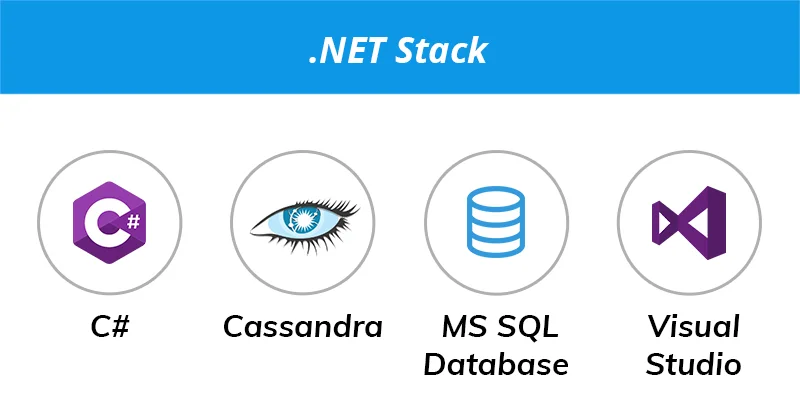
The .NET framework is a very robust and thoroughly tested framework capable of developing dynamic web applications. The .NET framework and C# programming language are the centerpiece of Microsoft’s tech stack.
The .NET stack is basically a full-stack solution that can handle both client and server-side development requirements. One of the USPs of the .NET stack is that it provides 60+ platforms, libraries, frameworks, and SDKs across 13+ layers.
This makes the stack highly interoperable and flexible in terms of programming language. It is one of the most secure stacks, capable of protecting against all major types of attacks. The speed of development and portability of the solution are solid features of the .NET stack. Microsoft has moved to cross-platform development with .NET 8 (LTS) and .NET 9. These versions are significantly faster than previous versions, making .NET a preferred choice for enterprise Windows environments and for cloud- and Linux-based deployments.
6. Ruby on Rails Stack

Ruby on Rails (ROR) stack offers a very high library integration. The developers call these libraries gems. So when a developer says they added a Gem to their app, it means they added a library.
The framework is highly scalable and has a built-in database, and is also compatible with MySQL and PostgreSQL.
In MySQL, if you want to pull up data from the database from multiple tables, you write 3 or 4 lines of code. In Ruby, you can do that in 3 words. This type of speed makes the development time cut short on a vast scale. Released in late 2024, Rails 8 introduced Solid Queue, Solid Cache, and Solid Cable. These are built-in database alternatives for Action Cable and Redis, thereby reducing infrastructure dependencies for more projects.
7. JAMstack and Next.js: The Modern Web Architecture
You can’t complete your tech stack guide for modern web development in 2026 without learning about JAMstack and Next.js.
JAMstack (JavaScript, APIs, Markup) separates out the frontend from the backend. So, instead of a traditional web server rendering each page on request, JAMstack pre-builds static HTML at deployment time and uses REST or GraphQL APIs for dynamic data. As a result, you can reduce load time, improve security, and enjoy effortless global CDN delivery.
Here are the commonly used JAMstack tools:
Next.js, built on React, has become the dominant choice for web applications over the last few years. It provides features like static site generation (SSG), server-side rendering (SSR), and incremental static regeneration (ISR). That’s why major brands like Netflix, Uber, and TikTok use Next.js in their production. For projects where you need high-class SEO performance, Core Web Vitals score, and faster interactive time, Next.js should be your go-to choice.
8. T3 Stack: TypeScript-First Full Stack
The T3 Stack (Next.js + TypeScript + Tailwind CSS + tRPC + Prisma + NextAuth) has made a name as a modern, type-safe full-stack architecture. The teams that want to build SaaS products where developer experience and maintainability matter a lot prefer the T3 stack.
Key components of the T3 stack:
Teams that want the productivity of a monorepo and the safety of a full-stack in a single tech stack should opt for T3. However, if you’re dealing with large distributed systems, where a microservice architecture is preferred, you shouldn’t use the T3 stack.
How to Choose a Technology Stack for Web Application Development?
You can learn all about these stacks all day and yet feel very confused when you have to settle for your project finally. Hence a better approach is to see how other successful businesses and enterprises chose their web application stack. The decision to choose the right tech stack also depends on the web application idea that you are implementing.
Although, the ones mentioned here are not to be considered the final word. Your needs may differ from what they had in their minds. Still, you can learn from these technology stack examples.
Social Media Networks (Eg: Facebook & Instagram Tech Stack)
Programming Language
Database
Frameworks
JavaScript UI Libraries
Collaboration Tools & SaaS Products (Eg. Slack & Notion Tech Stack)
Programming Language
Database
Frameworks
Web Servers
eCommerce Platform (eBay & Amazon Tech Stack)
Programming Language
Database
Frameworks
Web Servers
Learning Platform (Eg. Coursera & Udemy Tech Stack)
Programming Language
Frameworks
Other Tools
Database
Web Servers / Cloud
Q&A Forums (Eg. Reddit & Quora Tech Stack)
Programming Language
Database
Frameworks
Web Servers
Other Tools
Information & Blogging Website (Product Hunt & Medium Tech Stack)
Programming Language
Database
Frameworks
Web Servers
AI Integration and Its Impact on Tech Stack Decisions
If you’re selecting a tech stack in 2026, you can’t just think about backend and frontend alone. Nowadays, you need to develop a web that includes AI features such as LLM-powered search, personalization engines, and predictive analytics. That’s why your modern-day tech stack should also reflect how you can integrate and deploy AI models.
Here are the things you need to keep in mind when building an AI-ready web stack:
At Excellent Webworld, we help clients to build stacks that are AI-integration ready and use all the modern technologies so that the tech choices don’t become a bottleneck as you add intelligent features in the future.
Word of Advice
The best technology stack for web applications won’t be the one from the choices mentioned here. Here, we have tried to cover the most relevant and proven web technology stacks used in 2025 and poised to become a force in 2026. The web app tech stack horizon is expanding with new-age possibilities such as the T3 stack, edge-native architectures, and AI-integrated backends, redefining what “full-stack” truly means.
We hope you make the right choice with your web stacks. It is a bit of advice that besides doing your own research, you should talk to development experts who can guide you more firmly towards the right options.

Article By


Mahil Jasani began his career as a developer and progressed to become the COO of Excellent Webworld. He uses his technical experience to tackle any challenge that arises in any department, be it development, management, operations, or finance.