The way web applications are built has changed drastically in the last few years. Static pages have been replaced by robust, fully functional web applications that serve millions of users simultaneously. Today, web apps, whether a customer-facing SPA or an enterprise portal built through web portal development services, are connected to cloud servers, live data streams, and AI systems, and users expect all of it to work fast and seamlessly.
A web application that works on a remote server with the help of the internet. The app is stored on the remote server and gets delivered over the browser interface.
But to build a perfect and robust web application, the critical part is to select the right web application architecture and its components. In fact, you have to make sure that the architecture is suitable when you implement AI in the web development process.
In this guide, I’ll provide you with details on what web application architecture is, how it works, its core components, modern types, architectural layers, and the 2026 best practices you should be aware of before writing a single line of code.
What is Web Application Architecture?
Web architecture professionals are managed by project managers in a structured web development team.
To understand better, consider the example of opening a web page and how the process goes on. As a user hits the URL in the address bar, the message will go to the server. Later, the server will send a file to a browser, which then shows the requested page to the user. The point to note here is the code behind all this stuff.
But the code may not every time have the specific instruction to let the browser know how to interact with every user input. A web application architecture includes all the subcomponents which are necessary to load a page on the user’s device successfully.
Understanding how these components come together and help you run web apps becomes crucial. Analyzing the architecture is especially vital if you are still considering developing a web or mobile app. This comparison lets you determine which approach is better, especially if it aligns with your business goals.
A well-designed architecture directly impacts your website performance and business outcomes. A good foundation in terms of solid web application architecture can increase your performance by many folds. However, most of the web applications still comprise at least one vulnerability, which mostly originates from design-level or architectural-level oversights. Therefore, getting your architecture right from the beginning is paramount.
Why Web Application Architecture Matters
If you choose the wrong architecture, it doesn’t just create technical debt, but it compounds it manyfold. Here’s what you get by opting for a well-designed web application architecture:
- Scalability: The ability to handle 10x traffic spikes without rewriting the system from scratch
- Security: Implements access control at all layers, not at the code level
- Maintainability: Allows teams to update or make changes to one layer without disrupting the other layers
- Performance: Separate heavy computing workloads from user-facing response paths
- AI-readiness: Ability to integrate model inference layers, real-time event streams, and LLM APIs without architectural retrofitting
Teams that are running mid-market and enterprise-level companies should pay keen attention to the last point. Web applications that aren’t designed with AI integration in mind are adding architectural debt when organizations try to add AI-powered features.
How Does Web Application Architecture Work?
For any web application, there will be two subprograms running side by side.
- Server-Side Code: The program which responds to the HTTPs request.
- Client-Side Code: The program which responds to the user’s input.

For delivering any web application, these two sets of programs will work simultaneously. Both the programs will work as per the user inputs. The server-side code will be written in Java, Python, Node.js, Go, or PHP, among others.
Whereas the code written in HTML, CSS, and JavaScript is used for the Client-Side. When it comes to client-side architecture, React, Vue, and Angular are leading the charts as they allow you to develop rich Single Page Applications (SPAs) and Progressive Web Apps (PWAs) that behave like a native application. Web application architecture will play a significant role in deciding the functions on the server as well as the client-side. It will even be able to determine how the functioning will go between these two in relation to each other.
Layers of Web Application Architecture
Modern-day web application architecture is divided into three logical layers. Understanding these layers will help you select the best possible architecture pattern.
1. Presentation Layer (Frontend)
Everything that the user sees and interacts with comes under the presentation layer. HTML, CSS, JavaScript, and frontend frameworks like React or Angular come in this layer. The presentation layer comprises some business logic via client-side rendering (CSR) or hybrid rendering strategies like Next.js’s server-side rendering (SSR).
2. Application Layer (Business Logic)
The application layer processes requests, applies business rules, orchestrates service calls, and manages authentication/authorization. This is the layer where your middleware, microservices, and API gateways reside. If you’re dealing with AI-integrated apps, this is also the place where AI pipeline orchestration, LLM API calls, and inference requests take place.
3. Data Layer (Storage and Retrieval)
Data layer handles NoSQL stores (MongoDB, Redis), all persistence — relational databases (PostgreSQL, MySQL), in-memory caches, and object storage (Amazon S3). A well-designed data layer helps you to separate out the read and write paths, thereby facilitating horizontal scaling without any hiccups.
Components of Web Application Architecture
The web application software architecture contains many components. These components are further combined into two categories.
User Interface App Components
They have a role related to the web app page like statistics, notification, settings, configurations, display, activity log, and much more. User interface app components are related to the experience rather than the development part. In a web app, they play a role in the layout plan in the interface.
Structural Components
The structural components in the architecture of web applications can be divided into three sub-parts: the client, server, and database components. The client component comprises web applications’ functionalities with which the end-user interacts.
The server layer, which is also known as the application server, handles business logic, manages service-to-service communication, and processes API requests. Lastly, the database server component stores, retrieves, and provides data. In modern-day architecture, this layer comprises multiple data stores, each serving a different purpose.
Now, in the production web application architecture, two more structural components have become standard:
- Load Balancer: It helps you to distribute incoming traffic among multiple server instances, thereby ensuring high availability and preventing any single server from becoming a major bottleneck for the web application.
- DNS (Domain Name System): It translates domain names into server IPs. If you have an effective DNS configuration, it helps you to ensure higher availability and geographic performance for the web application.
What Are The Types of Web App Architecture?
How you distribute logic between the client and server determines your architectural pattern. In 2026, there are five primary types of web application architecture — the classic three, plus two that have become standard for modern production systems.
How you distribute the business logic between client-side and server-side determines your architecture pattern. In 2026, there are five major types of web application architecture that you should be familiar with. Out of five, three are old ones, and two have been the ones that have become standard for modern-day web applications.
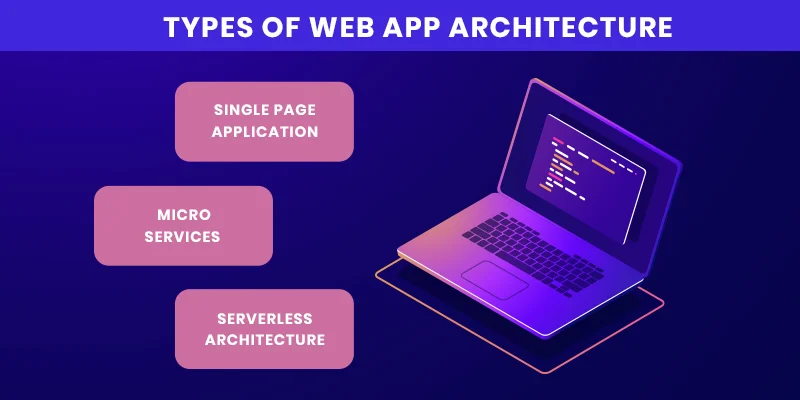
1. Single Page Applications (SPAs)
A modern web app architecture that focuses on enhancing the user experience. Single page application will load the whole web page only once. Later, when a user clicks on anything on the page, then only the requested data will get updated. The rest of the web page will remain as it is.
SPAs become a reality due to AJAX — Asynchronous JavaScript and XML. Today, frameworks like Angular, Vue.js, and React empower most of the SPA implementations. The only concern with SPA is that it requires careful SEO handling (typically via SSR or pre-rendering), and it could be complex to manage as the codebase scales.
2. Microservices Architecture
These are lightweight and small services that execute single functionalities. Microservice architecture comes with so many advantages for developers as well as users. This modern web application architecture increases productivity and makes the deployment process faster.
The best thing about microservice architecture is developers can pick any stack of technology as the components that make the application do not depend on each other. Microservices architecture makes web application development services easier and faster in nature. You deploy microservices in containers (Docker) and orchestrate with Kubernetes, which has become the de facto standard for enterprise-grade microservices. Uber, Amazon, and Netflix are some of the most popular examples of microservices.
3. Serverless Architecture
In this type of modern web architecture, third-party cloud infrastructure is responsible for maintaining and computing servers. A web app developer will hire a third-party cloud infrastructure for the server as well as infrastructure management. With the help of serverless architecture, we can execute the application code without the need of infrastructure-related tasks.
In 2026, Azure Functions, Google Cloud Functions, and AWS Lambda are the most dominant serverless platforms. Serverless architecture is best suited for scheduled jobs, event-driven workloads, and API endpoints with unpredictable traffic. The major limitation of this architecture is cold start latency, which can be a bottleneck for time-sensitive applications.
4. Progressive Web Apps (PWAs)
PWAs aim to occupy the space between traditional web applications and native mobile applications. PWAs use web app manifests, service workers, and modern browsers APIs to provide push notifications, home screen installation, and offline functionality, without the need to download the application. If you’re targeting both web and mobile audiences and don’t want to maintain two separate codebases, PWAs should be your best bet.
5. Monolithic Architecture
A monolithic architecture packages frontend, backend, and data access logic into a single codebase or deployable unit. While microservices are always mentioned in all the headlines, monoliths are a starting point for many startups and MVPs. The reason behind that is that monoliths are simpler to develop, test, and deploy. So, the architectural decision is not ‘monolith vs microservices’ but ‘when to decompose a monolith.’
Web Application Architecture Patterns and Models
In addition to the types, web app architecture is also defined by its architecture pattern or models, i.e., how components are physically structured and logically organized. Here are the most common models:

Three-Tier Architecture
The three-tier model is used for most modern-day web applications. It helps you to separate major concerns into three independent layers: Presentation (frontend), Application (business logic), and Data (storage). You can scale, update, or replace each layer independently.
Java Web Application Architecture
Java – a versatile programming language that is popular in an enterprise development environment. It is one of the most popular programming languages among developers. Java web application architecture can help you achieve desired results for any type of web apps.
Whether it is informative or simple web apps or multi-tiered, you can expect the best with this web app architecture. Spring Boot is the most dominant Java framework for web applications nowadays, as it provides embedded server capabilities and convention-over-configuration features that help you reduce boilerplate code.
Node.js Web Application Architecture
Node.js has a pattern of different model views like model-view-view-model and model-view-controller. It relies on entity-relationships that ensure the working, breaking of logic to modules, and data systematization. When it comes to I/O intensive, real-time applications (chat, live dashboards, streaming), Node.js should be your best possible option.
As Node.js provides you with a non-blocking event loop, it is a perfect candidate for applications that need to handle thousands of concurrent requests. Fastify and Express.js are the most commonly used Node.js frameworks for API development.
PHP Web Application Architecture
PHP web application architecture permits robust and straightforward development. PHP development services are among the least complex and highly functional options for developers and clients, particularly suited for CMS-driven projects.
Laravel is the most popular PHP framework that provides you with built-in ORM (Eloquent), queuing, caching, comprehensive tooling for authentication, and an elegant MVC structure.
Cloud-Based Web Application Architecture
In a cloud-based web architecture, the distinction between the web app and cloud app is clear. Traditional apps rely on centralized servers, while cloud apps leverage distributed cloud infrastructure for better flexibility and performance.
If you’re prioritizing operational efficiency, a cloud-native architecture built around managed services, auto-scaling, and infrastructure-as-code (IaC) is the way forward. Three major cloud service providers (AWS, Azure, GCP) offer managed architecture that frees you up from server management for most use cases.
Angular-Based Web Application Architecture
Angular web application architecture works in dual mode — for HTML as well as TypeScript. It comes with benefits, including UX with lazy loading and reduced coding size.
With the introduction of Angular 17+, you have standalone components and a new control flow syntax, which helps you to reduce bundle size and improve runtime performance. If you’re looking to build enterprise web applications that focus on an opinionated project structure and strict typing, then you should consider Angular.
Web Application Architecture with AI Integration
In this day and age, AI is no longer a standalone feature. It’s part of your core application architecture that affects your application layer, data layer, and API contracts.
How AI Changes Web Application Architecture
When you integrate AI capabilities into your web application, you introduce several new architectural concerns:
- LLM API Gateway: It’s a dedicated server layer that helps you manage calls related to Google Gemini, OpenAI, Anthropic, or self-hosted models. These models will help you to handle rate limits, cost tracking, response caching, and retries.
- Vector Database Layer: If you’re dealing with Retrieval-Augmented Generation (RAG) use cases, a vector store (Pinecone, Weaviate, pgvector) becomes your core data layer component alongside a relational database.
- Streaming Response Handling: As AI-generated response streams in a token-by-token manner, it requires WebSocket or Server-Sent Events (SSE) support at the frontend and API layers.
- Edge AI: With the help of Microsoft Edge, you can allow web apps to run lightweight models (like Phi-4-mini) directly in the browser, enabling on-device inference for latency-sensitive features.
Web Application Architecture Best Practices for 2026
Here are the best practices that you should follow while designing a web application architecture:
1. Design for Scalability from Day One
You should always think about horizontal scaling (adding more instances) compared to vertical scaling (adding more servers). Also, design your application layer to be stateless so that any instance can handle any request, thereby making auto-scaling trivial.
2. Implement a Security-First Architecture
You should apply the principle of least privilege at every layer of your web application architecture. You should also use API gateways to enforce authentication and rate limiting before each request reaches your app servers. Lastly, you should separate public-facing components from internal services.
3. Use CI/CD Pipelines for Continuous Deployment
With the help of Continuous Integration and Continuous Deployment (CI/CD) pipelines, you can automate your build, test, and deployment processes. Teams that use CI/CD pipelines ship 200x more frequently and recover 24x faster from failures. CircleCI, GitLab CI, and GitHub Actions are some of the popular tools for web app deployment pipelines.
4. Adopt Containerization and Orchestration
If you containerize your web application with the help of Docker, you can ensure consistent behavior across development, staging, and production environments. With the help of Kubernetes, you can manage orchestration, i.e., automated deployment, scaling, and management of your containerized services. You can use managed Kubernetes services like Amazon Elastic Kubernetes Service (EKS), Google Kubernetes Engine (GKE), and Azure Kubernetes Service (AKS) for this purpose.
5. Plan Your Caching Strategy Explicitly
Most people consider caching as part of the performance optimization process, but it’s an architectural decision. You need to define what to cache (static assets, API responses, database query results), where to cache (CDN edge, Redis, in-memory), and for how long to cache. A good caching strategy can help you reduce database load and decrease API response time significantly.
Final Thoughts
Web application architecture in 2026 is not about deciding between monolithic and microservices architectures. It’s more about designing a scalable and secure system from the outset, which is AI-ready, processes data in a jiffy, and supports third-party API integrations with utmost ease. It should also be easily maintainable for a long time.
The robustness, scalability, security, and responsiveness of any web app highly depend on the types and models of the web application architecture, and the web app idea that you select to work on. Validating your app for potential vulnerabilities through web application penetration testing can help ensure it performs securely and reliably. You should make that decision based on your traffic, integration needs, operational maturity, and AI roadmap.
Our expert team can help you get the best solution for your web app. Whether you’re architecting from scratch or re-platforming a legacy system, Let’s Talk!
Frequently Asked Questions About Web Application Architecture
Web app architecture is the overall structure design of the system. It defines how your backend, frontend, database, and services are organized and interact. On the other hand, web server architecture defines how each server component is designed and deployed (redundancy, load balancing, and server capacity). So, web server architecture is one element within a massive web application architecture.
If you judge on scalability, then microservices architecture stands out from the rest as it allows you to scale individual services independently according to the current demand. However, if you’re operating with a small team, a well-structured modular monolith can also scale easily and is easy to operate. The final call depends on your team size, traffic, and domain complexity.
AI integration will add some new layers to your web application architecture: an LLM API gateway, a vector database for semantic search and RAG, streaming response infrastructure, and potentially edge inference capabilities. You need to take these into account while designing your architecture. Adding them later on, as you think about AI, will create tech debt.
Three-tier architecture divides a web app into three layers: the presentation layer (frontend/UI), the application layer (business logic and APIs), and the data layer (databases and storage). You can develop, deploy, and scale each layer independently. Due to this aspect, it has become the norm for new-age web applications.
A monolithic architecture packages all functionality into a single deployable unit. On the other hand, a microservices architecture divides functionalities into independent, loosely-coupled services that communicate via APIs. Monolithic architecture is simple to develop and test, but hard to scale and update as your app grows. Compared to that, microservices offer greater flexibility and scalability but require you to invest in good infrastructure.

Article By


Paresh Sagar is the CEO of Excellent Webworld. He firmly believes in using technology to solve challenges. His dedication and attention to detail make him an expert in helping startups in different industries digitalize their businesses globally.


