As a founder, COO, or product owner leading a hospital, clinic chain, telemedicine startup, or digital health platform, you already know that healthcare web development is the backbone of modern care delivery. Your core infrastructure helps you connect your healthcare providers, patients, and sensitive data, and addresses the issue that was slowing down your operations, disrupting business workflow, and affecting patient care.
If you want to know more about how to build a healthcare platform, what the features are that make it world-class, how much it costs, or what is the most effective way for digital transformation, then you’re at the right place. We at Excellent Webworld, with 15+ years of experience, have helped thousands of healthcare organizations digitize their core systems, streamline business processes, and modernize their workflows and user experience.
Based on years of experience and lessons learned from firsthand experience, we’ve designed this step-by-step guide to help you plan your healthcare web development efficiently, avoid mistakes that lead to recurring costs, and build a future-proof platform for long-term success.
Why Opt for Healthcare Web Application Development?
Here is the list of reasons why you should always choose healthcare web application development:
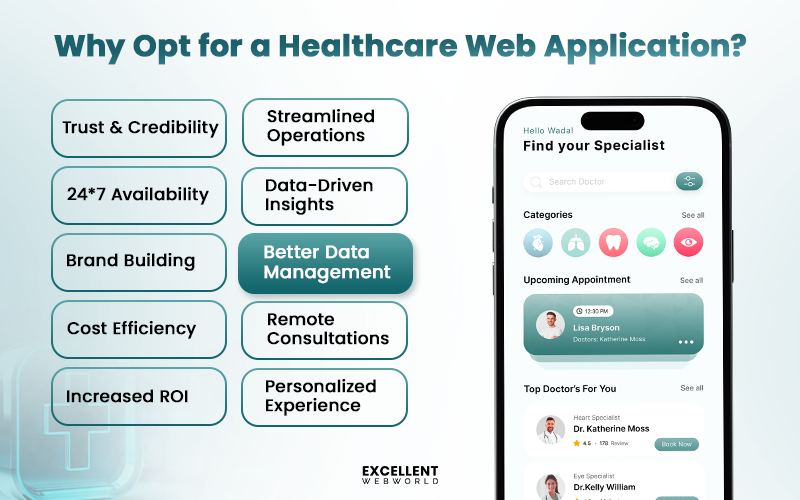
1. Trust and Credibility
Any patient will check your website before visiting your healthcare organization or hospital in person, by phone, or through email. Now, if your healthcare organization doesn’t have an online presence, or has an outdated website, it sends the wrong signal to your patients.
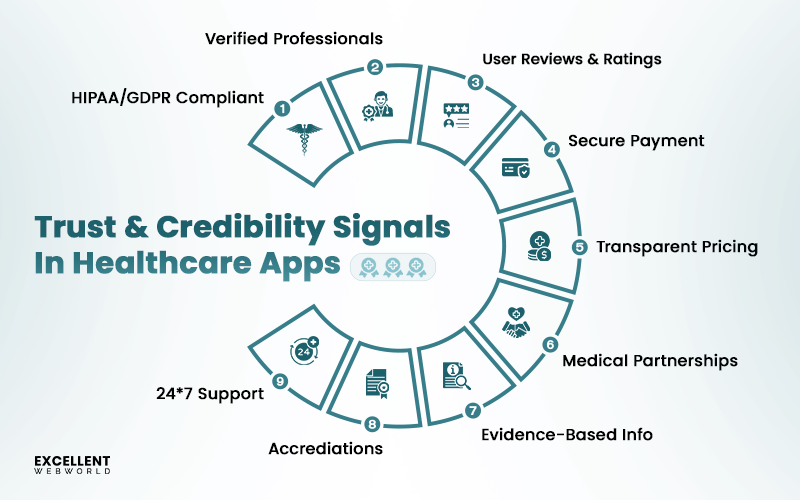
They won’t be able to trust you. However, if your website is built with the latest technologies, is easy to navigate, has a transparent privacy policy, and displays built-in compliance certificates on the first fold, users will instantly trust you.
2. 24×7 Availability
Nowadays, people don’t have the patience to wait even 10-15 minutes for a response. With the healthcare web application, you can give patients the option to book appointments, make payments, and chat with customer support at their convenience. It also helps you to reduce missed appointments and front-desk overload.
3. Brand Building
A generic site won’t cut it anymore. With thoughtful healthcare website development, your brand creates memorable first impressions, not just looking professional, but actually making the patient journey easier and more personal.
4. Streamlined Hospital Operations
Manual administration encourages errors, delays, and burnout. By digitizing dietary intake, check-ins, and discharges, employees have more time to focus on the most important person – the patient.
5. Data-Driven Insights
You can quickly pick out gaps or bottlenecks with centralized reporting. In our experience, dashboards help flag resource issues in days, not quarters. That’s the business value of intelligent analytics.
6. Remote Consultations
Virtual care is a must-have for retention. A robust web platform ensures you don’t fall behind as more patients prefer online consultations, especially across regions or for simple follow-ups.
7. Personalized Healthcare Experience
Patients expect more than generic care. Nowadays, even a basic AI-powered reminder or tailored recommendation can lift engagement and satisfaction. Tracking this is much simpler; no more guessing who needs outreach.
8. Better Data Management
Cloud-backed solutions enable secure, instant access across roles and departments. That’s less reliance on IT rescue and more energy for strategic growth.
9. Cost Efficiency
Automating standard processes cuts recurring expenses. This shift makes every dollar go further, turning admin from a cost center into an engine for scale.
10. Increased ROI
Working with a proven healthcare app development company multiplies every operational win, whether it’s reduced churn, higher digital usage, or a measurable boost in profit margin.
What are the Types of Healthcare Web Apps You Can Build?
You can build different types of healthcare web apps depending on where your workflows feel outdated, slow, or disconnected. When you approach this with a clear medical web development plan, it becomes much easier to modernize without confusing your clinical or operations team.
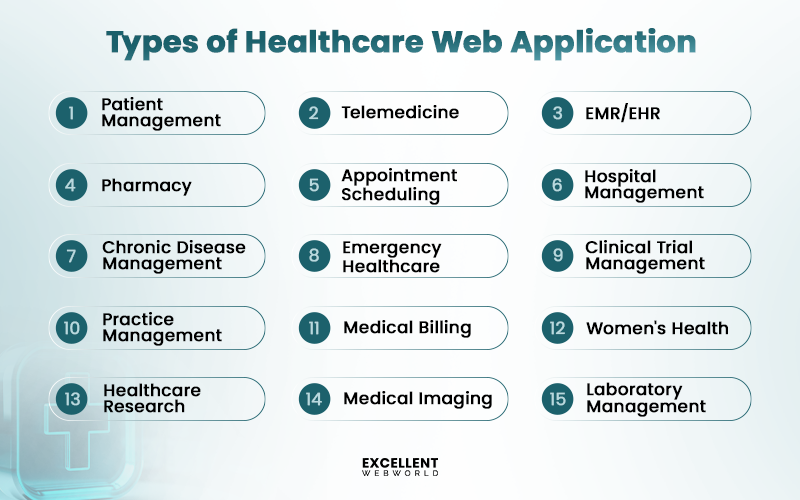
1. Patient Management Systems
Usually, consider this when patient information lives in too many places. With thoughtful health web design, you can pull everything, records, forms, and communication into one clean and dependable system.
2. Telemedicine & Virtual Care Web Apps
Use these apps when patients expect quick consultations without having to travel. A solid medical website development setup helps you offer video calls, e-prescriptions, and remote follow-ups more professionally and reliably.
At Excellent Webworld, we’ve built a telemedicine app for multi-location clinics and digital health startups that handle 10,000+ monthly consultations. So, partner with us if you want a world-class telemedicine app for your clinic.
3. EMR/EHR Web Apps
If your legacy healthcare software is slowing down your healthcare operations, consider using EMR or EHR system development. By partnering with an experienced healthcare web developer, you can development such systems which can fix workflow issues, simplify documentation, and reduce manual errors.
4. Pharmacy Web Apps
You should consider pharmacy web apps if you’re experiencing issues with medication refills, stock tracking, or delayed verification. By following a detailed healthcare app development guide, you can automate these processes and reduce back-and-forth between departments.
5. Appointment Scheduling Web Apps
If phone calls and manual booking are taking up a lot of your time and reducing your productivity, you should consider using appointment-scheduling web apps. It allows you to streamline day-to-day scheduling, give your staff more control over the process, and make it easier for patients to schedule appointments.
6. Hospital Management Systems
If you’re running a massive hospital chain and are frustrated with the lack of collaboration and effective communication between various departments, you should think about Hospital Management Systems (HMS). With the help of HMS, patient admission, pharmacy, billing, labs, and administration can collaborate easily under a single platform.
7. Chronic Disease Management Web Apps
If you have many patients with chronic diseases who require frequent monitoring, you should opt for chronic disease management web apps. It provides patients with long-term treatment plans, monitors their symptoms, and takes direct follow-ups at regular intervals without overburdening your physicians.
8. Emergency Healthcare Web Apps
If you’re associated with emergency services, you should consider developing an emergency healthcare web app, as each second in an emergency is like gold. With these kinds of apps, you can do real-time monitoring and receive instant alerts if a patient’s health is failing quickly, so you can take corrective measures rapidly.
9. Clinical Trial Management Web Apps
You should consider developing a clinical trial management web app if your research team wants to streamline its operations. These types of apps help you to simplify documentation, make it easy to track participations, and enable a quick approval process so your research teams can focus on other complex tasks.
10. Practice Management Systems
If you’re not able to handle administrative work with the utmost efficiency, you should consider adopting Practice Management Systems (PMS). These systems will help you to integrate reporting, billing, time management, and insurance checks in a centralized workflow.
11. Medical Billing Web Apps
If your hospital’s billing department is struggling to process medical claims or other patient grievances about bill errors with efficiency, and it’s affecting your business revenue, implement a medical billing web app in your ecosystem. It will automate the billing process, helping you reduce errors and receive payments faster than ever.
12. Women’s Health Web Apps
If you want to establish a dedicated division focused on improving women’s health, consider developing web applications for women’s health. It will help you provide solutions to major women’s health problems, such as pregnancy care, fertility tracking, and menstrual cycle management, all in one place.
13. Healthcare Research & Training Web Apps
If you’re someone who is associated with the healthcare research wing and wants to create a central system that can help your research team seamlessly collaborate, think about healthcare research and training web apps. With this app, your team can access all research materials, training modules, and clinical trial assessments within minutes.
14. Medical Imaging Web Apps
If your radiology department needs quick access to all X-rays, MRI scans, Doppler tests, ultrasound, and other medical reports within minutes, consider developing a medical imaging web application. It will help you improve the viewing and sharing of reports with the hospital and provide quick diagnoses to patients when teams are working across various locations.
15. Laboratory Information Management Web Apps
If your laboratory team wants to streamline its workflow and improve efficiency, consider implementing a Laboratory Information Management System (LIMS). These applications help you with automated sample tracking, accelerate report generation and sharing, and minimize human error.
What are the Current Healthcare Web Design Trends?
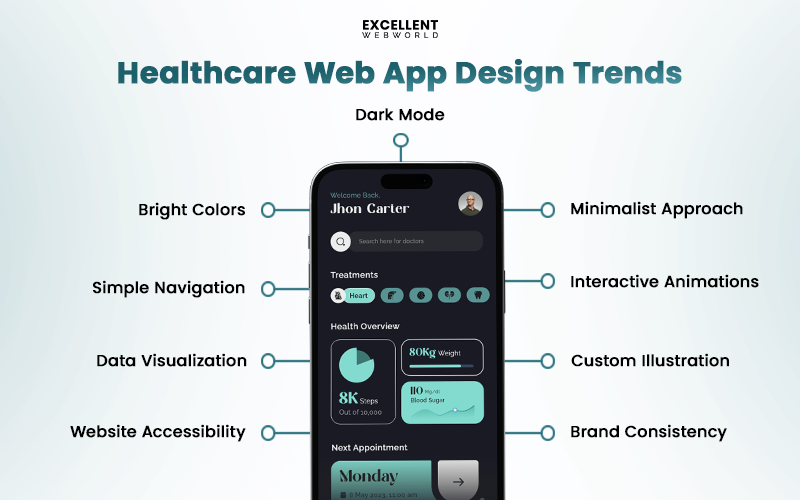
Here are the current healthcare web design trends that you should be aware of to design a modernized healthcare user experience:
1. Data Visualization
If your application can visualize important patient information, such as reports, lab results, and vitals, in charts and dashboards, the hospital can make quick, informed decisions. You don’t have to read pages and pages of complicated analysis to make treatment plans for the patients.
2. Website Accessibility
Your web design for the healthcare industry should be such that any type of person with disabilities, like older people, low-vision users, and people with mobility challenges, should be able to navigate through your website with utmost ease.
3. Bright Colors
Always use a bright color palette in your healthcare web design to engage users and convey that your healthcare platform is easy to approach, rather than making it feel too scientific.
4. Simple Navigation
Strong website development services always emphasize ease of navigation. If your menus, buttons, and workflow are easy to understand, booking appointments or accessing your healthcare portal feels seamless to patients
5. Minimalist Approach
Taking a minimalist approach when designing your healthcare web applications is key to success today. Only keep elements that matter to the patient and eliminate the rest, which are just for a gimmick. It will enhance patients’ experience and reduce the load time of your website as well.
6. Dark Mode
Dark mode is one of the most widely adopted trends in healthcare UI/UX design today because it reduces eye strain and provides a soothing viewing experience, especially during long sessions or in low-light environments.
7. Interactive Animations
Having interactive animations on your website makes your website appear responsive to the patient and provides them with updates on the current status of their request (e.g., loading, submitting, confirming). These micro-interactions reduce uncertainty and build trust.
8. Custom Illustration
Use custom illustrations to help patients understand complex concepts, such as processes, services, or core steps, more simply
9. Brand Consistency
Maintain consistency in visuals, fonts, logo, and color throughout your healthcare website, portals, and telehealth app to ensure brand consistency and appear as a single entity to patients, which builds trust.
What are the Current Healthcare Web Development Trends?
Here is a list of healthcare web development trends that you should consider:
1. HIPAA-Compliant Analytical Tools
Incorporate HIPAA-compliant analytical tools into your healthcare ecosystem to continuously monitor patient behavior and website performance while using audit logs, end-to-end encryption, and role-based access control.
2. Use of AI Solutions
You should use AI in web development to automate repetitive tasks, such as form filling, routing clinical requests, and appointment scheduling, to reduce staff workload.
3. Strong Focus on Content Optimization
Patients want quick solutions to their queries, and that’s where minimalist medical web design, ease of navigation, and keeping only core service pages reduce confusion.
4. Need for Advanced Cybersecurity
Use encryption at rest and in transit, multi-factor authentication, and API controls to protect sensitive patient data while staying compliant with cybersecurity regulations.
5. Personalization of Healthcare Experience
Integrate personalization into every aspect of patient care, such as personalized reminders, tailored suggestions based on the patient’s track record, and follow-up instructions, to improve patient engagement.
6. Augmented Reality (AR) and Virtual Reality (VR)
Your healthcare team can use AR and VR to offer virtual hospital tours and conduct virtual consultations, helping patients better understand their treatment plans.
7. Big Data Analytics
Use big data analytics across various departments to find operational inefficiencies, workflow challenges, and staff shortages before they affect patient care.
8. Cloud Computing
With the help of a cloud computing platform, you can collect, manage, and process your core patient data with utmost ease. It also helps with backups, recovery, updates, and integrations while ensuring scalability and security
9. Interoperability
Always develop a well-connected ecosystem for your healthcare organization so you can share information across departments, including insurance, billing, pharmacy, labs, EHR, and medical imaging, to reduce errors and delays.
10. Digital Twins
With digital twins, you can test your new workflow and see the results before integrating it into the live environment.
11. Microservices
With the help of microservices, you can separate various functions of your healthcare ecosystem so that an error or update in one module doesn’t affect the entire system.
12. Internet of Medical Things (IoMT)
With IoMT-based devices, you can monitor patient health remotely in real time without adding stress on your staff.
13. Chatbots and Virtual Assistants
Chatbots in the healthcare industry can help you to streamline your customer service department by answering all the frequently asked questions within a few minutes to reduce call center workloads.
How to Develop a Healthcare Web App?
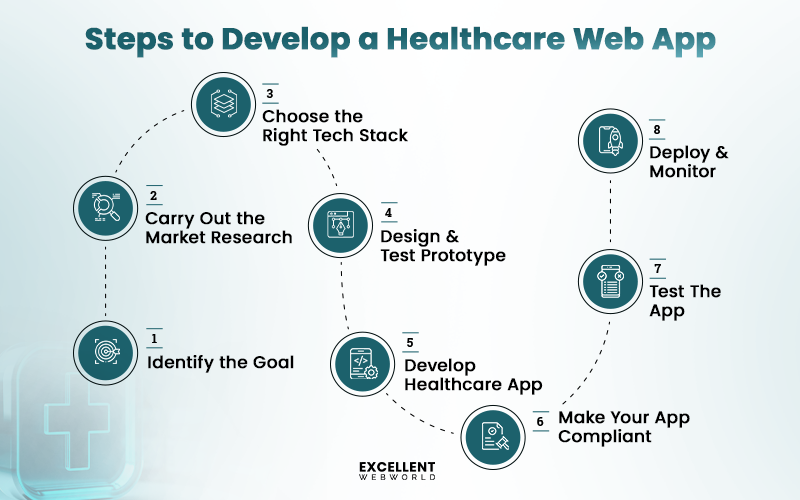
Here is a step-by-step process for developing a healthcare web app that helps you streamline hospital operations, protect sensitive patient data, and reduce departmental disputes.
Step 1: Identify the Goal
First, you need to define what you want to achieve by developing a healthcare web application. Always focus on real-world problems your staff and patients face.
Answer these questions:
It will help you to define goals and objectives for your medical website design and development.
Step 2: Carry Out the Market Research
Carefully understand your patient’s behavior, their likes, dislikes, and pain points. Also, conduct a detailed survey of your competitors to identify gaps that could be opportunities.
You should carefully analyze:
These insights will help you with healthcare website design.
Step 3: Choose the Right Tech Stack
Always choose technologies and web development languages that help you achieve scalability, security, and peak performance.
Think about:
Your ideal web development team structure should comprise experienced, skilled professionals across frontend, backend, security, QA, integrations, DevOps, and more.
Step 4: Design and Test Prototype
You should always create a prototype before moving on to full-fledged app development.
Focus on:
After developing the prototype, conduct rigorous testing of your healthcare web application; testing early doors helps you catch bugs before actual development begins.
Step 5: Develop a Healthcare Web App
Once you have stakeholder approval for the prototype, you can proceed with full-fledged development.
You should follow agile practices such as
If you hire software development services with expertise in healthcare solutions, you get a high-quality solution that is secure, scalable, and compliant.
Step 6: Make Your App Compliant
Compliance and regulations help you protect your patients and secure your organization against cybersecurity threats and data breaches.
Focus on:
Always try to address all compliance issues early on in the development lifecycle. Fixing issues later on can put you in a spot regarding legal and financial penalties.
Step 7: Test Your Healthcare App
Conducting detailed testing of your healthcare app ensures it is reliable, secure, and high-performing.
Always check these things:
Step 8: Deploy, Monitor, and Maintain
Deploy your application to the production environment and launch it to your target users. Before carrying out these activities, you should establish a monitoring pipeline.
Track:
After deploying and monitoring your application, the next step is to maintain it to sustain peak performance for your medical website design and development.
What are the Must-Have Features of a Healthcare Web App?
Here are the must-have features for your healthcare web application:
1. Create and Manage User Profiles
You allow patients to create and manage their personal information, medical records, and insurance details, reducing repetitive work.
2. User Authentication
It enables secure access to protect sensitive patient data by implementing end-to-end encryption, role-based access control, and multi-factor authentication.
3. Telemedicine Consultation (Video and Chat)
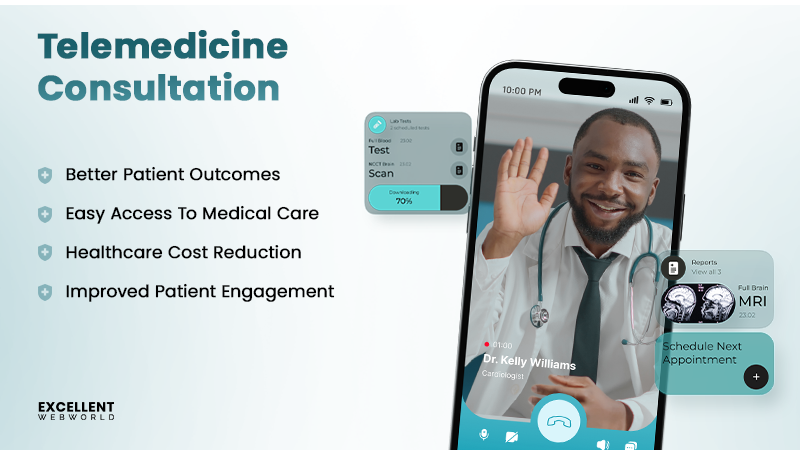
It helps you provide remote patient care via chat or video call, reducing the burden on on-site staff and enabling faster resolution of patients’ problems.
4. Doctors Team Overview
The patient can view the doctor’s profile, including experience, area of expertise, and daily schedule, before booking an appointment.
5. Appointment Management
Patients can schedule, reschedule, or cancel appointments within a few clicks. They also get automated reminders about the appointments.
6. Search Functionality
It allows patients to find information about doctors, departments, the pharmacy, lab tests, and other administrative services without confusion.
7. Payment Gateway
You can provide secure online payment options to patients for consultation and lab reports, thereby shortening the billing cycle.
8. Calendar Integration
It allows you to integrate your app with Apple and Google Calendars so patients receive timely reminders about their appointments.
9. Push Notifications
You can send alerts about appointments, reports, and medications so the patient is always aware of their health.
10. Patient Portal
It lays the foundation for your healthcare web application development, allowing patients to view their prescriptions, medical history, bills, and reports in one central platform.
11. Staff Management
You can organize the schedule, duties, and shifts, and set permissions for your workflow to streamline your day-to-day operations.
12. Customer Service Chatbot
A customer service chatbot can answer your most searched questions accurately and quickly.
13. Prescription Checking
You can allow your patient to access current and previous prescriptions to avoid confusion during follow-up visits.
14. Symptom Checker
With the help of AI, patients get guidance on which symptoms to look for in case of a particular disease and what actions to take, so they don’t have to visit the hospital for a minor issue.
15. Remote Patient Monitoring (RPM)
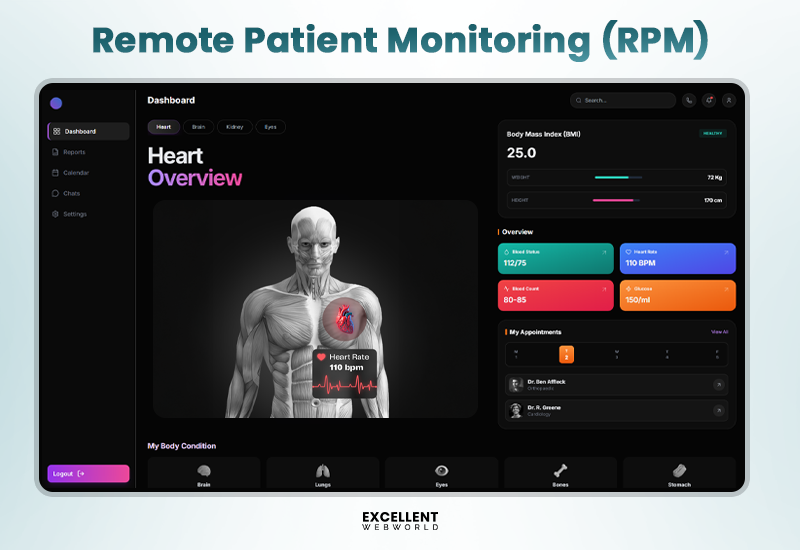
It allows you to track your patients’ vital signs and follow-up data in real time so that you can take corrective measures for ongoing chronic diseases.
16. Wearable Device Integration
It allows you to connect your wearable device to a centralized healthcare system to measure blood sugar levels, steps, sleep patterns, and heart rate, supporting preventive care.
What are the Best Practices to Build a Healthcare Web App?
Here are the best practices that you must follow while building a healthcare web app:
1. Security for Sensitive Medical Data
When you’re dealing with healthcare solutions, you always need to be that extra careful about the security aspect, as you’re dealing with sensitive patient data.
Partner with a company that has relevant experience in healthcare website development. They will be able to provide you with the necessary assistance.
2. Compliance with Healthcare Legal Regulations
Treat compliance as part of the development process from the beginning, rather than as an afterthought, to avoid costly penalties and rework.
3. Integration with Existing Medical Systems
Integrate your new healthcare platform with insurance, labs, billing, EMRs, EHRs, medical imaging, and more to create cohesion and improve response times.
Modern medical web development enables you to support these types of integrations while keeping your platform scalable and secure.
What are the Key Challenges of Healthcare Website Development?
Here are the key challenges that you may encounter while developing a healthcare website:
1. EHR or EMR Integration Complexities
When building a healthcare system, you need to address challenges related to EHR or EMR integrations when using legacy standards. If that happens, your patient data will remain inaccessible, which could be a huge setback for your team.
2. Navigating the HIPAA Compliance
You have to contend with the significant pressure of legal and financial penalties when handling patient data.
3. Designing for a Flawless User Experience
As a healthcare professional, you need to design the simplest possible user experience for your staff and patients. That means there can’t be any confusing menus or slow-loading pages.
What is the Cost of Healthcare Web Application Development?
There’s no one-size-fits-all approach to determining the cost of healthcare web application development. It depends on various factors such as project size, number of features, integrations, compliance needs, and location of developers.
Here’s a detailed breakdown of your healthcare web application cost:
| Project Size | What You’ll Get | Approximate Cost |
|---|---|---|
| Small | Basic website, patient registration, simple portal | $40,000 – $80,000 |
| Medium | Patient portal, appointment scheduling, basic integrations, simple dashboards | $50,000 – $150,000 |
| Large/Enterprise | Full EHR/EMR integration, telemedicine, multi-role access, analytics, compliance features | $100,000 – $300,000+ |
How Excellent Webworld Helps You Build a Secure and Compliant Healthcare Web App?
If you want to develop a world-class healthcare platform that is secure, compliant, and patient-centric, you need a partner with experience and expertise in the healthcare industry. With years of healthcare experience, we can help you plan, optimize, and implement a world-class healthcare solution through our business IT consulting services.
Here’s what you get by partnering with us:
Ready to build a compliant healthcare web solution? Connect with our industry experts and avail of a custom roadmap that puts you on the path to success.
FAQs on Website Design & Development Trends:
One of the best companies for healthcare web development services in the US is Excellent Webworld. Their holistic project approach enables them to deliver and deploy only the best products.
Advantages of healthcare websites for users (or patients) are – the 24×7 availability of information, healthcare websites, online scheduling of appointments, referring to articles by doctors they trust, etc. On the other hand, the advantages of healthcare websites for hospitals and medical institutes are credibility and more owners’ trust in the industry.
Your best bet to create a health website is to consult an experienced website development company like Excellent Webworld. The reason you should hire an experienced company is that you want to build a website that is HIPAA-compliant. Keep in mind, this is not an easy accomplishment and so only depend on a reliable company for this.
Having a website makes people believe in the healthcare body more. Also, it makes passing information quite easy and accessible for all to check appointment schedules.
The shades of blue, purple, and a little tone of green are added while deciding on the healthcare website design. These hues are best used in hospital and medical web portal designing.
User experience in healthcare platforms implies that the platform should throw off safe and reliable vibes. Also, it should function well and take less reload time to help satisfy the ever-growing patient (or user) anxiety and tension.
Building a healthcare web app can take anywhere from 3 to 12+ months, depending heavily on its complexity, features, and regulatory requirements. A basic app may be completed in a few months, while an enterprise-grade platform can take over a year.

Article By


Paresh Sagar is the CEO of Excellent Webworld. He firmly believes in using technology to solve challenges. His dedication and attention to detail make him an expert in helping startups in different industries digitalize their businesses globally.