MERN vs MEAN is a highly debated topic because it’s a critical tech stack decision for decision-makers who plan to build secure & scalable applications. As both stacks are made to perform full-stack development, they differ in frontend frameworks, performance behavior, and architectural flexibility. All these factors can directly affect development speed, system scalability, and long-term cost. So, choosing the right tech stack for web and mobile applications is crucial because it’s not just a technical preference; it’s a strategic IT decision.
With 15+ years of experience, we are partnering with enterprises and high-growth organizations at Excellent Webworld to design and build applications. Our experts make sure that web and mobile apps are aligned with business objectives, infrastructure strategy, and growth plans. This gives us a clear perspective on how MERN stack and MEAN stack perform in real-world enterprise-level scenarios. Based on that, we have created a guide that presents a clear, business-focused breakdown of MEAN vs MERN to help founders choose the best stack for scalability, maintainability, performance, and long-term value.
What Is MEAN Stack and MERN Stack? (Core Components Explained)
The MEAN and MERN stacks are the best JavaScript frameworks used for full-stack development. They enable enterprises to build scalable and high-performing web applications using a unified system for development. Let’s understand what MEAN and MERN stands for.
What Is MERN Stack, And What Are The Core Components?
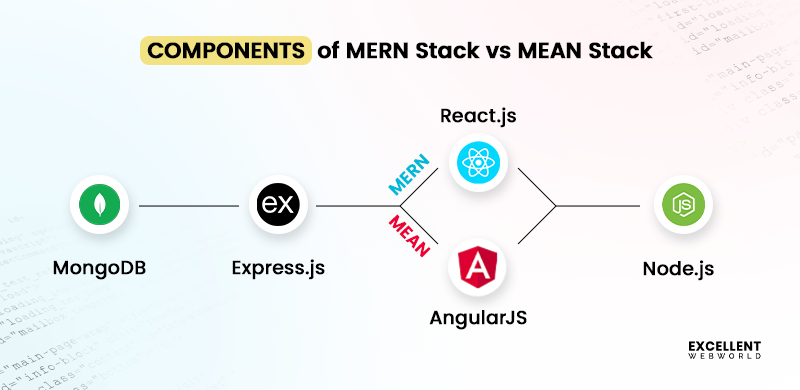
The MERN stack is a highly flexible full-stack JavaScript framework made of MongoDB, Express.js, React, and Node.js. These stack combinations build highly interactive web applications, which prioritize frontend performance, rapid iteration, and component reusability. It is preferred for rapid prototyping and single-page application development.
What Is MEAN Stack, And What Are The Core Components?
The MEAN stack is a JavaScript framework for full-stack development that combines technologies, including MongoDB, Express.js, Angular, and Node.js. These tech components from MEAN stack build structured, scalable, and maintainable enterprise web and mobile applications leveraging a unified development method. An enterprise application and complex UIs can be developed with the MEAN stack.
MERN vs MEAN: Quick Comparison Table
Quickly compare and evaluate the difference between MERN and MEAN stack with key points. This highlights helps you go through the core differences between MERN vs MEAN, which gives basic understanding of how they work and differ.
| Criteria | MERN Stack | MEAN Stack |
|---|---|---|
| Frontend Framework | MERN uses the React frontend framework, which gives a component-based library that highly focuses on UI flexibility. | MEAN leverages the Angular frontend framework, which is full-featured and opinionated. |
| Architecture Style | The MERN architecture is flexible and modular, and is ideal for developing products with an iterative approach. | The MEAN architecture is highly structured and opinioned, which is best for large and controlled systems |
| Feature Flexibility | Features’ flexibility is high because of the third-party ecosystem. | The feature’s flexibility is medium due to the in-built standardized tooling. |
| Performance | User interface performance is high with efficient rendering. | It gives UI performance consistently for data-driven applications. |
| Scalability | The scalability is good for both user-facing as well as enterprise-level applications. | Highly scalable for large and complex enterprise-level applications. |
| Learning Curve | For those teams who are familiar with JavaScript, the learning curve is easier than for others. | Because of Angular’s framework conventions, the learning curve is steeper for developers. |
| Ideal Enterprise Use Cases | SaaS platforms, customer-facing apps, and real-time dashboards. | Enterprise portals, internal systems, and applications with heavy data sets. |
MERN vs. MEAN: What Are The Key Differences? (Learn In Detail)
As we have gone through the quick comparison of MEAN vs MERN, now it’s time to discover the structured and business-first comparison that highlights how MERN and MEAN differ in actual terms. It covers key differentiation points like frontend approach, architecture, performance, and long-term operational impact for enterprise-grade web applications.
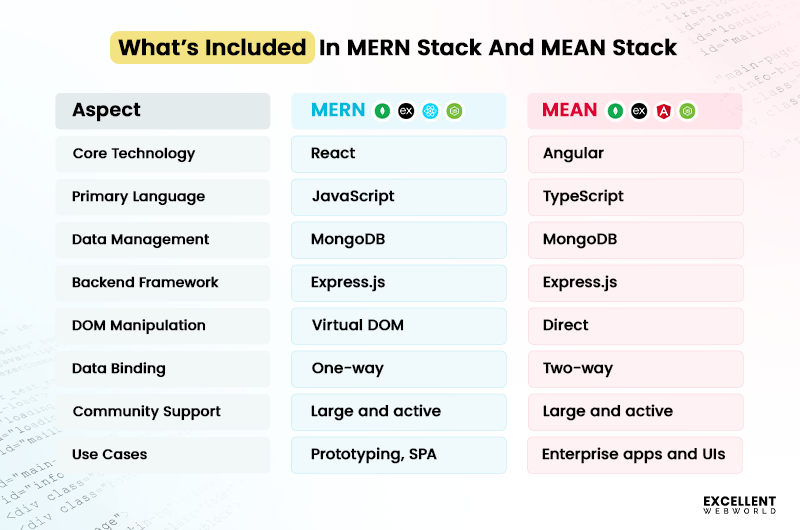
Frontend Framework Approach (React vs Angular)
The frontend framework you choose is going to decide how your user interfaces will be built, scaled, and maintained in the future. MERN and MEAN differ specifically in the flexibility of UI, development freedom, and how enterprises manage the complexity level in the frontend system.
| Aspect | MERN (React) | MEAN (Angular) |
|---|---|---|
| Framework Nature | React’s UI-focused library helps full-stack developers to design interfaces that have maximum flexibility and few limitations. | Angular offers a complete frontend framework that gives standardized patterns and consistency in architectural flow. |
| UI Development Style | Rapid UI experiments and customizations are possible with component-driven methods. | Structured method that has already defined workflows and non-changing design patterns. |
| Control & Customization | The control on UI is very high, and it is ideal for customer-side experience-based products. | Customization level is controlled and is ideal for enterprise interfaces with uniform needs. |
| Enterprise Suitability | Highly suitable for dynamic, user-centric applications that require UI updates on a frequent basis. | Best for big and standardized applications that have the same type of UI requirements consistently. |
Architecture & Application Flow
The mobile and web application architecture developed with any tech stack is meant to determine how different layers of the application interact with each other and grow as time passes. The difference between MERN and MEAN is that MERN focuses on flexibility, while MEAN prioritizes predictable structure. Both are impacting scalability, governance, and system maintainability.
| Aspect | MERN | MEAN |
|---|---|---|
| Architecture Style | It is modular and flexible, which allows teams to adapt the architecture as per the business needs. | It has an opinionated architecture that delivers a consistent application structure seamlessly. |
| Application Flow | Workflow is defined by developers who support the fastest iterations and the latest innovations. | The workflow is carried out by frameworks that lead to low ambiguity and variation. |
| Client-Side Rendering | It is optimized to enable highly interactive and UI-powered experiences in the web application. | Supports predictable rendering that is highly suitable for enterprise systems with heavy data. |
| API Interaction Model | Flexible RESTful APIs are made based on the specific needs of the web application. | Angular conventions established the standardized APIs. |
Feature Set and Development Capabilities
The features’ availability and complexity, plus tooling, directly affect the development speed and customization level. MERN is dependent on a rich ecosystem, while MEAN serves built-in capabilities to ensure controlled enterprise app development.
| Aspect | MERN | MEAN |
|---|---|---|
| Tooling Approach | It is based on an ecosystem, allowing web developers to choose the best-fit libraries and tools. | The tooling and features are built in; they are directly provided by the framework. |
| Customization Level | Flexibility is super for UI, state management, and app integrations. | Customization is limited, but it improves consistency throughout the projects. |
| Reusability | Component levels are reusable to support the UI architecture’s scalability. | Modules can be reused as they align with Angular’s structure. |
| Extensibility | Easily extended with third-party libraries and plugins | Controlled extensibility to maintain architectural discipline |
Performance and Scalability
App performance and scalability level impact the user experience and stability in operations. If we compare MERN vs MEAN, then we can see that MERN stack development focuses on the responsiveness of the user interface; on the other hand, MEAN delivers performance consistency for complex and data-intensive enterprise applications.
| Aspect | MERN | MEAN |
|---|---|---|
| Rendering Efficiency | To create highly interactive and real-time user interfaces, MERN plays a highly efficient role. | Rendering is stable and easily predictable for enterprise data workflows. |
| Handling Large User Bases | With proper component and state management, it can scale effectively. | It can scale reliably throughout the large and structured enterprise systems. |
| Enterprise Scalability | The stability level can be boosted because of the microservices and modular design pairing actions. | Highly suitable for the centralized and large-scale deployment of enterprises. |
Development Speed and Team Productivity
The total product development speed is responsible for deciding the time-to-market and innovation cycles. When we compare MERN and MEAN, we can find that MERN enables faster iteration, while MEAN stack supports disciplined collaboration throughout a large mobile and web development team that is working on the same big enterprise systems.
| Aspect | MERN | MEAN |
|---|---|---|
| Learning Curve | Teams who already know modern JavaScript and UI libraries, for them, it’s easy to work on MERN. | Steeper learning curve because Angular’s conventions and tooling are harder to learn than the React framework. |
| Team Collaboration | Productivity between small to mid-sized teams is high. | Provides strong collaboration for big and distributed teams in enterprises. |
| Time-to-Market | The development cycle is short, which enables faster release to market. | Initial setup speed is quite slow, but it can control long-term development efficiently. |
Maintenance, Cost, and Long-Term Value
Long-term success depends on how you do maintenance and cost control for your product. MERN stack provides flexibility but also asks for governance, on the other hand, MEAN stack structure leads to lower technical debt and supports growth for enterprises.
| Aspect | MERN | MEAN |
|---|---|---|
| Code Maintainability | It is heavily dependent on development standards and how architectural discipline is maintained. | It has enforced conventions that result in high maintainability. |
| Technical Debt Risk | The risk is high in the case of unmanaged flexibilities. | Risk is low as it has standardized patterns. |
| Long-Term Cost Efficiency | It is a cost-effective tech stack for innovation-driven products. | It is predictable and optimized for long-term operations of enterprises. |
When Should You Choose MERN vs MEAN?
By now, you understand the key differences between MERN and MEAN and how each performs. The remaining question is which stack best aligns with your business needs. Here we have listed business needs that explain when you should leverage MERN or MEAN stack development services for various requirements and enterprise goals.
MERN is Ideal If Your Enterprise Prioritizes:
MEAN is the Better Fit If Your Enterprise Focuses On:
What Are the Real-World Use Cases And Examples of MERN & MEAN Stack?
The difference between MERN vs. MEAN becomes clearer when examined through real-world use cases and their respective examples. These examples help you find out how MERN and MEAN technologies benefit businesses and solve problems in the real-world.
MERN Stack Use Cases
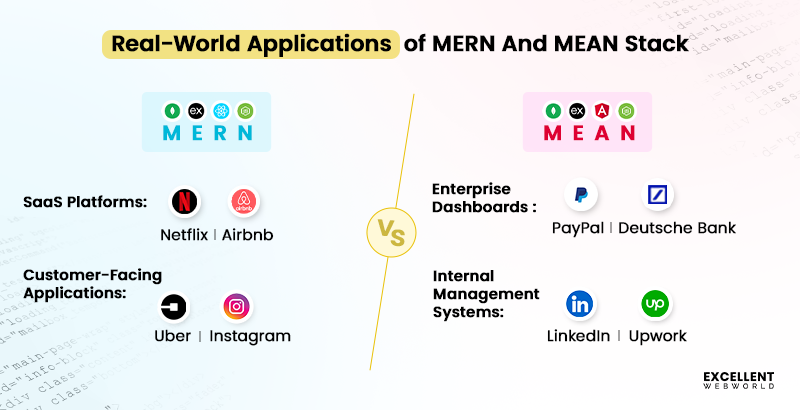
The MERN stack is widely adopted for externally facing digital applications for performance, best user experience, and rapid scalability to achieve business success.
1. SaaS Platforms
MERN stack is commonly implemented in SaaS application development that needs frequent feature updates, modular components for the user interface, and seamless scalability.
2. Customer-Facing Applications
For those applications where user engagement is the core reason for revenue, such as marketplaces, booking platforms, or digital services, MERN suits best. It enables fast, responsive, and real-time interactions that boost customer satisfaction.
MEAN Stack Use Cases
The MEAN stack is highly suitable for internally driven, heavy-process enterprise systems that need demand structure, stability, and long-term maintenance as their priority.
1. Enterprise Dashboards
MEAN tech stack is mostly used to build enterprise dashboards that manage large volumes of data into structured and role-oriented views.
2. Internal Management Systems
MEAN stack provides a controlled development environment for the ERP modules, HR systems, or any operational management platforms to ensure standardized workflows.
What Are the Future Trends of MERN & MEAN in Enterprise Development?
Here are the key tech trends of MERN and MEAN stacks for enterprise application development.
AI-Powered Web & Mobile Applications
Cloud-Native Architectures
Microservices Adoption
Final Thoughts: MERN vs MEAN
Selecting between MERN vs MEAN is not about which stack is great and better than the other, but which stack suits and fits more closely with your business needs, operations, and long-term goals. MERN is best for enterprises looking to build highly interactive customer-facing platforms that need speed, flexibility, and rapid iteration. On the other hand, MEAN stack is best for organizations that focus on structured architecture, governance, and stability for large-scale internal systems. So, based on your core priorities, you can choose the most suitable stack to achieve your goals without any trouble or money losses.
At Excellent Webworld, we help enterprises like you to make better decisions on these with clarity. Our mobile and web development services are designed to align tech stack choice with business outcomes, whether you need MERN to develop a scalable platform or you require MEAN for enterprise systems. With deep experience across modern JavaScript stacks and more, we partner with companies to make their dreams a reality by developing future-ready web & mobile apps.
Frequently Asked Questions
The core difference between MERN and MEAN stack is about the frontend framework, as MERN has React for the frontend framework, and MEAN has Angular for the frontend framework. With this UI flexibility, development method, and architectural control, the approach can vary based on the tech stack type you choose.
For SaaS products, MERN is generally opted for by enterprises, as it gives UI based on components, faster iteration cycles, and scalability. The MERN stack leads to the feature updates and gives user-focused experiences.
For security aspects, both MERN and MEAN can be equally safe when your development team implements them with proper security practices.
Yes, migration is possible, but MEAN project migration into MERN or vice versa needs careful planning, especially when changing the frontend part. Enterprises mostly migrate only to reduce risk and operational disturbance.
For small, single-page, or UI-focused applications, the MERN stack can be chosen for the faster options, as it has React’s efficient rendering. However, actual performance is based on various factors, including application design, core infrastructure, and optimization strategies.

Article By


Mahil Jasani began his career as a developer and progressed to become the COO of Excellent Webworld. He uses his technical experience to tackle any challenge that arises in any department, be it development, management, operations, or finance.