It’s so obvious that people want their essentials in 10 minutes, rather than waiting for 3 to 4 days. This marks the fundamental difference between Quick Commerce (Q-commerce) and traditional E-commerce. But as a business owner or investor, it must strike your head: Quick commerce vs eCommerce which model defines the future of retail?
Quick Commerce is maturing rapidly. It’s moving out of its VC-subsidized growth phase to a profitable model. The global quick commerce market is projected to reach a value of USD 283 billion by 2030 (source: PwC), while eCommerce continues to dominate globally at USD 6.8 trillion, heading toward USD 8 trillion by 2027 (source: Statista). These statistics definitely state that Quick commerce is growing tremendously, and the popularity of e-commerce development services has never faded.
To learn all the differences between quick commerce vs eCommerce, we will compare many factors, such as features, functionality, monetization, pros, cons, etc., of both models. This guide will help you understand how Q-commerce and E-commerce are different and still the same. Also, which model do people like the most and can give revenue benefits to you, as per your business idea? Let’s begin.
What is Quick Commerce (Q-commerce)?
Quick Commerce, or Q-commerce, is the new and faster form of on-demand delivery and e-commerce services. The core meaning of quick commerce is the capability to combine traditional eCommerce services with innovation to offer last-mile delivery, which leads to ultra-fast order fulfillment.
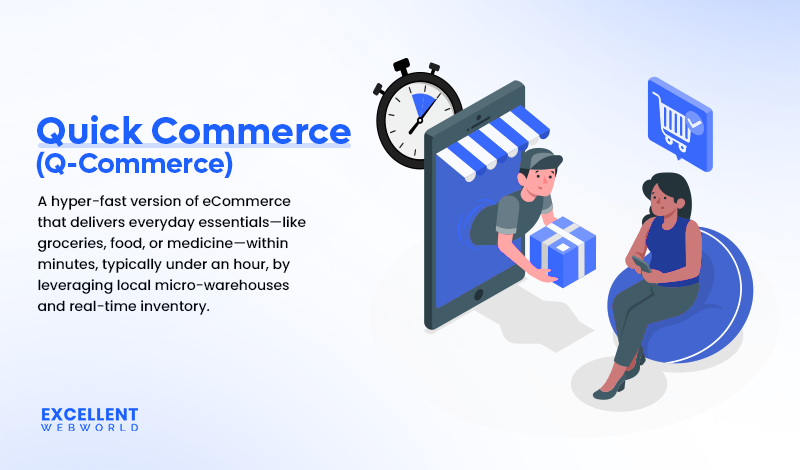
The concept behind the Quick commerce business is to build an on-demand delivery app that delivers items like groceries, perishable goods, cooked foods, etc., with the speed of a few minutes, not days.
How Quick Commerce Works (The 10-Minute Engine):
Step 1: The user places an order via a Q-commerce mobile app or website.
Step 2: Smart algorithms match the order with the nearest dark store or micro-warehouse.
Step 3: Warehouse staff identify the order, pick it, and pack it in real-time.
Step 4: The delivery partner is immediately assigned and dispatched.
Step 5: The order is delivered to the customer’s doorstep (mostly within 10–30 minutes)
To learn more about the quick commerce vs eCommerce differences, let’s move on to understand what eCommerce is and how this business works.
What is eCommerce?
E-commerce, or electronic commerce, is the process of buying and selling goods or services over the internet. It helps businesses and consumers to complete online transactions, including product browsing, ordering, payments, and delivery, mostly through websites or mobile applications.
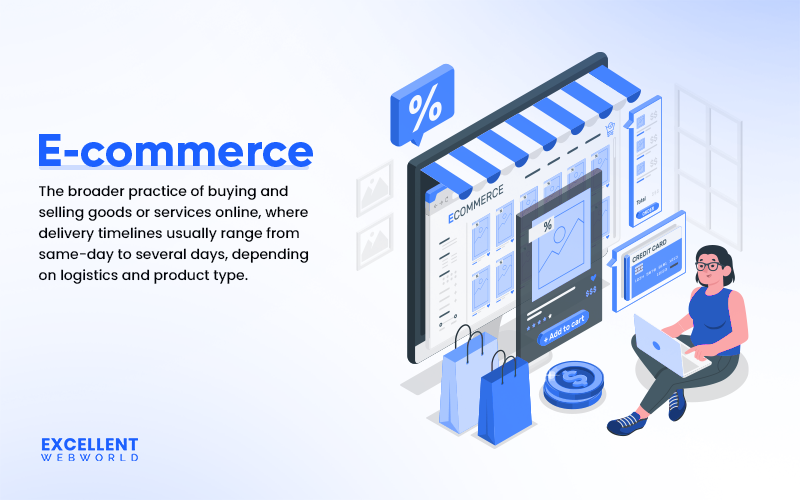
Many different types of market segments can operate this model over computers, smartphones, tablets, and other smart devices. Customers can get almost every imaginable thing and service via eCommerce transactions, like clothes, footwear, books, music, movie tickets, and even financial services such as online banking and stock investing. However, keeping up a shopping platform with eCommerce trends is crucial to stay ahead of the competition.
How eCommerce Works (The Centralized Model):
Step 1: The consumer browses products on an online store or marketplace.
Step 2: Add items to the cart or directly click on the buy now option and proceed to checkout.
Step 3: Make the online payment through secure online gateways.
Step 4: The Seller on the e-commerce platform receives the order and processes it.
Step 5: Products are packed and shipped via logistics partners.
Step 6: The Order is delivered to the customer within a few days.
Now, you have an idea regarding both Q-commerce and E-commerce business concepts and how they work. For clarity on actual differences, check the next section to understand by doing a head-to-head comparison.
Read Also: Magento vs. Woocommerce – Which is Best for Your E-commerce Store?
Head-to-Head Comparison: Q-Commerce vs E-Commerce [Quick Differentiation For You]
Here is the quick comparison table for you to understand the most common differences between the quick commerce and eCommerce business models. Let’s see how they actually differ from each other.
| Aspect | Quick Commerce | E-Commerce |
|---|---|---|
| Delivery Speed | 10–30 minutes; conceptually optimized for urgent needs. Speed is the core value proposition. | Takes 1–3 days as standard delivery time (same-day in selected cities, often with premium subscription or extra charges). |
| Product Range | 1,000–5,000 SKUs; essentials, groceries, OTC medicines. | 100,000+ SKUs; electronics, fashion, books, all categories. |
| Order Size | Small, frequent (on average, USD 12/order). | Larger, less frequent (on average, USD 50/order). |
| Consumer Expectations | Urgent needs and instant availability. | Multiple options, different varieties, affordability, and detailed product info. |
| Inventory Model | Hyperlocal fulfillment, dark stores, and micro-warehousing. | Centralized warehouses, regional distribution hubs, large warehouses, IoT-based livestock management, and global supplier networks. |
| Customer Experience | Real-time tracking, instant gratification, and minimal options. | Reviews, broad selection, detailed product info, and route tracking. |
| Advanced Technology Usage | AI agent development for Quick commerce enables instant delivery tracking and route optimization. | AI integration in software enables advanced search with filters, recommendation engines by tracking user behavior, and multi-warehouse logistics for the eCommerce sector. |
| Tech Stack for Full-Stack Solution | Tech stacks such as Flutter, React Native, Kotlin (Android), Swift (iOS), Node.js, Django (Python), Laravel (PHP), TensorFlow, Amazon Personalize, etc., are used for full-stack Quick commerce development. | Tech stacks such as React.js, Next.js, Angular, Vue.js, Node.js, Django, Magento, Shopify (headless), WooCommerce, Saleor, etc., are used for full-stack eCommerce development. |
| Market Focus | Urban-centric, target metro cities. | Available for urban as well as rural areas globally. |
| Business Model | Hyperlocal delivery, limited territory, and instant gratification. | Nationwide or global presence and operational scalability. |
| Profitability | High delivery cost per order with lower margins and premium pricing. | Lower cost/order, higher margins, and scalable. |
| Return Policy | Instant refunds, handled by courier. | Standard 7–30 day window and centralized returns. |
| Platform Examples | Gopuff, DoorDash, Instacart, Uber Eats, Amazon Fresh, and Shipt. | Amazon, eBay, Walmart, Etsy, Target, Home Depot, and Best Buy. |
While delivery speed and customer experience differ, both models rely heavily on backend efficiency—making it useful to explore the best ecommerce order management software that supports real-time inventory, order routing, and multi-channel fulfillment.
Quick Commerce vs eCommerce: Which Model is Best For Your Business Success?
Each model serves different business goals and has its advantages and disadvantages, depending on product type, customer behavior, and operational capacity. Let’s break it down with the most crucial factors:
Delivery Speed
Generally, fast delivery defines customer satisfaction. While eCommerce provides flexibility, it takes around 3+ days to deliver. On the other hand, Quick Commerce works on urgency and near-instant fulfillment through localized infrastructure. Here’s how both models handle the delivery speed:
| Factor | Quick Commerce | E-Commerce |
| Delivery Time | 10–30 minutes | 1–7 days |
| Fulfillment Base | Local dark stores or micro-warehouses | Centralized warehouses or seller locations |
| Customer Expectation | Immediate delivery | Scheduled or standard delivery |
Product Type & Use Case
Q-Commerce is customized for fast-moving, everyday products, while eCommerce service excels in serving a wide product range, including all categories suitable for planned or one-time purchases.
| Factor | Quick Commerce | E-Commerce |
| Best for | Daily essentials, groceries, and medicine | Apparel, electronics, furniture, books |
| Purchase Frequency | High-frequency, repeated orders | Medium to low, planned purchases |
| Catalog Size | Limited and curated | Massive, mostly marketplace-style |
Operational Cost
The cost structure of Quick commerce is high because of the logistics and real-time demands. Instead, eCommerce businesses benefit from bulk logistics and centralized fulfillment. In fact, the Quick commerce and e-commerce app development cost varies due to different features and functionality.
This is where the benefits of AI in eCommerce become crucial, as AI-powered solutions can optimize logistics and enhance the customer experience, directly impacting the overall cost structure. Let’s see the cost factors of both:
| Factor | Quick Commerce | E-Commerce |
| Warehousing Costs | High—micro-warehouses, mostly in urban areas | Moderate—central hubs reduce rent |
| Delivery Costs | High—instant, one-to-one delivery | Low—batch deliveries and AI-based route optimization |
| Tech Investment | High—for speed & live delivery tracking | Moderate—for catalogs and user journey |
Scalability & Reach
The Q-Commerce business model is location-bound and grows slowly because it needs infrastructure setup between short distances, while eCommerce can scale rapidly with tech and third-party logistics partners.
| Factor | Quick Commerce | E-Commerce |
| Ideal for | Highly populated urban areas or cities | Urban, suburban, and rural localities |
| Expansion Speed | Slower because it requires physical presence | Faster with tech-based onboarding |
| Inventory Model | Distributed across multiple local hubs | Centralized or dropshipped from sellers |
Customer Expectations
Quick commerce users prefer speed and immediacy, while eCommerce consumers expect variety, a wide range of product options, the best deals, and reliable tracking. Let’s compare the expectation factors from customers on both models:
| Factor | Quick Commerce | E-Commerce |
| Buying Intent | Urgent need (e.g., missing groceries) | Intent-driven, price, or feature comparison |
| Experience Priority | Delivery speed, product availability, and convenience | Choice, pricing, and trust |
| Brand Loyalty | Low because customers can easily switch to another for speed | Higher based on the quality and consistent service they get |
Business Model & Profitability
Quick commerce operates on lower margins and high volume, but the marketplace business model of eCommerce sector provides broader monetization strategy options, including subscription, upselling, marketplace commissions, and more.
| Factor | Quick Commerce | E-Commerce |
| Revenue Model | Per-order margin and delivery fees | Product sales, ads, subscriptions |
| Profit Margins | Not much—due to logistics and operations | Higher, especially in niche or DTC brands |
| Monetization Options | Limited—relies on volume | Diverse – marketplaces, private labels |
Quick Commerce vs. E-Commerce: Which Model Fits Which Business? [Top Use Cases]
Choosing between Quick commerce vs eCommerce is not a one-moment thing; there are many factors that matter to the choice you make. Your product type, target market, delivery needs, etc., are essential to make your business move. Here are the top business use cases suited for each model. If you don’t find your relevant scenario, then you can connect with a commerce expert to embrace IT business consulting services and move forward with the right decisions.
| Business Use Case | Quick Commerce Suitability | eCommerce Suitability |
|---|---|---|
| Urban Grocery Delivery | Excellent fit: People want groceries in urgent need. Ultra-fast delivery of fresh produce & essentials within 10-30 minutes makes Quick commerce an ideal Choice. | Moderate fit: The Product range is vast, but delivery time is slower (1-3 days). Better for planned bulk grocery shopping. |
| Daily Essentials & Household Items | Highly suitable: Quick commerce enables fast replenishment of toiletries, snacks, medicines, and convenience items. | Suitable: Not all the time are daily essentials needed on an urgent basis; people prefer bulk shopping. eCommerce gives a wide assortment of products, but doesn’t deliver in minutes. |
| Electronics & High-Value Goods | Limited fit: Typically not stocked in Q-commerce due to inventory and delivery constraints. | Excellent fit: Extensive catalogs, detailed product info, multiple offers, and secure shipping. |
| Fashion & Apparel | Low to moderate fit: Limited SKUs and sizes; Quick commerce may offer fast delivery for basics or accessories, but can’t prioritize stocking fashion products over daily essentials. | High fit: Fashion app development offers a wide product variety, detailed descriptions, and return or exchange options. |
| Impulse Buying & Last-Minute Needs | Perfect fit: This one is for spontaneous purchases like snacks, beverages, or forgotten ingredients. | Limited fit: Due to longer delivery times, the effectiveness of impulse purchases is limited. |
| Subscription & Bulk Orders | Not ideal: Q-commerce focuses on small, frequent orders rather than bulk or scheduled deliveries. | Ideal: Supports subscriptions, bulk buying, and scheduled deliveries, which increase its profit margins more than Quick commerce. |
| Rural or Suburban Markets | Limited fit: Q-commerce has a dependency on dense urban micro-fulfillment centers; it is less viable in low-density areas. | Strong fit: eCommerce’s vast logistics network covers broader geographies and is able to fulfill international order requirements. |
| New Product Launch & Brand Positioning | Good fit: Q-commerce enables rapid market testing and instant availability in urban hotspots. | Good fit: eCommerce provides a broad reach and detailed product showcasing. |
| Sustainability-Focused Businesses | Strong fit: Localized inventory reduces emissions; instant bike deliveries lower the carbon footprint. | Moderate fit: Centralized warehousing for an eCommerce business can increase transportation emissions. |
| Businesses Prioritizing Profit Margins | Challenging fit: High delivery costs and low margins require scale or premium pricing. | Better fit: Economies of scale and higher average order values improve profitability. Also, ads and subscription options can raise revenue. |
Impact of Quick Commerce on Traditional eCommerce
Quick commerce is actually transforming the E-commerce industry by raising customer expectations and accelerating delivery demands. It also pushes businesses to adopt faster logistics, smarter tech, and localized fulfillment strategies to stay competitive in the market.
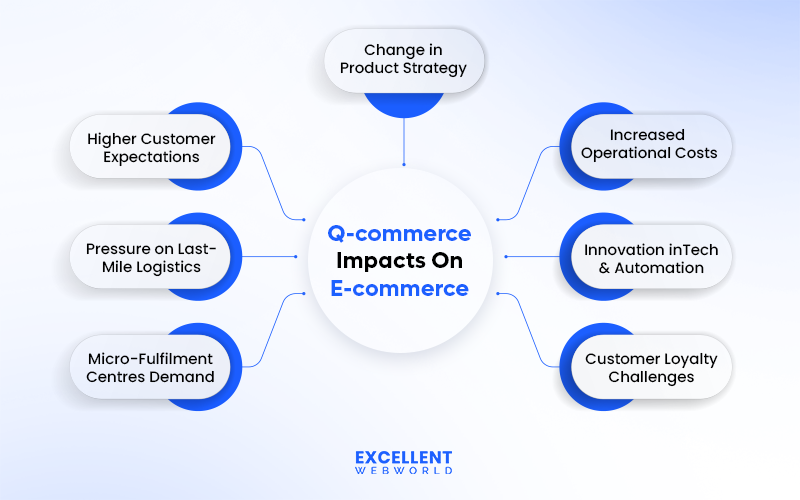
Hire dedicated developers from an experienced firm like Excellent Webworld to craft both Q-commerce and eCommerce platforms that don’t get left behind by any new trend or market challenges. Let’s see the key factors of Quick commerce that make trouble for E-commerce businesses:
Final Words: Which Model Wins For Future Scalability?
Overall, when we consider which model fits best for future scalability, both Quick Commerce and traditional E-Commerce have unique strengths. Q-Commerce thrives with its high delivery speed in urban markets, while eCommerce provides broader geographical reach, vast product diversity, and stronger margins over time. The right model choice depends on your business goals, target audience, and operational capacity.
However, one thing is very clear: customer behavior is changing, evolving, and demanding convenience very fast. That’s why businesses must be agile, tech-driven, and customer-centric to scale effectively in the upcoming years.
If you’re planning to build or scale your e-commerce or Q-commerce platform, Excellent Webworld can be your ideal technology partner. Additionally, if you already have your Quick commerce app and are looking to integrate eCommerce services, or you run an E-commerce platform and want to upgrade it with Q-commerce functionality, then we are your one-stop solution to integrate vice versa commerce services.
As a top-notch AI-driven app development company with years of experience and deep expertise in building high-performance commerce apps, real-time delivery systems, and scalable backend architecture, our professionals help startups and enterprises launch faster, smarter, and future-ready platforms. Let’s build a thriving commerce business together. Book your free consultation with us today.
FAQs: Quick Commerce vs eCommerce
The Quick Commerce model offers a clear, quick path to profitability. Positive unit economics is now the driving force, rather than pure expansion. Promoting high-margin private-label products and expanding high-margin non-product revenue streams, such as retail media (in-app advertising), are important tactics used by major international firms.
Traditional e-commerce (T-commerce) is based on large, centralized warehouses and national and international transport networks. They place a higher priority on a wide product selection and economies of scale (delivery time: 1–7 days). Q-commerce leverages a dense network of dark storefronts, or micro-warehouses, to enable speed and spur-on purchases. Hyperlocal fulfillment is made possible by this (delivery time: 10–30 minutes).
Q-commerce is quickly gaining ground in high-value, low-footprint industries. These industries include small electronics and gadgets (such as cables and headphones), cosmetics, pet supplies, and even fast-fashion accessories. These are intended to raise margins significantly and the Average Order Value (AOV). On the other hand, these industries are already heavily managed by T-commerce.
Zoning and municipal laws pose particular challenges for Q-commerce. Due to the need for quick delivery, they have difficulty getting permits for dark businesses in residential areas. They are closely examined by labor regulations regarding gig workers’ benefits, safety, and categorization.
It refers to the three primary streams of revenues, which are needed to ensure long-term sustainability: 1. Product Sales (optimal for margin/turnover), 2. In-App Advertising (Retail Media), and 3. Private Label Brands. By diversifying revenue streams, the model becomes less dependent on delivery fees or thin product margins.
No, they are converging and coexisting. While T-commerce promotes planned/scheduled shopping (low frequency, extensive selection, large basket), quick commerce caters to the instant/impulse need (high frequency, small basket). To meet all customer demands, big retailers will adopt a hybrid omnichannel model in the future.
With a huge, potentially infinite SKU count (millions of products) appropriate for major electronics, furniture, and specialist items, T-commerce thrives. Q-commerce keeps a small, carefully chosen range (usually 1,000-5,000 SKUs) dedicated to high-demand, rapidly moving necessities that support the rapid fulfillment model.
Because traditional e-commerce relies on well-established third-party logistics (3PL) providers and sizable central distribution hubs, it is inherently more scalable for national and international reach. The expansion of Q-commerce is slower and location-specific, necessitating the expensive and time-consuming physical establishment of a dense network of dark storefronts in each new local trade region.
Long-haul shipping and bulky packaging are problems for T-commerce. The high frequency of small, single-item deliveries puts pressure on Q-commerce and can raise the carbon footprint of last-mile deliveries. To solve this, both models are optimizing delivery batching and incorporating Electric Vehicles (EVs) into their last-mile fleets.

Article By


Mahil Jasani began his career as a developer and progressed to become the COO of Excellent Webworld. He uses his technical experience to tackle any challenge that arises in any department, be it development, management, operations, or finance.