If you want to understand how to create a travel app, the first step is seeing how people interact with the apps they already trust.
Businesses like yours planning to build or develop a new travel product must study the small decisions users make while searching for stays, checking flight prices, or comparing routes. These moments show what convinces someone to continue or abandon a booking.
- Airbnb guides users to the right stay with minimal effort.
- Booking.com supports quick changes during planning.
- Hopper gives timely booking cues.
- Skyscanner keeps comparisons clear and simple.
These experiences have shaped what travelers now expect from any new app. The scale of this shift is clear when looking at industry numbers. The online travel market size worldwide reached 654 billion USD according to Statista.
This scale signals strong interest in digital trip planning. For anyone preparing to create a travel app, the opportunity is steady and well supported by user demand.
On this note, before developing a travel app, let us check out some ongoing and upcoming travel trends among people.
Trends to Know Before You Learn How to Build a Travel App
Recent industry movement points to growing interest in mobile-based travel planning. Many travelers now choose apps that provide quick confirmations and dependable trip updates.
- Recent reports by Market.us show that the market of travel applications reached around USD 544.1 billion in 2023 and is now expected to reach around USD 1,445.1 billion by 2032.
- The reports of Statista reveal that close to seven out of ten travelers now prefer to book travel through online channels. This signals the growing reliance on travel apps for planning trips.
- In North America, the transportation category dominated the app market in 2022, as highlighted in the reports of Market.us. It takes more than 40% of total revenue with rising bookings across flights, buses, and trains.
- Also, reports from Business of Apps show that the number of users for travel apps has crossed around 850 million in 2023. This indicates a stronger preference for travel planning via mobile and rapid information update as well.
With the technology shift, travelers expect their planning experience to change. Travelers now prefer suggestions that mirror their travel style and interests. Transparent pricing and availability checks support travelers with instant comparisons that build confidence in their choice.
Such a shift clarifies why businesses are working toward refined travel app experiences. The next step is to look at the main travel app categories and how each category matches a particular user need.
How to Create a Travel App From Scratch?
What gives you better control over timelines, budgets, and feature planning for your travel app? It’s knowing how the mobile app development process works. At long last, let us begin with learning the steps of building a travel app.
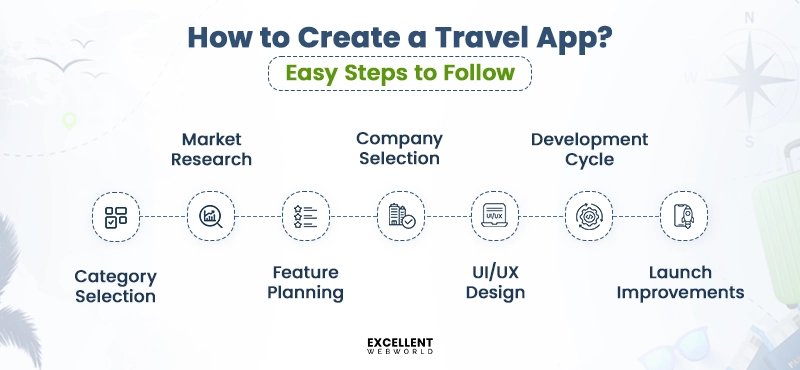
Step 1. Define Your Travel App Category
You can choose to build various types of applications. This first step requires you to make a wise decision. Everything further in your business will depend on the category of travel app you select to build.
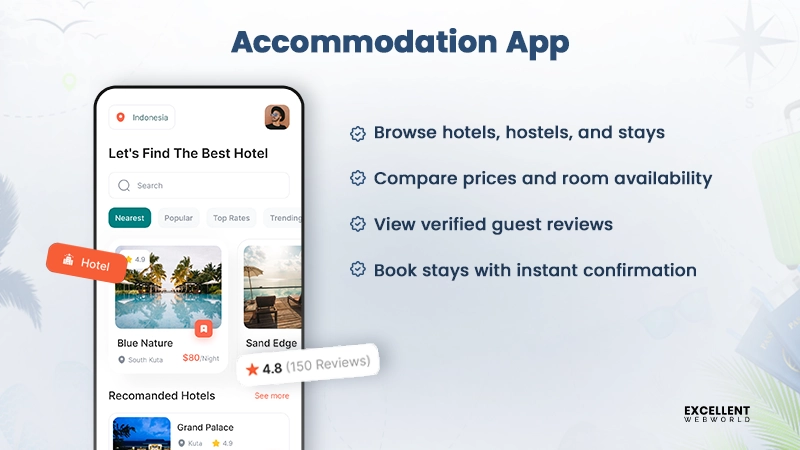
1. Accommodation Apps
Users can check out room prices, reviews, and comments by previous guests. This is basically a hotel booking application. People, as per their budget, choose 2,3,4,5-star hotels, hostels, and zostels for their stay.
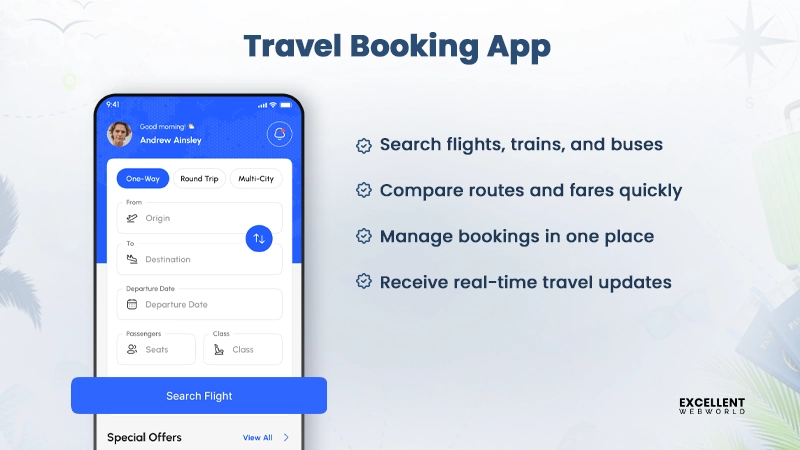
2. Travel Booking Apps
This includes flight booking apps, seat choosing apps, online boarding pass apps, etc. You can add as many transport services as you want to your app. Remember, the more travel options you provide to the users, the more preference variants of users you will meet.
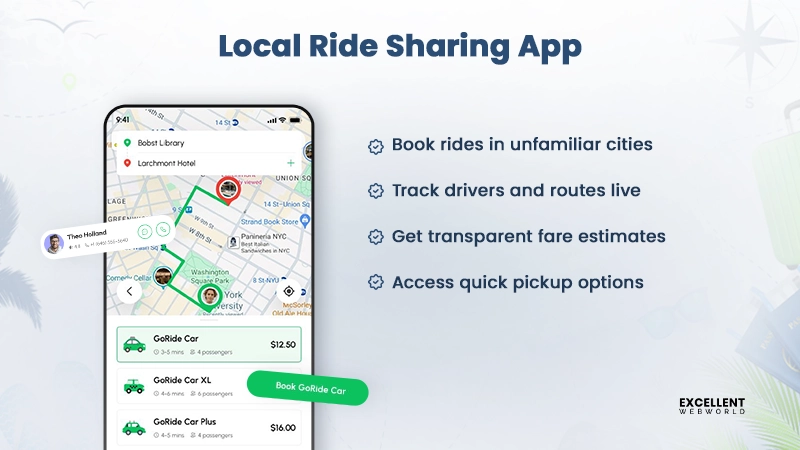
3. Local Ride Sharing Apps
Not everyone owns a vehicle. Perhaps, when talking about strange cities, travelers would prefer to book a ride. Hence, the ride-hailing and ride-sharing apps would be of much help in such scenarios.
4. Travel Guide Apps
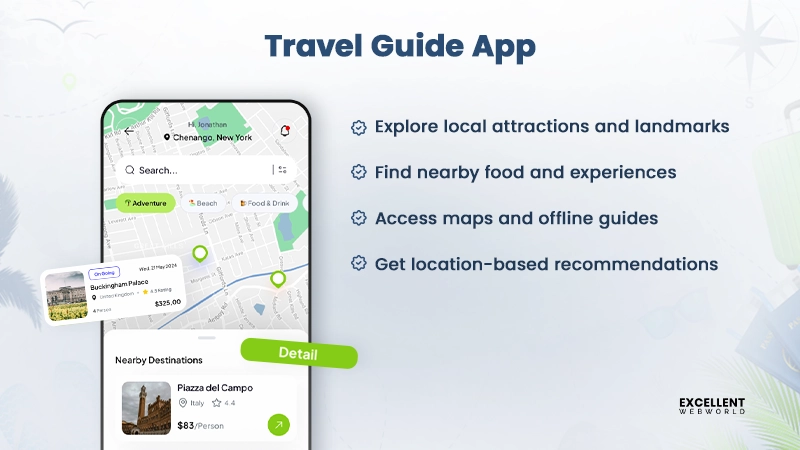
Those days are gone when travelers hired tour guides to discover new sunset points, waterfalls, hidden lakes, eateries, etc. Digital tour guides, i.e., Travel guide apps, are the best companions for travelers today. Such an app needs a huge information database, which should also be regularly updated after it has been launched in the market for relevance.
5. Itinerary Planner Apps
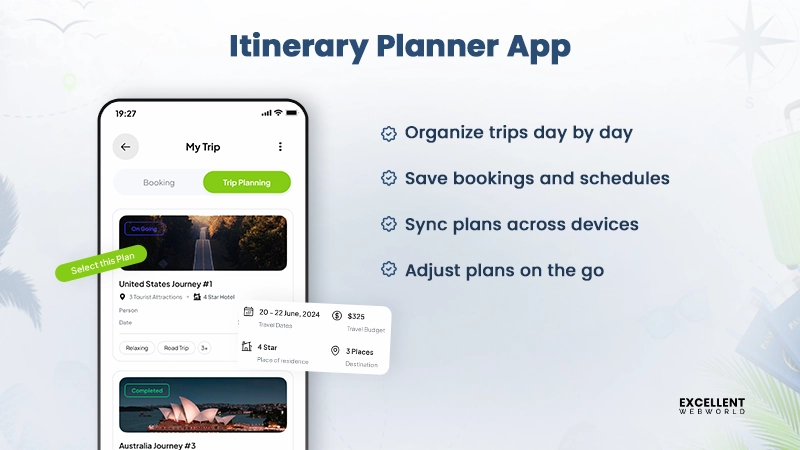
Trip planner apps help users create structured day-wise plans for their trips. These mobile apps include various functionalities like route suggestions, timing estimates, and activity planning to simplify decision-making.
6. Budget and Expense Tracking Apps
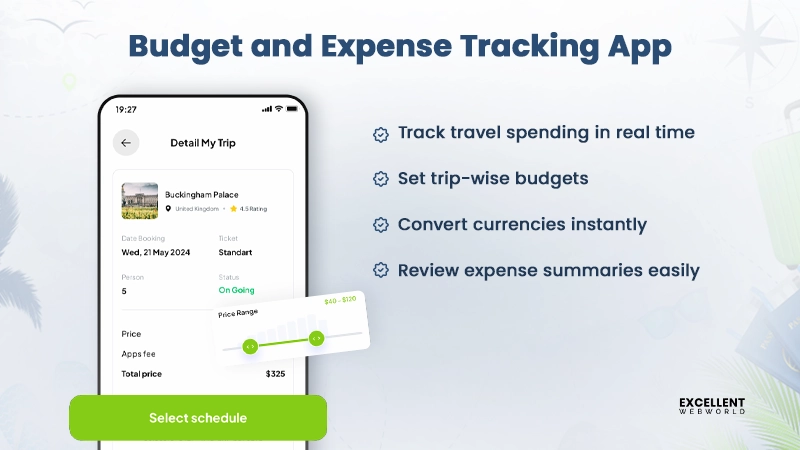
These apps help travelers organize costs during the trip. They are useful for people who want clarity on spending and cost distribution.
 There are many other travel app ideas, like location tracking apps or community-based travel apps, that we haven’t mentioned in the above list. You must consider these options as well. If you are looking for specific solutions, such as bus ticket booking app development or tourism app development, our team can help you build a platform tailored to your requirements.
Step 2. Conduct Market and Competitor Research
You should not tread further in the industry without knowing what your competitors are capable of. Here is what you can do.
- You first need to identify direct and indirect competitors that provide booking and accommodation facilities, in some cases, local ride services.
- Check each competitor’s functionalities. Also, track their positive and negative comments by users in the feedback.
- Analyze the complete flow of the user from onboarding to payment. This helps you understand what works well and what does not.
- Evaluate the pricing structure. Check the refund approach. Analyze the support quality to see how to handle customers.
- Review how the competitors promote on app stores and social platforms to understand the user acquisition strategy.
You should always know what you are competing against. By discovering the market rivals’ strengths and weaknesses, you can target the audience accordingly.
Step 3. Plan the Feature Scope of Your Travel App
What makes or breaks the momentum of an app in the market?
Its features!!!
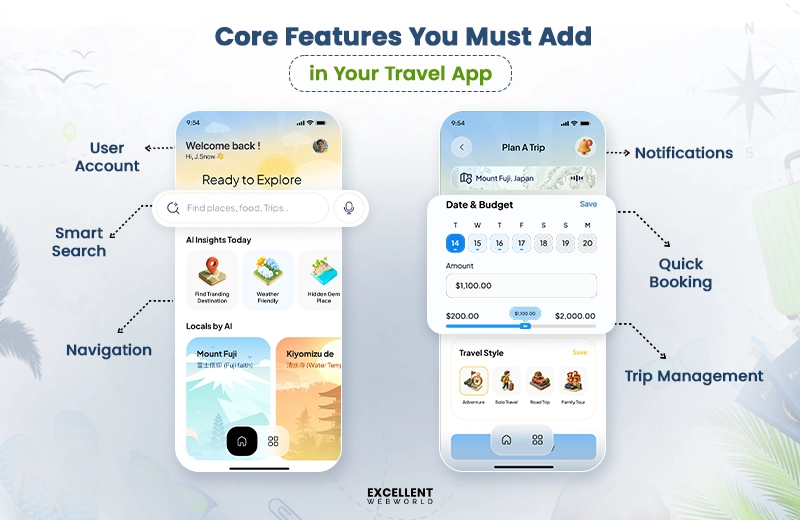 We would suggest you jot down the list of features that you find attractive about travel applications. Once done, sort your list out. Pick the most interesting features that make your app helpful. Equip your app with those functionalities. Here is a list to give you a wider approach.
| Feature Category | Core Features for Minimum Viable Product (MVP) | Advanced Features for Later Versions |
|---|---|---|
| Search & Discovery |
|
|
| Booking & Management |
|
|
| User Account |
|
|
| Payments |
|
|
| Support & Help |
|
|
| Navigation Tools |
|
|
| Reviews & Content |
|
|
| Notifications |
|
|
| Safety & Verification |
|
|
| Local Discovery |
|
|
| Social Interaction |
|
|
| Trip Management |
|
|
| Deals and Offers |
|
|
| Language and Accessibility |
|
|
| Integration Features |
|
|
| Admin Controls |
|
|
ENTREPRENEURSHIP TIP! 💡
The travel application you launch does not necessarily need to have A to Z all the features. It can have the most basic features for the first launch, and you may keep adding new features with further updated versions. To launch the first and mini version of your travel app, you can opt for MVP app development and then further act upon the feedback of users.
Step 4. Choose a Travel App Development Company
A clear and focused approach here removes risks and helps your travel app project progress in the right direction. Here is what you need to check before finalizing a company.
- Review past travel projects: Check completed apps that match booking or trip planning use cases.
- Evaluate design skills: Look at UX samples to understand how the company builds user journeys.
- Confirm platform direction: Discuss whether the app should begin on Android, iOS, or both.
- Assess technical capability: Check the company’s skill in handling maps, calendars, listings, and payments.
- Request a post-launch plan: Ask for details on updates, fixes, and improvement cycles.
If you opt for an experienced travel app development company, you give your app a confident start and reduce avoidable hurdles during development phases.
Choose the company carefully because you will be entrusting responsibilities of some of the core aspects of your app, like API development and integration, hotel listing, filters, calendar integration, payment gateways, etc.
Step 5. UI UX Design for Your Travel App
What appeals to the eye appeals to the heart. Isn’t it true?
Every travel experience is a once-in-a-lifetime experience. Hence, the travel app’s design has to be great. Right from the booking experience to returning from a trip, the app’s design has to be top-notch and amazing.
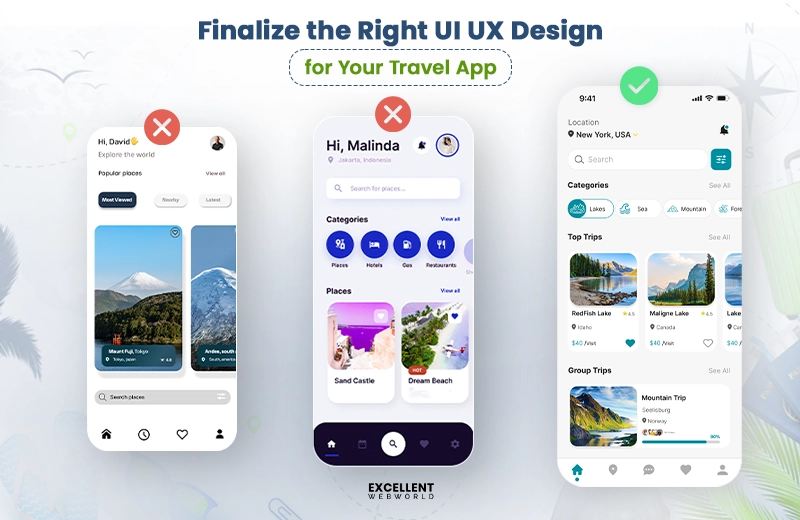 Design shapes the way users move through each step of planning and booking, which is the same core practice followed across mobile app design services. So here is what you need to avoid in this stage:
❌ Overload screens with too many visuals or elements that fight for attention
❌ Skip early user flow mapping, which leads to confusing navigation later
❌ Ignore loading states or tap responses that reassure users during wait times
❌ Use inconsistent spacing or color choices that break the visual rhythm
❌ Add animations that feel slow or interrupt the booking journey
And, here is what exactly you need to focus on in travel app designing, the green flags that shape a smooth booking journey:
✅ Create screen layouts that support the primary booking action
✅ Build a predictable flow from search to final confirmation
✅ Use a clear visual hierarchy so users can identify important details
✅ Ensure buttons, filters, and cards are placed for quick and repeat actions
✅ Test layouts on multiple screen sizes to maintain a smooth journey for all users
The interface has to guide actions without effort and present key information with clarity. A balanced design approach helps your travel app create comfort for first-time users and confidence for regular travelers.
Step 6. Develop & Test the Travel App with the Right Tech Stack
A specialized task force is assigned during the army’s special or very important missions. Similarly, app development is no child’s game. You have to be extremely vigilant about which app development company team you work with.
Let’s check out what you need to carry out with the development of your travel application.
1. Structure the codebase for smooth scalability
The team sets up a clean project structure that allows future upgrades without breaking existing features.
2. Build core travel workflows step by step
2. Build core travel workflows step by step Search, filters, bookings, cancellations, and payment actions are developed in a fixed sequence to maintain clarity.
3. Introduce maps and geolocation with stable logic
Location-based actions are added with precise routing and marker controls to support nearby hotels or rides.
4. Add third-party integrations with controlled testing
APIs for hotel listings, flights, reviews, and availability data are connected in phases to avoid integration conflicts.
5. Prepare the admin panel for operational control
The admin system is set up to manage listings, update offers, view analytics, and maintain daily activities.
The development stage is where the planned features turn into functional ones that users rely on for booking and trip planning. The important part is to test after the entire development. Let’s discuss what type of testing needs to be carried out and what needs to be taken care of.
- Functional Testing: Checks each user action, like search, booking flows, profile updates, and saved trips, to ensure everything behaves as expected.
- Performance Testing: Evaluates how the app handles peak usage during holiday seasons or flash sales.
- Device Testing: Validates the interface on different screen sizes and confirms consistency on various devices.
- Network Testing: Observes app behavior during low connectivity moments that users often face while travelling.
- Security Testing: Verifies the safety of payment steps, login sessions, and API communication.
Following a well-organized and systematic development cycle with routine testing provides your travel app stability. Such stability sets the base for future upgrades without complications.
Step 7. Launch and Post-Launch Improvements
Many people think launch is the last step, but it’s not. It marks the first public entry of your travel app. For example, you can release your app in one particular city to observe how travellers respond to search results and booking tasks. Early reactions make it easy for you to know which actions work well and which require modifications.
To ensure a smooth rollout, you should follow key points to consider while launching an app. This part of the travel app development process can be guided by raising simple checks within the ongoing flow. Check out:
- Are real users finding the key actions without confusion?
- Are support queries pointing to patterns that highlight what to adjust next?
As these observations turn into updates, your app grows with steady improvement paths. With each release, the app reflects real behaviour more accurately and grows via consistent feedback.
Now, you get your answer to “how to build a travel mobile application”, so let’s have a quick look at why prioritizing features is a must.
Must-Have Features & Functionalities for Your Travel App
A travel app must bring people, passion & places together!
So, on which basis would you prioritize features when developing a travel app? Well, it is all about what the users would want. On this basis, you can decide the features of the application. Since all users have different choices, every set of users would find a different feature interesting.
This section will help you understand which features ought to be included, should be included, and can be included in your dream travel application.
Some features ought to be a part of the app. These inevitable features include:
1. Basic Block: Sign Up, User Profiles, Push Notifications, Payment Gateway ⚙️- In no case should these features be excluded from the application. The travel mobile app development company you hire must be great at integrating various types of API for the user logging in and payment gateway smooth activities.
Keep in Mind 💡
The sign-up procedure should not be very lengthy. Also, it should not be a compulsion because lengthy sign-up processes can be a core reason users bounce off. You can enable social media profile login for users to make it even easier for them to log in.
2. Booking Block: Transport, Hotel, Travel, Tour, Car Rental Booking 🚉✈️ – Users enter their travel date and stay to book the flights, trains, hotels, etc. Here, the filters make it easy for the users to finalize their bookings. Like, filters in prices, amenities, timings, filters, and photos.
3. Travel Planning Block: Document Holder, Itinerary Management, Real-Time Alerts 🗄⚠️ – Here’s a situation, visualize it while you read — Jumbling among various applications to fetch the documents you need can be very messy when you are standing at the gate to board your flight, and there is a long queue waiting behind you.
4. Extra Highlights Block: Tips, Guides, Weather Forecasts, Currency Calculators ☁️🆕 – Apart from the features mentioned above, you can equip your app with the functionalities like tips for traveling, compact packing guides, in-app currency converters for overseas travelers, weather forecasts for destinations, etc.
What Are the Best Ways to Monetize a Travel App?
 Your frontline motto of launching a travel app might be to help the users book their travel and stay easily. However, you are surely looking forward to earning thousands and gradually reaching millions on the rear side.
Therefore, to meet your revenue goals, read out this section to understand the ways to make more money with your travel app venture.
Collect Commission
Since you list the hotels on your application and users book whatever fits their budget, you help both parties. You are the mediator through which hotels get booked; hence you can charge a percentage of the booking amount as your commission. This technique is similar to the Agency Business Model.
In-App Advertisements
Running ads on your flight booking app is a good way to earn extra bucks. However, there are downsides to this. Many users find these ads very annoying. So, how will you battle this?
Well, if the ads being displayed are related to the app’s nature, the user is better likely to click on them.
For instance, you can show the airport shuttle or taxi booking ads on a flight booking app.
Merchant Concept of Earning
The merchant business model-inspired method of booking the hotel rooms in bulk will help you avail a bulk-booking discount. Post this; you can add your margin and sell the rooms to guests to earn profits.
As an app owner, you can allow merchants to book your services bulk. Or, as a merchant thyself, you may do the same to get an edge on your profits.
Offer Premium In-App Purchases
Premium services are a luxury. And some extravagant set of customers enjoy luxuries. To meet their high standards, the travel mobile app can provide multiple high-end luxurious services to premium subscription users. You can keenly follow this advertising business model.
For example – this may imply a translator feature in an app for traveling to enable smooth check-in in a different-lingo (language) country.
Another crucial monetization policy is to create a super app for travellers and hotels. You can use super app development to bundle different travel apps into a single application that allows users to access multiple services, such as local ride-sharing, guided tours, and more.
If you consider building such travel apps, you might have questions that “How much does it cost to create an app” or ”How much does it cost to design a mobile app”. So let’s address your questions.
How Much Does It Cost to Develop a Travel App?
The cost of building a travel app starts from USD 25,000 for a basic version, which still depends on various factors. The cost can exceed USD 150,000 for a full-scale product with bookings, maps, listings, and payment features.
No doubt, the travel app development cost depends on various factors, but here is a breakdown of the cost if you are looking for particular services with travel mobile app development.
| Cost Component | Description | Estimated Range (USD) |
|---|---|---|
| Design | Screens, user flow, and visual style | 4,000 – 20,000 |
| Development | Core features and backend work | 15,000 – 90,000 |
| Testing | Functional checks and bug fixes | 5,000 – 25,000 |
| Project Management | Coordination across the full cycle | 3,000 – 15,000 |
| Post Launch Support | Updates and issue handling | 3,000 – 12,000 |
Now, let’s have a look at each of the factors that influence the cost of travel application development.
- Feature complexity: Defines the number of screens, interactions, and development hours required.
- Platform choice: Sets the timeline based on whether the app is built for Android, iOS, or both.
- App category: Influences the base cost since booking, planning, or metasearch apps need different features.
- Design depth: Impacts the price when custom visuals, polished flows, or advanced UI patterns are needed.
- Backend structure: Affects the estimate depending on server load, data storage, and search logic.
- Third-party integrations: Raise the budget based on the number of APIs, like maps, hotels, flights, and payments.
- Testing needs: Expands the cost when functional, compatibility, and performance tests are added.
- Team expertise: Shapes the overall cost since pricing varies by region, team experience, and skill level.
- Team structure: The organization of roles and responsibilities within the app development team structure impacts efficiency and cost.
Take the Next Step Toward Building Your Travel App
Hiring Excellent Webworld as your custom mobile app development company can get you many benefits. First being first, experience matters a lot. Our team has experience working in the travel industry for over a decade and is well-versed with all the trends. Here is what you get with our travel app development services.
- 200+ proficient app developers
- 13+ years of industry experience
- Top 3% of global software developers
- Cost-effective hiring models
- Time zone-aligned teams
- 100% transparency in communication
Lastly, if this blog on how to create a travel app helped you in any way, then placing an enquiry for a FREE consultation call is worth it!

FAQs On How to Create a Travel App?
The best travel apps help users search for destinations, book travel, compare their stay options, and make bookings. Additionally, these apps also help travelers with currency conversion, weather forecast details, and tour guides.
There are a couple of reasons to build a travel application – keeping up with the digitized era, earning maximum profits since users use mobile to make bookings, and lastly leverage the boom in travel industry.
Choose the right travel app to make every trip enjoyable. Here are the most popular travel mobile apps.
- Airbnb: Short stay rentals and unique accommodations with instant booking.
- Booking.com: Hotels, flights, and packages with flexible cancellations.
- Skyscanner: Compares flights and fares with price alerts.
- Hopper: Predicts flight and hotel prices for optimal booking.
- TripAdvisor: Reviews and recommendations for hotels, restaurants, and attractions.
Both a tourism app & a travel app overlap in purpose, but each serves a distinct function. Tourism apps provide travelers with detailed information about local attractions, services, and city highlights. In simple terms, tourism apps assist travelers on-site. Travel apps support tourism apps throughout the journey.
The time it takes to build a travel app is around 3 to 8 months, depending on various factors.
- Complexity of the features
- Platform choice (Android, iOS, both)
- Design depth and screen count
- Third-party API integrations
- Backend structure and data volume
- Team size and workflow speed

Article By


Mahil Jasani began his career as a developer and progressed to become the COO of Excellent Webworld. He uses his technical experience to tackle any challenge that arises in any department, be it development, management, operations, or finance.