Cross-platform app development has become a popular approach to building a mobile app. Flutter and React Native are the most preferred and leading tools for creating a cross-platform solution. Both have their own features, unique ecosystems, and advantages for various use cases.
As a leading React Native and Flutter app development company, we have created a guide that helps you understand the practical differences between Flutter vs. React Native. So, you can clearly choose which one is best for the specific needs of your business in 2026.
Flutter vs. React Native: A Side-by-Side Comparison
Flutter and React Native are the two most dominant and preferred frameworks for cross-platform mobile app development in 2026. Both have major architectural overhauls and a narrowed performance gap. Now, the decision is dependent on team expertise, project scope, and long-term platform ambitions rather than raw speed.
We know that developing and maintaining apps for both iOS and Android used to be a daunting task. Separate codebases, separate teams, expensive development cycles. What a mess!
Cross-platform development changed that completely, and Flutter and React Native are still leading the charge. But if you are making this decision in 2026, you definitely look at current data, not just three-year-old benchmarks. Continue reading the next section to differentiate better between React Native vs. Flutter.
When Does Cross-Platform App Development with Flutter and React Native Begin?
Not only developers but businesses and startups, too, were testing the water by developing a cross-platform app for their businesses. And unsurprisingly, they liked it.
More and more cross-platform app development frameworks have started to sprout up for better efficiency in app development.
Facebook jumped back in 2015 and introduced React Native.
Undoubtedly, it was bound to get an excellent response. Today, React Native is behind apps like Facebook, Walmart, Uber Eats, Instagram, & Tesla.
Google also joined the party and introduced its much-acclaimed cross-platform framework named Flutter. Which promised native-like performance to all the applications.
Since then, there has been a dilemma among new startups and enterprises about what to choose for their app development. This gave a boost to the debate of Flutter vs React Native.
Let’s move forward with the Flutter vs React Native comparison.
What is Flutter?
Flutter is an open-source UI software development kit (SDK) developed by Google. At first, it was released in 2017. Startups and enterprise owners can build native mobile apps, web, desktop, and even embedded devices with Flutter. Everything from a single codebase written in Dart.
In 2024, Flutter’s Skia rendering engine was replaced by Impeller, which is a custom GPU-accelerated engine. The Impeller is popular for delivering 60–120 fps performance consistently across platforms. Till now, Flutter has achieved 170,000 GitHub stars, becoming the most-starred cross-platform framework.
What is React Native?
React Native is an open-source framework built by Meta (formerly Facebook) and was released back in 2015. For mobile app development, it uses JavaScript and React that are rendered using native platform components.
The biggest shift in the React Native framework happened in 2022 for the new architecture. It features the Fabric renderer, JSI (JavaScript Interface) bridge replacement, and TurboModules. This eliminates the original async JS bridge that caused performance bottlenecks. As of now, version 0.74+ offers bridgeless mode as the default.
Flutter vs React Native: What’s the Difference?
Both frameworks are mature, production-ready, and backed by trillion-dollar companies. The Flutter framework is best for rendering consistency and raw performance. React Native gives ecosystem breadth and developer availability.
So, is Flutter good for app development or React Native? Let’s have a detailed look at the difference between the two platforms and find out the pros and cons of using React Native and Flutter.
Programming Languages
Flutter uses Dart. While Dart is less widely known. It provides both JIT compilation for fast development cycles and AOT compilation for high-performance production builds. However, it’s new to developers. But those who have experience in OOP languages such as C++ and JAVA can easily learn to code it. Dart’s syntax is clean, well-documented, and increasingly taught in developer programs globally.
React Native uses JavaScript and TypeScript. You get strong typing and better tooling support in React Native projects with TypeScript. The talent pool is huge, as JavaScript is used by over 67% of developers worldwide (Source: Stack Overflow 2025).
Architecture
Flutter’s architecture always has a simpler form. Dart code compiles AOT to native ARM/x86 machine code. The Impeller engine of Flutter renders every pixel on its own canvas. There is no dependency on platform UI components. This way, it gives pixel-perfect consistency across iOS, Android, web, and desktop.
React Native’s original architecture relied on an async JavaScript bridge to communicate between JS and native modules. It’s a well-known bottleneck. The new architecture eliminates this with the following:
- JSI (JavaScript Interface): Direct communication between JS and native code.
- Fabric: A new concurrent rendering system.
- TurboModules: On-demand loading of native modules.
Performance
In 2026, the differentiator layer of performance is diminished. Both frameworks deliver near-native performance for most production use cases.
Flutter‘s Impeller engine renders at 60–120fps with AOT-compiled Dart. This makes Flutter the stronger choice for animation-heavy, graphics-intensive, or custom-UI applications.
React Native’s new architecture removed the old bridge-related latency. In fact, for standard apps, including e-commerce, booking, and content, most users cannot distinguish React Native from a fully native app.
Development Speed
Flutter’s hot reload is the fastest in class. The changes appear on the device in 0.4–0.8 seconds with the state preserved. The Flutter framework has a unified widget system and pre-built Material/Cupertino components. This leads to less time hunting for third-party packages for common UI patterns.
Recently, Flutter 3.24 introduced Gemini-powered AI widget suggestions in VS Code and Android Studio. It analyzes your widget tree in real time. After that, it suggests layout improvements and accessibility fixes. Ultimately, it improves development speed.
React Native’s speed benefit comes from familiarity with JavaScript. If your team already works in React for web, the onboarding to React Native becomes easy. Tasks such as sharing business logic and some components between web and mobile are a practical reality for JavaScript-heavy teams.
Platform Reach
The platform reach is the factor where Flutter has a clear advantage. It supports multiple platforms beyond mobile. Flutter supports iOS, Android, web, macOS, Windows, Linux, and embedded devices with a single codebase.
React Native’s primary focus remains iOS and Android in terms of platform reach. For mobile-only development, this is a non-issue. For hybrid app development, Flutter’s reach is better than React Native.
IDE and Developer Tooling
Both frameworks, Flutter and React Native, support VS Code and Android Studio as primary IDEs.
Flutter‘s Dart DevTools provides a unified profiling suite. It includes performance timelines, memory tracking, network inspection, and widget tree exploration, everything at one place.
React Native’s tooling system is very broad by default. It includes Flipper, Reactotron, and Redux DevTools. But this also means more configuration. React Native has a major role to play in the app development process and also in deciding which is better: native app vs. hybrid app development.
Code Structure
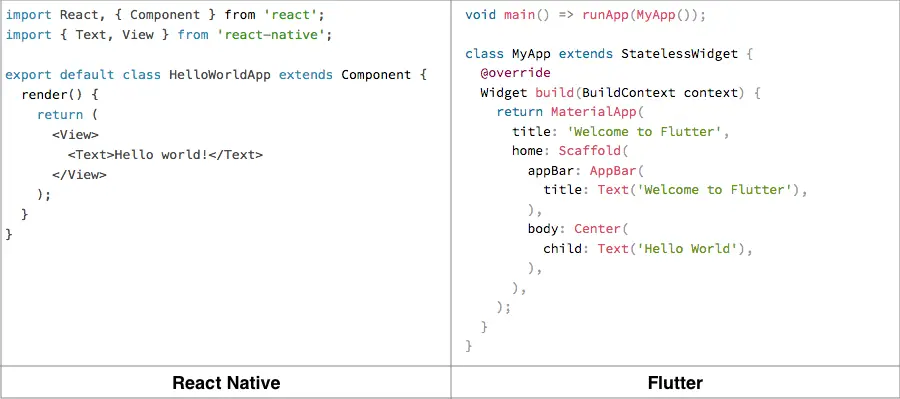
Google’s Dart does not have separation of template, style, and data files. Therefore, the code becomes a little bit hard to understand. Whereas JavaScript follows a simple code structure. As a result, it is cleaner for the developers to understand and write the code.
Stability and Flexibility
One of the most imperative aspects for a flawless mobile application is stability. Both platforms have the support of leading tech communities, so there is no doubt about stability. Both have good stability.
React Native has a large community support; hence, it enjoys being one of the most popular and reliable frameworks.
On the other hand, Flutter launched its new version 3.38 in Feb 2026. This also has some impressive features for the developers.
When it comes to giving flexibility and customization, React Native is clearly leading. It offers a seamless user experience by directly interacting with Native platforms.
Flutter offers a rich set of customized widgets to create an engaging experience. Although it is in its beta version, it is trying to establish itself in the market.
Popularity & Market Share (2026 Data)
Flutter leads in GitHub with over 170,000 stars vs React Native‘s 123,000. A 2026 Statista forecast the cross-platform market share of Flutter at approximately 46% vs React Native at 35–38%.
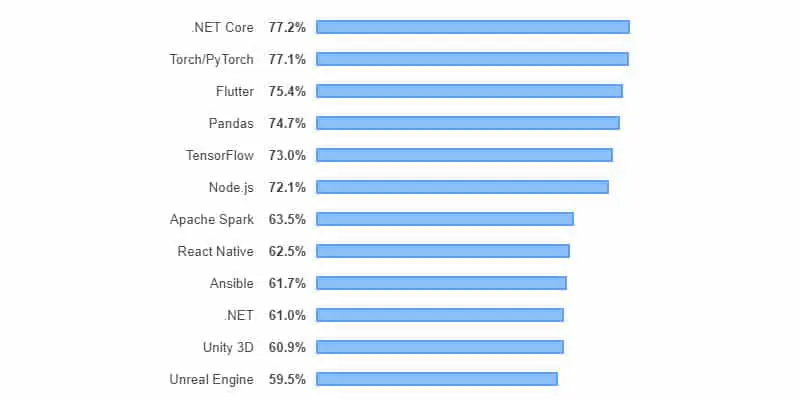
Stack Overflow‘s 2025 Developer Survey shows Flutter at 9.12% usage vs React Native at 8.43%. The gap has narrowed significantly from React Native’s 51% vs Flutter’s 29% in 2023.
React Native vs Flutter: Quick Comparison Table
Check out the key takeaways on the differences between React Native and Flutter.
| Aspect | React Native | Flutter |
|---|---|---|
| First Release | Jan 2015 | May 2017 |
| Built By | Meta (Facebook) | |
| Coding Language | JavaScript/TypeScript | Dart |
| GitHub Stars (2026) | ~123K | ~170K |
| Learning Curve | Easy for JS/React devs | Moderate; easier with OOP background |
| Architecture | New Architecture: JSI, Fabric, TurboModules | BloC, Riverpod, GetX, Provider |
| Rendering Engine | Fabric (Native components) | Impeller (custom GPU-accelerated engine) |
| Hot Reload | Supported | Supported (0.4–0.8s, state-preserving) |
| Performance | Excellent (JSI bridge eliminated) | Excellent (AOT + Impeller, 60–120fps) |
| UI Components | OS native components (Fabric) | Proprietary widgets (pixel-perfect) |
| Cross-Platform Reach | iOS, Android, Web | iOS, Android, Web, Desktop, Embedded |
| Ecosystem | Very mature, vast npm library | Growing fast, 30K+ pub.dev packages |
| Community (2026) | Large, older, web-heavy | Larger on GitHub (170K stars) |
| Time to Market | Fast (JS familiarity) | Faster (unified widget system) |
| Developer Availability | High (JS-first market) | Growing, strong in APAC + fintech |
| AI Tooling (2026) | GitHub Copilot, Cursor support | Gemini-powered widget suggestions in the IDE |
| Popular Apps | Facebook, Instagram, Shopify, Walmart | Google Ads, BMW, Hamilton, Alibaba, Tencent |
When to Choose Flutter vs React Native: Decision Scenarios
Consider the following as your decision framework between React Native vs Flutter:
Choose Flutter if:
- Your app has heavy custom UI, animations, or a branded design system.
- You need to ship across mobile, web, and desktop from one codebase.
- Your hired Flutter developer has experience in OOP languages such as Java, C++, C#, and Swift.
- You are building in fintech, automotive, or enterprise internal tools.
- Your application wants the best raw rendering performance and UI consistency.
Choose React Native if:
- Your team already has experience in the React/JavaScript ecosystem.
- You need to share code between a web app and a mobile app.
- Native look-and-feel on each platform is a product requirement.
- You need to hire a React Native developer on an immediate basis for the North American markets.
- Your app relies heavily on third-party JS library integrations.
What Are the Similarities Between React Native and Flutter?
- Both have the power of popular tech communities.
- They are for cross-platform development.
- Both allow running new code and holding application state.
- Open source, free, and fast.
- Possesses top-notch UI support & native Experience.
- Both have growing enterprise adoption across healthcare, fintech, and retail verticals.
- The React Native App cost & Flutter App cost are lower than any other native app development.
- Both now have mature architectural foundations.
Flutter vs React Native: Which One is Best to Choose in 2026?
In 2026, both Flutter and React Native frameworks will give tough competition to each other. They are production-grade, enterprise-proven frameworks. Their popularity and individual benefits diverted from’which is stable’ to ‘which fits your constraints.’
Flutter is best when your mobile application demands visual consistency and native-like performance across multiple platforms. Also, a clean architecture from the beginning. React Native is most suitable when your developer team lives in JavaScript. You need fast hiring or extending an existing web product to mobile.
To make the right call for your specific project, check for timeline, budget, team skills, and product requirements. Consider discussing with a development team that has moved production apps to both frameworks. Our Flutter app development company and React Native app development company teams at Excellent Webworld have done exactly that. Get in touch for a free framework consultation.
Frequently Asked Questions
Neither is universally better. Both have their own advantages and disadvantages. Flutter leads in performance, rendering consistency, and multi-platform reach. On the other hand, React Native leads in ecosystem maturity, developer availability, and JavaScript familiarity. The right choice is completely based on your project requirements and team composition.
Flutter’s Impeller engine gives a little superior rendering performance. Mostly for animation-heavy apps due to its 60–120fps with AOT-compiled Dart capacity. React Native’s New Architecture has closed most of the performance gap for standard apps. For general business applications, such as e-commerce, booking, and content, both frameworks perform comparably on mid-range and premium devices.
React Native still leads in North American job postings by approximately 2:1, driven by the large JavaScript developer base. Flutter jobs are growing faster, particularly in enterprise, fintech, and APAC markets. Both frameworks, React Native and Flutter, have strong career trajectories.
Not really. Each framework serves different project profiles. Flutter is replacing React Native in performance-critical and multi-platform use cases. While React Native can replace Flutter for the JavaScript-native teams and projects with web & mobile code-sharing requirements.
React Native is easier for developers already in the JavaScript or React ecosystem. Flutter is easier for developers with OOP language backgrounds, such as Java, C++, and Swift.

Article By


Paresh Sagar is the CEO of Excellent Webworld. He firmly believes in using technology to solve challenges. His dedication and attention to detail make him an expert in helping startups in different industries digitalize their businesses globally.