Key Takeaways
- Cost: $15,000 to $130,000+, depending on complexity, compliance scope, and integrations.
- Timeline: 8 weeks for a basic MVP, up to 9 months for an advanced, AI-enabled app.
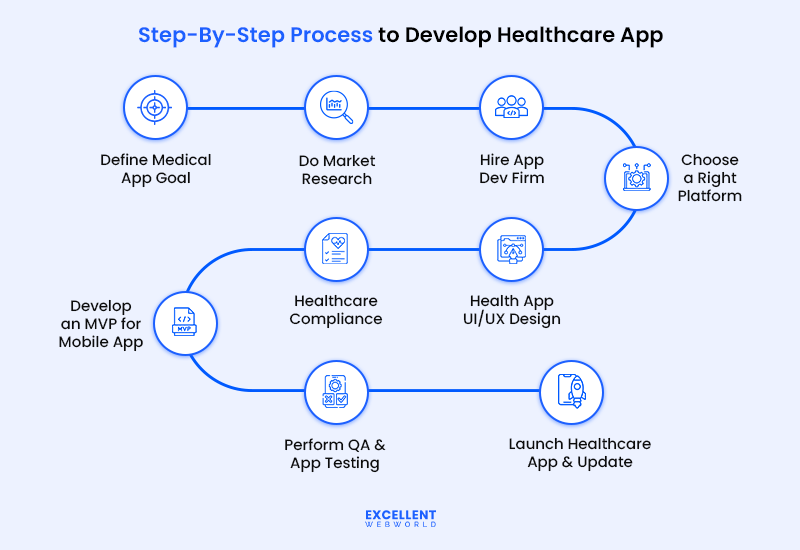
- Process: 9 steps, from defining the goal and classifying regulations to launch and ongoing updates.
- Compliance: HIPAA, HITECH, GDPR, and FDA rules (if your app qualifies as medical device software) shape the architecture from day one.
- Tech stack: Secure cloud hosting under a signed BAA, FHIR and HL7 for EHR integration, and encryption in transit and at rest.
Digital health is now standard care. It’s no longer a complex and difficult-to-implement-in-real-world scenario, which is why healthcare app development has become the bedrock of modern medicine.
From AI-powered diagnostic tools to telemedicine platforms, the healthcare apps streamline provider workflows to improve patient outcomes.
However, building a healthcare app takes more than clean code. It requires a delicate balance between HIPAA & other regional compliances, user-centric design, iron-clad encryption, robust data security, and seamless interoperability.
Because healthcare is one of the most heavily regulated industries with strict rules, regulations, & parameters, navigating it is quite difficult, especially for startup owners.
This healthcare app development guide offers a comprehensive roadmap for the complete healthcare app development lifecycle.
Whether you’re a large-scale healthcare organization looking to digitize your internal operations or a healthcare startup aiming to nail chronic disease management, it’s important that you understand the essentials so you can launch a healthcare app that is both clinically transformative and commercially viable.
Budget is usually the first question. Jump to the cost and timeline section, or read our full healthcare app development cost guide.
What is Healthcare App Development?
Healthcare app development is a process of designing, developing, testing, and maintaining mobile or web apps customized to the medical industry to improve patient care and manage health data. Not demos. Not experiments. Real patient, provider, and clinical workflows.
What makes healthcare app development different is the environment it operates in. Every healthcare app is built around constraints like:
- Protected health data that cannot be exposed or misused
- Clinical workflows that cannot be simplified blindly
- Systems that must integrate with hospitals, labs, or EHR platforms
- Regulations that influence architecture, storage, and access from the start
Because of this, it is more about making correct decisions early.
Today, healthcare apps are more advanced than basic scheduling or record access. If you look at the role of AI in healthcare app development, it’s clear how advanced platforms manage symptom analysis, patient follow-ups, and clinical decision support in real time.
What Are the Types of Healthcare Apps?
There are various types of healthcare apps that can be developed to streamline healthcare industry operations and establish ease of health tracking for patients and health-conscious people. Let’s see the different types of healthcare apps with their prominent examples to better understand: Many of these fall under mHealth app development, the broader category of mobile health apps. Read our guide to mHealth app development for more.
Healthcare Apps for Providers
These provider-based healthcare apps are more focused on improving care delivery and clinical efficiency, and these apps follow strict compliance standards like HIPAA, HITECH, and region-specific healthcare data protection laws.
- Doctor Appointment App Development: Zocdoc, Practo
- Electronic Health Records (EHR) App Development: MyChart, Apple Health Records
- Healthcare Tracking App Development: Apple Health, Health Connect (Android)
- Networking App Development (for doctors): Doximity, Sermo
- Telemedicine App Development: Teladoc Health, MDLIVE (see also telemedicine app development cost)
- Medical Reference App Development: Epocrates, UpToDate
- Medicine Delivery App Development: CVS Pharmacy, Capsule Pharmacy
- Pharmacy App Development: Walgreens, GoodRx
- Medical Billing Software Development: athenahealth, Tebra
Healthcare Apps for Patients
Patient-centric healthcare apps are built to focus more on daily health management and preventive care. While compliance still matters, user experience is a more important aspect that defines future engagement of the patients.
- Reminder App Development: Medisafe, CareClinic
- Healthy Lifestyle App Development: Headspace, Calm
- Dieting App Development: MyFitnessPal, Lose It!
- Diagnosis App Development for Preventive Purposes: Ada, K Health
- Fitness App Development: Fitbit, Nike Training Club
Looking for a build partner? Explore our healthcare app development company services.
Must-Have Features of a Healthcare App
Features depend on your users and your care model. This table lists the baseline most healthcare apps need before you add advanced capabilities.
| User Role | Core Features |
|---|---|
| Patients |
|
| Providers |
|
| Administrators |
|
Building a telehealth product? See the full list of telemedicine app features.
How to Develop a Healthcare App? [9 Simplified Steps]
Whether you are developing a desktop software solution, a web app, or a mobile platform, every healthcare application follows a systematic workflow. To simplify this, let’s discuss the mobile application development process for healthcare in nine easy steps.
Step 1. Define the Healthcare App Motive (App’s Goal)
Identify the specific problems or pain points faced by users in the healthcare industry and the requirements to understand their exact needs. Evaluate how your healthcare app can solve the issues effectively and determine its core focus, whether it is for doctor’s appointments, managing diabetes, tracking health data, or addressing other health concerns.
You must ask these questions at this stage:
- Who is the main user of this app (patients, doctors, providers, or all)?
- What problems or concerns must the app solve?
- Which features and functionalities are important for achieving your goal?
- How will success be measured after the launch (in terms of engagement, adherence, or operational efficiency)?
- Are there any similar kinds of apps in the current market?
- If yes, what gaps can you uniquely fill to stand out?
- What compliance and regulatory requirements are mandatory for your app?
- How can advanced tech like AI improve your app’s ability to meet user needs?
Considering AI in the planning phase can play a crucial role by analyzing patient behavior, healthcare trends, and feedback data to understand deeper insights. AI-driven analytics helps you prioritize features users are actually looking for, personalize care experiences, and even forecast future requirements based on usage patterns.
In clear words, defining an app’s goal is all about ensuring that it matches user expectations and achieves its primary purpose. Artificial intelligence is helping to make all decisions smarter, faster, and more user-centric.
Step 2. Prioritize Market Research to Reach the Right Healthcare Audience
Conduct thorough industry research to find out the data of competitors and gaps that can be filled by your app. Utilize this market information to define different features and functionality that will make your app stand out from the competition.
Here are the insightful tips that help you make your research more actionable.
- Sort out the top 3-5 competitors and list which features are most used.
- Analyze App Store and Google Play reviews and ratings to find user pain points.
- Track the advanced technologies in healthcare apps, like AI chatbots, remote monitoring, or wearable integration.
- Identify patterns in provider and patient behavior to understand which functionalities drive engagement.
- Research well and highlight gaps that no competitor currently addresses.
Put efforts into collecting the data-driven insights on the target audience’s specific needs and behaviors. Collect info from patients, doctors, and caregivers to make sure your app is serving what they actually want.
Step 3. Ensure Healthcare App Compliance [Risks & Regulations to Consider]
Start here, because compliance decides your architecture, hosting, and whether you need an FDA pathway. First confirm two things: whether your app qualifies as Software as a Medical Device (SaMD), and whether you are a HIPAA covered entity or a business associate.
Healthcare apps consist of private data processing regarding users’ profile information, contact information, health data, etc., which needs protection under privacy concerns. Let’s discuss key compliance related to the health sector that is mandatory for healthcare app development, which ensures risk and regulations.
- HIPAA (USA) : Protects patient data privacy and security in U.S. healthcare apps; ignoring this and developing with non-compliance leads to heavy penalties.
- GDPR (EU): Regulates data collection and user consent for healthcare apps targeting European Union residents.
- HITECH Act (USA): Strengthens HIPAA rules, ensures secure electronic health record (EHR) handling and notification.
- FDA Guidelines (USA): Applies to mobile medical app development that impacts diagnosis, treatment, or patient monitoring outcomes. If your product behaves like a device, see our guide to medical device development.
- ISO 13485: Quality management standard for medical device software, relevant if your app qualifies as Software as a Medical Device (SaMD).
- ISO/IEC 27001: Make sure to implement robust data security management systems to safeguard healthcare information from breaches.
- PIPEDA (Canada): Mandates how personal health information is collected, used, stored, and disclosed in Canadian healthcare apps.
- DPA (UK): The Data Protection Act aligns with GDPR for the secure processing of health-related personal data.
- FTC Health Breach Notification Rule (USA): Applies to consumer health apps that fall outside HIPAA and requires notification after a breach of health data.
- State privacy laws (USA): Laws such as Washington’s My Health My Data Act and California’s CMIA add consent and data-handling rules beyond HIPAA.
- 21st Century Cures Act (USA): ONC information-blocking rules limit practices that interfere with access to electronic health information and shape how EHR-connected apps expose data.
- SOC 2 and HITRUST: Third-party security attestations that many health systems request during vendor reviews.
- WCAG (accessibility): WCAG 2.1 AA is the common benchmark for accessible digital products and supports ADA-related expectations.
Encrypt PHI in transit (TLS 1.2 or higher) and at rest (AES-256), and sign a Business Associate Agreement (BAA) with your cloud provider and every vendor that touches PHI. Additionally, you can use compliance-driven tools to match all the healthcare regulations and develop a HIPAA-compliant app with unique features.
Step 4. Select an Appropriate Platform and Architecture as Per Your Healthcare Needs
Choose a suitable platform for your healthcare app, such as Android, iOS, web, or cross-platform, based on the preferences of your target audience. Base this decision on your own user research, not on assumptions about age groups.
Customize your platform choices to match the expectations of your intended users. Android, iOS, or hybrid app development, whichever method you choose will determine the tech stack expertise you need in your team.
Decide the architecture now as well: cloud hosting under a BAA, an API layer built on FHIR for EHR connections, and a separate compliance rules layer (see the tech stack section).
May You Want to Read: Android vs. iOS App Development
Step 5. Work On User-friendly UI/UX Design of Healthcare App
The UI/UX of your app is a crucial thing for the success of your business idea. If you thought of an excellent solution for your patients, doctors, or any other health professionals, but they find difficulty using your app, then it doesn’t work at all.
So make sure you are choosing the right company that provides expert UI/UX design services, or hire expert UI/UX designers who have your industry experience and understand the user perspective of using an app.
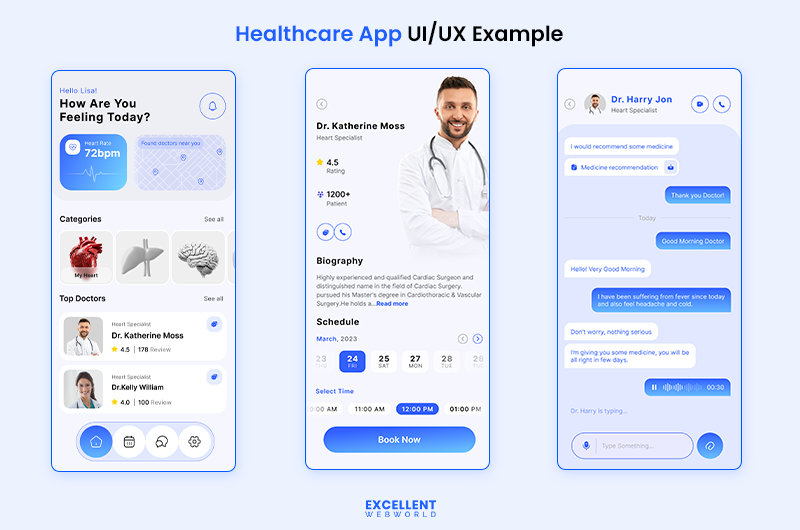
- For older users, design a healthcare app with simple navigation and larger fonts to ensure ease.
- On the other hand, younger users prioritize vibrant, colorful, and eye-catching UIs with advanced features and functionality.
Moreover, what you can do is to align your design with emerging healthcare UI trends, like easy navigation, dark mode, and micro-interactions, to make your app engaging in a highly competitive market. Make sure your UI is compatible with different screen sizes to satisfy a large audience and offer a seamless user experience. Design to WCAG 2.1 AA from the start so the app works for users with visual, motor, or hearing impairments.
Step 6. Build Your Team: In-House or Development Partner
If you work with a mobile app development company, prioritize a team with a strong product mindset and the ability to scale with you. Check the following criteria:
- Team experienced in healthcare compliance, like HIPAA, HITECH, or local laws.
- Portfolio with apps of similar functionality or scale.
- UI/UX designers with healthcare expertise for patient-first interfaces.
- Developers familiar with AI, wearables, or telemedicine integration.
- Prioritize long-term collaboration and low team turnover.
- Request case studies or references showing measurable healthcare outcomes.
Alternatively, build an in-house team of business analysts, UI/UX designers, and developers. This gives you more control but takes longer to hire, and you will still need compliance expertise. A long-term collaboration and high employee retention are signs of a good development company, which ensures consistency and expertise throughout the development cycle.
Pro Tip: If you are looking to run your healthcare operations more smoothly, investing in both a web platform and a mobile app through a reliable software development company experienced in healthcare solutions is a better idea. Such a team can help integrate AI and create an engaging experience for patients and providers alike. Excellent Webworld has successfully delivered HIPAA-compliant healthcare solutions with a skilled team of developers and designers.
Step 7. Develop an MVP for a Healthcare Mobile App and Integrate with EHR Systems
Build a Minimum Viable Product (MVP) to test your healthcare app’s core features and functionality before investing in full-fledged app development. You can develop a minimum viable version of your app, test it with real-world users, and make changes accordingly based on the feedback received from them.
One more advantage of this step is that the cost of MVP development is more affordable than the full-fledged app, so your budget is also managed well. Moreover, you can demonstrate your healthcare app demand and capabilities to attract investors. This way, you can reduce launch risk and learn what users actually need before scaling.
Integrate with EHR and hospital systems during the MVP, not after it. Use HL7 and FHIR interfaces, and test against the EHR vendors’ sandbox environments before touching live patient data.
Step 8. Perform QA and App Testing
Never skip the part of QA and testing; thoroughly test your healthcare mobile app before deployment to ensure a stable and secure user experience. Continuously monitor and update your app to provide ongoing support and improvements to your users.
- Functional testing to confirm features work as intended.
- Non-functional testing to evaluate performance, speed, and stability.
- Compatibility testing across devices, screen sizes, and OS versions.
- Security testing to identify vulnerabilities and data exposure risks.
- User acceptance testing to validate real-world usability.
You can leverage usability testing tools to assess navigation flow, accessibility, and user interaction patterns for a smoother experience.
Prioritize security, ensure compliance with the industry guidelines & policies, and verify Protected Health Information (PHI) and Personally Identifiable Information (PII). Before launch, run penetration testing and a HIPAA security risk analysis, and fix every high-severity finding. Once all the bugs are resolved, the app is ready for the final deployment.
Step 9. Launch Healthcare App and Update
After you solve all the bugs and errors in the final testing and iteration, launch your healthcare mobile app for real-world users and keep the practice of continuous monitoring within your hired team. Developing a health app is not a one-time process; ongoing maintenance and regular upgrades are necessary to ensure long-term business success.
Collaborating with a top mobile app development company like Excellent Webworld offers post-deployment app maintenance support services for your health app. Adapting this privilege on a consistent basis keeps your app running and updated as per the latest trends, which leads to customer loyalty and retention.
- Publish on popular app stores (e.g., Apple App Store, Google Play Store).
- Ensure cross-platform compatibility (iOS, Android, web).
- Establish partnerships with healthcare providers.
- Integrate with Electronic Health Records (EHR) systems like Epic or Oracle Health (formerly Cerner).
- Implement targeted marketing campaigns.
- Encourage referrals through referral programs or incentives.
- Collaborate with health insurance companies.
- Conduct patient education and provider training.
- Localize the app for different regions and languages.
- Continuously improve based on user feedback.
Post-launch KPIs to track:
- 30-day user retention and active users
- Appointment completion and no-show rates
- Medication or care-plan adherence (for patient apps)
- Clinician time saved per task (for provider apps)
- App store rating and crash-free sessions
- Security incidents and audit findings
***Please note that the above-listed pointers are generic for health sector apps; you can pick only those that suit your healthcare app niche.
What is the Smart Use of AI in Healthcare App Development?
Implementing artificial intelligence in app development is very important if you are looking for advanced functionalities, including predicting health risks, developing the transcription of medical documents, and end-to-end drug discovery.
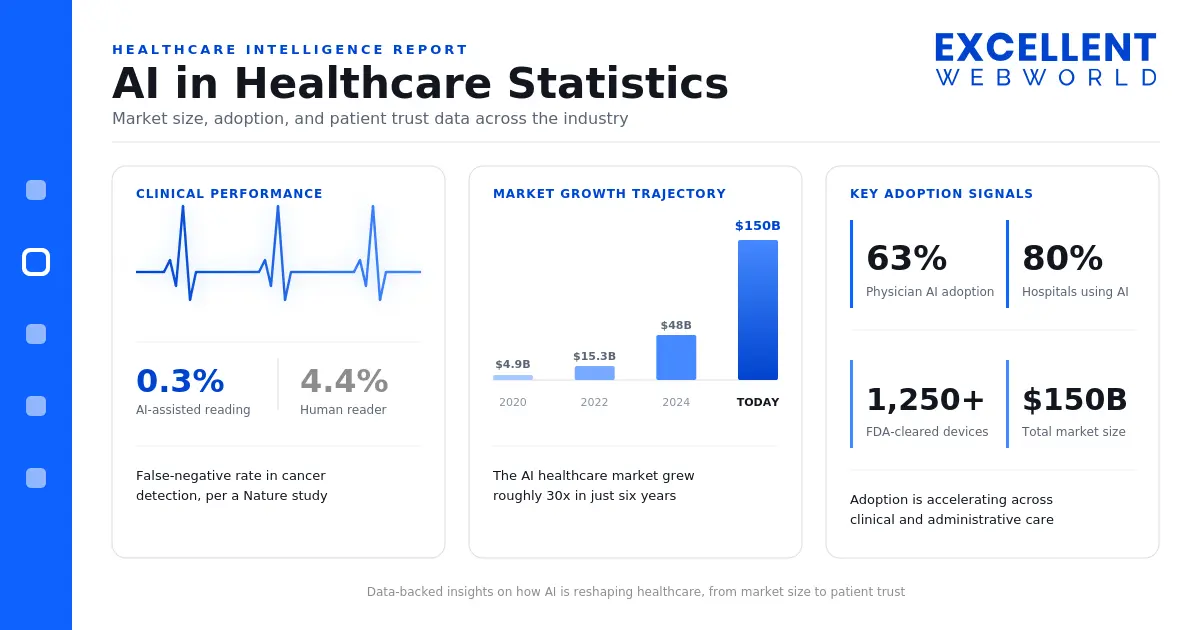
Statistics of AI in healthcare actually define that people are adopting AI and revolutionizing the healthcare sector on a grand level. With the use of AI and ML algorithms, early diagnosis, finding health patterns, and analyzing health data-like tasks can be done in cutting-edge healthcare solutions.
AI Applications in Healthcare Apps
There are many use cases of AI in the healthcare industry; to embrace it efficiently, you need to hire the right tech partner, like Excellent Webworld, which has a team of experts that provides productive AI development services. Let’s learn some of the popular applications of AI for healthcare solutions.
- Diagnosis: Huge medical data is processed by AI, which helps doctors step in early and make more accurate diagnoses.
- Prescription Support: With AI assistance, doctors can make the most effective decisions about prescribing medications to the patient.
- Medical Imaging: AI helps medical staff in analyzing medical images like X-rays, ultrasounds, MRIs, and CT scans.
- Patient Records Management: AI analyzes large volumes of patient data available in EHRs (Electronic Health Records); see our guide to AI for EHR. This way, diseases can be predicted and prevented.
- Virtual Assistants and Chatbots: AI chatbots handle symptom triage, appointment booking, and follow-ups. See our guide to AI chatbots in healthcare.
AI that influences diagnosis or treatment decisions may fall under FDA oversight, so check this in Step 3. To plan the budget, read our breakdown of the cost of implementing AI in healthcare.
What are the Top Benefits of Healthcare Application Development?
Entrepreneurs are revolutionizing care delivery by developing a healthcare app with the industry’s top healthcare app developers. This is what leads to accessibility and streamlined workflows, improved communications, and many more benefits.
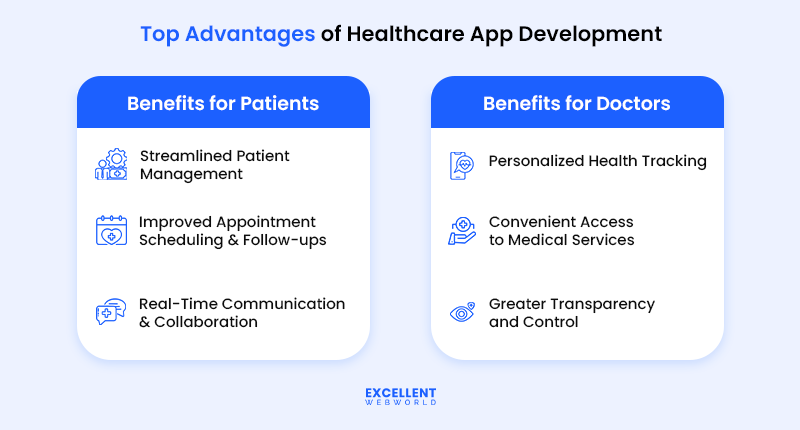
The global healthcare IT market is projected to reach USD 1.16 trillion by 2031, growing at a CAGR of 14.7% (Source: Mordor Intelligence). So let’s explore why it’s better to opt for healthcare or medical application development.
1. Healthcare App Benefits for Doctors and Healthcare Professionals
Here are the most common benefits experienced by doctors and other professionals who work in the healthcare sector.
a) Streamlined Patient Management Medical history, prescriptions, lab results, and everything related to patient data can be centralized in the healthcare app. This way, it becomes super convenient for doctors to access and update records in real time.
Example: Faster patient handovers between shifts or departments
b) Improved Appointment Scheduling & Follow-ups Healthcare professionals can reduce no-shows and manage their daily workflow efficiently, as the automated appointment systems and in-app reminders work properly. Some medical apps also provide integrated teleconsultation features to assist remote patients seamlessly.
Example: Automated reminders reducing missed follow-ups for chronic care patients.
c) Real-Time Communication & Collaboration Sometimes, when doctors need a second opinion to ensure accurate results, a healthcare app can give secure access to chat or video consult with colleagues or specialists. This collaborative approach improves care quality, especially in complex or emergency cases.
Example: Instant specialist input during emergency or critical care cases.
2. Healthcare App Benefits for Patients and General Users
Let’s discuss the key advantages of using a healthcare app by a patient or any other general user.
a) Personalized Health Tracking Many medical application development works on serving features like symptom checkers, fitness tracking, and medication reminders, allowing users to take charge of their lifestyle and well-being proactively. Data-driven details also benefit in performing early diagnosis and lifestyle management.
Example: Daily symptom logs help detect early warning signs.
b) Convenient Access to Medical Services A healthcare app for patients is like visiting a clinic at their fingertips. Medical services such as appointment scheduling, video consultations, and ordering prescriptions can be done from an app. No more waiting rooms or long commutes.
Example: Video consultations replacing routine clinic visits.
c) Greater Transparency and Control Patients can view their medical records, track progress, and even compare treatment options or providers. Mostly, EHR systems help you offer these features to your patients, which leads to transparency, builds trust, and empowers informed decision-making.
Example: Live access to test reports and treatment progress.
Pair these features with patient engagement software capabilities such as reminders, secure messaging, and educational content to keep users active.
Custom vs Ready-Made Healthcare App Development
Choose based on how unique your workflows are and how deeply you need to integrate with other systems.
- Custom development: Full control over workflows, compliance design, and integrations. Higher upfront cost and longer timelines, but no vendor lock-in and easier scaling.
- Ready-made or white-label: Faster to launch and cheaper at the start. Limited customization, harder EHR integration, and ongoing license fees.
A common path is to validate the idea with a ready-made tool or a custom MVP, then move to a custom build once the model is proven.
Technology Stack You Must Consider for Healthcare App Development
In the healthcare sector, every technology decision must support secure data handling and future feature expansion without rework. So let’s check out the complete healthcare mobile application development tech stack.
| App Layer | Technologies to Consider | Why It Matters in Healthcare |
|---|---|---|
| Mobile Frontend |
|
Ensures performance, accessibility compliance, and stable UI for clinical workflows |
| Web Frontend |
|
Used for admin panels, dashboards, and provider portals |
| Backend |
|
Supports secure APIs, business logic, and system integrations |
| Database |
|
Handles structured patient records and unstructured health data |
| Cloud Infrastructure |
|
Provides HIPAA-eligible hosting when covered by a signed BAA, plus data backups and scalability |
| API Standards |
|
Enables smooth EHR and hospital system integrations |
| Security Layer |
|
Protects PHI and ensures controlled system access |
| AI and Analytics |
|
Powers diagnostics, predictions, and data insights |
| Wearables and Device Data |
|
Syncs vitals and activity from consumer wearables. See our guide to IoT in healthcare. |
Insightful Tip: Instead of hard-coding compliance logic into the core backend, you must make sure to maintain a separate compliance rules layer. This allows faster updates when regulations change, without touching clinical workflows or re-certifying the entire healthcare application.
EHR and FHIR Integration for Healthcare Apps
Most clinical apps need to read from, and sometimes write to, the EHR. These practices keep integration manageable:
- Use FHIR APIs where the EHR supports them, and expect HL7 v2 interfaces in older hospital systems.
- Use SMART on FHIR for app authorization and launch inside the EHR.
- Start with read-only access, then add write-back once data mapping is proven.
- Build and test in vendor sandboxes before touching live patient data.
- Plan for differences between vendors. Epic and Oracle Health expose different APIs and onboarding processes. Our Epic vs Oracle Health (Cerner) comparison explains the trade-offs.
How to Monetize a Healthcare Mobile App?
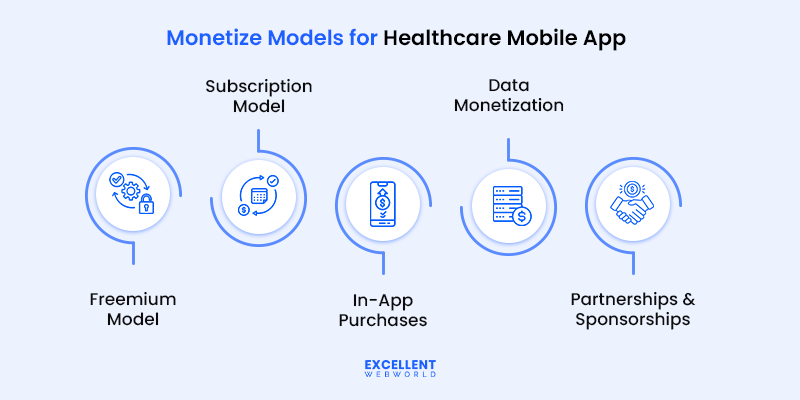
It’s essential to carefully evaluate and choose the monetization strategy that aligns with your app’s value proposition, user base, and market dynamics. Consider balancing revenue generation with providing a valuable and user-friendly experience to ensure long-term success.
1. Freemium Model
Offer a basic version of your app for free, while charging for premium features or advanced functionalities. These allow users to experience the app’s core value and encourage them to upgrade for additional benefits.
You see, MyFitnessPal offers free calorie tracking, with paid plans unlocking advanced nutrition insights and reports.
2. Subscription Model
Implement a subscription-based pricing structure, where users pay a recurring fee to access the full range of app features or content. This model can provide a steady revenue stream and ongoing engagement with users.
You see, Calm and Headspace use monthly and yearly subscriptions for guided meditation, sleep content, and mental health programs.
3. In-App Purchases
Offer additional services, content, or virtual goods within the app that users can purchase. This could include premium health content, personalized consultations, or access to specialized features.
4. Data Monetization
If your app collects anonymized and aggregated data, you can explore partnerships with researchers, healthcare organizations, or pharmaceutical companies who may be interested in purchasing insights or data trends derived from your app’s user data storage (ensuring privacy and legal compliance).
This is the highest-risk model in healthcare. Under HIPAA you generally cannot sell PHI without patient authorization, and FTC enforcement and state privacy laws also restrict selling consumer health data. Get legal review before pursuing it.
5. Partnerships and Sponsorships
Collaborate with healthcare providers, clinics, or pharmaceutical companies to promote their services or products within your app. These can include displaying relevant advertisements or featuring sponsored content.
You see, Zocdoc partners with clinics and healthcare providers, monetizing appointment bookings while improving patient access.
How Much Does It Cost and How Long Does It Take to Build a Healthcare App?
Healthcare app development cost ranges from $15,000 to $130,000+, and timelines run from 8 weeks to 9 months, depending on various factors which we will discuss further. First, let’s have a detailed cost structure of a healthcare app from an MVP to an enterprise level application. The following table provides the cost and timeline estimation based on the healthcare mobile app complexity.
| App Type | Features Type | Healthcare App Development Cost | Timeline |
|---|---|---|---|
| Basic MVP | Only Core Features and Functionality | USD 15,000* to 25,000 | 8 to 12 weeks |
| Mid-Level Healthcare App | Moderate Functionality, Such as Appointment Scheduling, Virtual Meetings, Health Tracking, etc. | USD 30,000 to 60,000 | 3 to 5 months |
| Advanced Healthcare App | Advanced Features Based On AI Implementations and Complex API Integrations, Such as Voice-Search, 24/7 Chatbot Support, etc. | USD 70,000 to 130,000+ | 6 to 9 months |
*Starting figure assumes a single-platform MVP with limited integrations and one user role. Apps with EHR integration, multiple user roles, or an FDA pathway cost more.
For a feature-by-feature breakdown, read our healthcare app development cost guide.
Note that the above-mentioned ranges vary with different factors. Let’s discuss all of those factors affecting the total budget and timeline of healthcare mobile app development.
- Regulatory and compliance requirements (HIPAA, GDPR, HITECH)
- Type and sensitivity of healthcare data handled (PHI, diagnostics, vitals)
- Feature complexity and AI implementation level, including model training and validation
- Third-party integrations (EHR systems, wearables, labs)
- Number of user roles and workflow complexity
- Platform coverage and device support (Android, iOS, web)
- Security architecture and scalability requirements
- QA, security testing, and audit cycles
This was all about the cost involved in creating an app for healthcare needs. If you plan to build a full healthcare software solution, including both a website and a mobile app, the budget and the app development timeline will vary based on features, integrations, and compliance requirements. Careful planning and collaboration with an experienced development team help keep your project on schedule.
Challenges and Best Practices in Healthcare App Development
Developing a healthcare app is like you are entering a space where data sensitivity, complex workflows, and strict regulations intersect. Each small misstep impacts patient trust as well as your app’s success in the market. So, let’s discuss each of the challenges in detail.
1. Lack of Proper Regulatory Compliance
Laws like HIPAA and HITECH make compliance a requirement that cannot be ignored by healthcare apps. If you ignore minor regulatory details, it leads to a delay in launch or damages your reputation. Privacy, data retention, and audits should be your priority to ensure approval.
- You must involve your compliance specialist from the beginning and document workflows.
- You must build privacy-by-design into your architecture with automated audit trails.
2. Inadequate Data Security and Privacy Measures
On a daily basis, healthcare apps store and manage sensitive data, which includes PHI, diagnostics, and personal identifiers. One small security lapse can easily destroy user confidence and trigger legal actions. Security is something that affects how users feel about sharing personal information on your platform.
- You must implement encryption in transit and at rest and secure multi-factor authentication.
- You must perform regular penetration testing and continuous security monitoring.
3. Difficulty Integrating Multiple Third-Party Systems
One of the common necessities for a healthcare app is integrations with EHRs, lab systems, insurance APIs, and wearables. Different platforms use different standards and communication protocols. That’s where mismanaged third-party connections frustrate patients and interrupt provider workflow. If you are connecting to legacy hospital systems, a healthcare software modernization plan often needs to come first.
- You must standardize integration using FHIR or HL7 protocols.
- You must test across multiple API versions and implement strong error handling.
4. Inability to Scale for High Traffic and Complex Workflows
At times, your app might need to manage thousands of teleconsultations and AI-driven predictions simultaneously. Without proper architecture and performance planning, you risk slow response times, crashes, and a poor patient experience.
- You must use cloud-native architecture with load balancing and auto-scaling.
- You must conduct stress testing to ensure smooth performance under peak usage.
Healthcare App Development Trends in 2026
These shifts are shaping what healthcare apps need to support. Treat them as planning inputs and validate each one against your own users and compliance scope.
- Ambient AI documentation: Apps that listen to visits and draft clinical notes reduce charting time. See our guide to ambient AI scribe development.
- AI-driven administrative automation: Prior authorization, claims, and intake are common targets. Read more on AI prior authorization in healthcare.
- Remote monitoring and wearables: Connected devices feed continuous data into care workflows.
- FHIR-first interoperability: Modern EHR integrations are increasingly built on FHIR APIs, with HL7 v2 still common in hospital messaging.
- Privacy by design and consent management: Stricter state laws push apps toward granular consent and clear data-use controls.
- Telehealth as a standard channel: Virtual care is now a permanent part of care delivery. Explore telehealth trends.
Develop a Healthcare Solution That Patients and Doctors Trust
As healthcare apps are no longer a luxury business idea, they have become a necessity in the fast-moving lifestyle of today’s generation. With features like appointment scheduling, virtual consulting, improved care coordination, or reduced operational costs, a great healthcare app can create a massive impact on patients, health professionals, clinical outcomes, and business growth.
You just need a good tech partner who makes efforts to make your healthcare business idea a reality. As a top-notch AI-driven healthcare app development company, our team at Excellent Webworld builds secure, scalable, and user-friendly healthcare applications.
With years of experience in HIPAA-compliant development, AI integration, and custom telehealth solutions, we help startups, clinics, and enterprises turn bold healthcare ideas into high-performing digital products. Let’s build your next-gen healthcare solution together to thrive tremendously.
FAQs About Healthcare App Development
Healthcare app development costs range from USD 15,000 to 130,000+, depending on features, complexity, and compliance needs. A basic MVP sits at the low end, while AI-driven apps with EHR integrations and multiple user roles sit at the top. See our healthcare app development cost guide for a feature-by-feature breakdown.
A basic MVP can take 8 to 12 weeks, while a fully featured app development may take 3 to 9 months or more, based on the app complexity. A mid-level app typically takes 3 to 5 months, and an advanced, AI-enabled app takes 6 to 9 months.
Absolutely. AI enhances symptom checking, diagnostics, patient engagement, and admin automation. A team of professional AI integration developers at Excellent Webworld can help you build an AI-based healthcare solution that ensures your business success.
Your healthcare app must comply with HIPAA in the United States, GDPR in Europe, and HITECH, plus FDA rules if it qualifies as medical device software. HL7 and FHIR are interoperability standards, not regulations, and should be used for secure data exchange.
Custom healthcare app development is well-suited, as it gives you the freedom to design and develop your app according to your preferences as well as users’ preferences. Ready-made solutions work for basic use cases but lead to limitations in customization and integration flexibility.
There are several functionalities that healthcare app uses such as encrypted data storage, secure APIs, role-based access controls, and regular security audits. And, privacy is maintained through consent management and strict handling of PHI and PII data.
Integration with EHR or particular hospital systems is carried out via secure APIs and healthcare interoperability standards like HL7 and FHIR, allowing error-free data transfer between the app and hospital system.
Yes, cloud hosting is safe when compliant cloud providers are used. When configured correctly, AWS, Azure, and Google Cloud offer data residency controls and compliance support.

Article By


Mayur Panchal is the CTO of Excellent Webworld. With his skills and expertise, he stays updated with industry trends and utilizes his technical expertise to address problems faced by entrepreneurs and startup owners.