Why Is This Article On MERN Stack Development Worth Your Attention?
MERN is not just a tech stack; its outcomes make it a user-first stack. Yes, if you see it from user expectations, you will find:
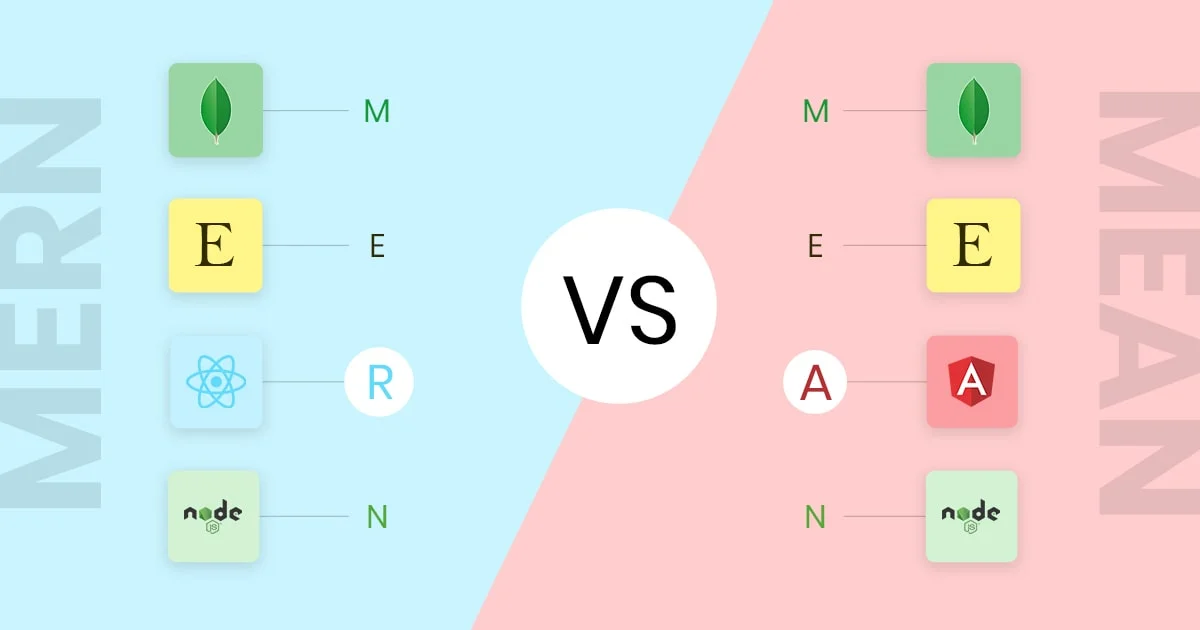
M – MongoDB – Modern experience
E – Express.js – Effortless performance
R – React – Responsive interface
N – Node.js – Next-level scalability
So, in this competitive world, if you want to promise fast, seamless, and reliable web applications to users, then considering MERN stack development is the best thing you can do.
Enterprises invest heavily in digital products, but many fail to achieve good ROI due to slow, fragmented, and poorly scalable platforms. These challenges rise not from budget or team size, but from technology decisions made early in development. Choosing the right tech stack is essential for building fast, scalable, and future-ready web applications. In such scenarios, choosing the MERN stack web development becomes an advantage for organizations that want performance-driven web applications.
MERN stack gives the ability to support rapid iteration, real-time experiences, and long-term scalability, enabling enterprises to turn their web app ideas into reality. That’s why understanding how MERN aligns with modern user expectations and helps enterprise growth models is crucial, not optional. In this blog, we have explained everything regarding the MERN stack development, including architecture, features, use cases, and best practices to implement it.
What Is MERN Stack Development?
The MERN stack development process is the modern approach preferred by web developers to create dynamic full-stack web applications. At its core, it’s a collection of popular JavaScript technologies, including MongoDB, Express.js, React.js, and Node.js, which leads to seamless experiences. The thing that makes the MERN stack valuable among businesses is its ability to support end-to-end web app development (frontend, backend, and database) with a single programming language. This reduces development complexities across teams and systems.
Organizations that struggle to manage large-scale applications efficiently can use the MERN tech stack, which enables faster development cycles, easier maintenance, and seamless collaboration between teams. Most importantly, MERN fulfills modern world requirements like AI-powered real-time performance and rapid feature iteration. Ultimately, it becomes the practical choice for long-term digital products rather than trying it for short-term experiments.
What Are the Core Components of MERN Stack Development?
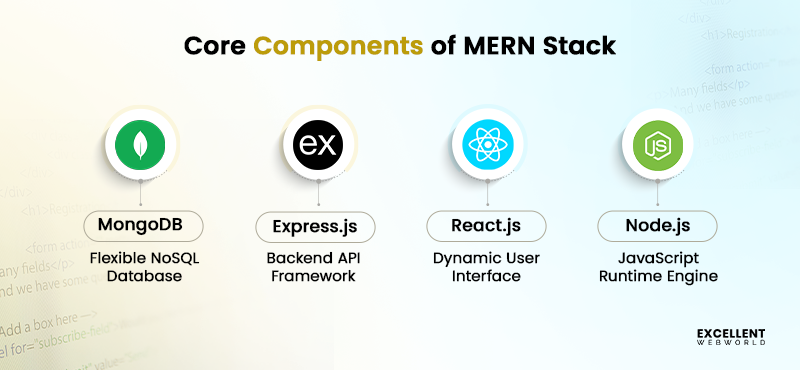
The key strength of MERN is in how each component plays a different yet tightly connected role within the application ecosystem. Let’s figure out the core components of this stack:
MongoDB (Database)
MongoDB in the MERN stack is an open-source NoSQL database that is popular for its scalability and flexibility. It leverages a document-oriented data model, which means you can work with data in a more natural way as compared to traditional relational databases.
Express.js (Backend Framework)
Express.js is a web development framework for the Node.js programming language that makes building web apps and APIs easy and efficient. Routing, middleware, and other common web app features are handled in a simple and minimalistic way with Express.js.
React (Frontend Library)
React is a resourceful library for developing user interfaces. With React, you can build components that can be reused and composed to create complex user interfaces. Moreover, it uses a virtual DOM to optimize performance consistently.
Node.js (Runtime Environment)
Node.js is known as a JavaScript runtime that allows you to do server-side JavaScript execution. To serve real-time, data-intensive enterprise applications, it is developed on top of the V8 JavaScript engine and a non-blocking I/O model.
How MERN Stack Architecture Works?
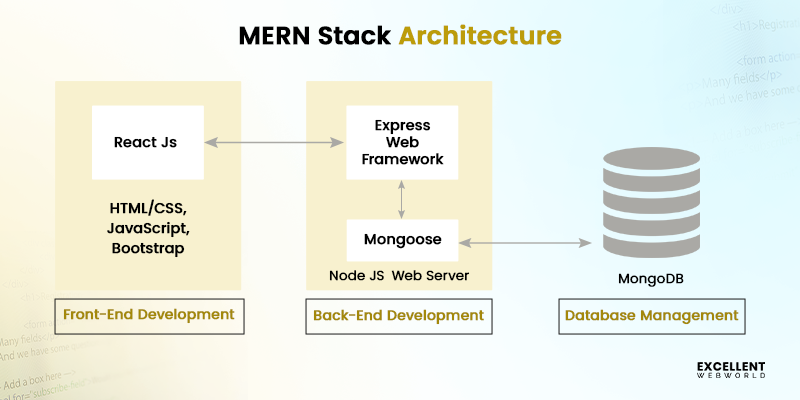
MERN follows a layered and API-driven architecture to be the best tech stack for web applications, which leads to scalability and performance. Here’s the MERN architecture for you to better understand the contribution of each component.
MERN Stack Development Process in 8 Easy Steps
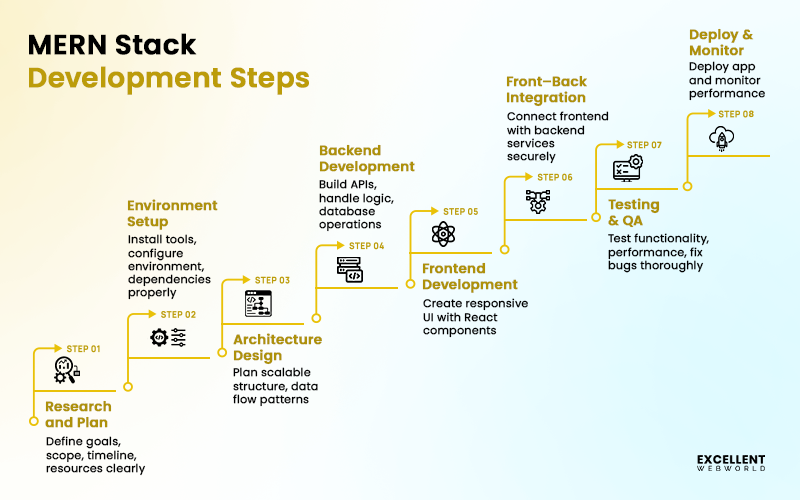
Building a MERN stack application requires a structured and iterative workflow. As MERN is about an end-to-end development, its steps should connect the frontend, backend, and database layers while keeping scalability and performance in consideration. Let’s start discussing each step with the key necessity.
Step 1: Requirement Analysis & Project Planning
The first step in full stack development with MERN is about understanding what the web application needs to achieve for businesses as well as users. In this phase, you should identify the target audience, define user journeys, list core features, and decide the app scope. The team of MERN stack developers also evaluates whether the project should start with MVP development or a full-scale solution.
Technical points like third-party integrations, data flow, scalability needs, and security expectations are also researched and finalized during the planning phase. Clear documentation of every research and decision taken at this stage helps in avoiding costly rework later in development.
Step 2: Setting Up the Development Environment
Once you find out the project requirements based on the research conclusion, a full-stack developer has to set up a structured development environment. This is to ensure smooth collaboration and consistency across teams. Here are the steps to set up the perfect development environment.
A well-organized development environment leads to a decrease in debugging time and improves development speed throughout the project lifecycle.
Step 3: Designing the Application Architecture
Before engaging your MERN stack developer in writing business logic, you need to define precisely how the frontend, backend, and database layers will interact with each other. This MERN architecture planning makes sure smooth data flow and prevents performance obstacles when the web application scales. Check which technologies play a role and what responsibilities they have for which layer.
| Layer | Technology | Responsibility |
|---|---|---|
| Frontend | React | It manages the user interface and client-side logic in the MERN architecture. |
| Backend | Express in Node.js | Best in API handling and ensuring the working of real business logic. |
| Database | MongoDB | Meant for secure data storage and retrieval. |
Designing a MERN architecture with proper planning makes your web application maintainable, testable, and extendable easily in the future.
Step 4: Backend Development (APIs & Business Logic)
Backend development creates the core module of a MERN stack application. In this stage of MERN stack development, the development team creates RESTful APIs to manage data exchange between the frontend and the database. For this, Express.js is used to define routes, and Node.js is responsible for handling the server-side execution.
Step 5: Frontend Development with React
Frontend development technologies in the MERN stack focus on creating an interactive and responsive user interface. Developers can build reusable components with the help of React to make applications faster and easier to maintain. State management makes sure data updates are reflected in real time without even reloading the page. Check what to cover in frontend development with React tech.
Step 6: Frontend and Backend Integration
This step is to make sure that all the components of the MERN stack work together as a unified system. So, once both frontend and backend modules are created in the MERN stack development, they need to integrate with each other for seamless communication. However, combining React with Node.js offers several benefits for MERN stack web development, including smoother data exchange, faster API responses, and more.
API endpoints need to be tested to ensure accuracy, response time, and error handling. Additionally, data consistency between MongoDB and React views must be validated every time to prevent any type of mismatches.
Step 7: Testing & Quality Assurance
To make sure that the MERN stack web application performs perfectly under real-world scenarios, it is crucial to conduct thorough testing and quality assurance. For modern enterprise projects, integrating AI in web development process helps teams automate all the test cases, identify possible bugs in the early stage, and predict performance issues before final deployment.
AI-powered testing tools accurately analyze application behavior, API responses, and user interactions to detect any errors or anomalies that can possibly be missed by traditional testing methods. This way, you can improve code quality, reduce manual efforts for testing, and enhance release cycles, while also maintaining application stability as well as security.
Step 8: Deployment & Post-Launch Monitoring
The final MERN stack development phase includes deploying the MERN application on the production servers. With the proper environment configuration, the frontend and backend services are hosted on cloud platforms. Following CI/CD pipelines for MERN web apps automates builds and updates, which leads to achieving faster releases.
After the final deployment of MERN web applications, taking help from monitoring tools can help track performance, uptime, and error logs. Continuous monitoring is great because it helps web development teams to identify issues early and optimize the application over time.
What Are the Advantages and Disadvantages of MERN Stack Development?
MERN stack is adopted by businesses on a global scale for building modern full-stack web applications, but like every other technology, it also has its own strengths and weaknesses. Understanding the pros and cons of the MERN stack helps entrepreneurs like you to decide whether investing in it is the right choice for your project requirements or not.
| Advantages of MERN Stack | Disadvantages of MERN Stack |
|---|---|
| Only a single JavaScript programming language is required across frontend and backend development. | A strong JavaScript expertise is a must; it can’t be compromised. |
| The reusable React components in the MERN stack enable faster development. | For large applications with advanced features, it requires careful MERN architecture planning. |
| Delivers high performance with Node.js and React Virtual DOM. | In case of poor optimizations, the web app performance can drop. |
| Scales well with futuristic tech trends for modern web applications. | Application scaling requires efforts from experienced web developers. |
| Its open-source stack characteristic reduces the web app development cost. | Possibilities of getting high infrastructure and scaling costs. |
| The JavaScript-based ecosystem of MERN makes integration with AI in web development easy. | MERN apps require high-quality data and performance monitoring for advanced AI features integrations. |
What Are the Use Cases & Applications Built Using the MERN Stack? (with Real-World Examples)
For developing scalable and high-performance web applications, the MERN stack is widely adopted by various industries. Let’s explore key segments that have adopted MERN stack development in the real world.
1. SaaS Platforms
Scalability and modular architecture of the MERN stack make it a perfect technology solution for building Software-as-a-Service platforms.
2. E-commerce Applications
The eCommerce industry leverages MERN to build fast and responsive platforms with its key features and functionalities, such as product catalogs, shopping carts, payment gateways, and order management systems.
3. Social Networking Apps
MERN stack development gives real-time capabilities with a scalable backend, which is great for building social media applications.
4. Enterprise Dashboards
An enterprise-level internal dashboard is developed with MERN as it manages analytics, reporting, CRM, and workflow efficiently.
5. Real-Time Applications
In most cases, MERN is used for real-time applications like chat apps, live tracking systems, and collaborative tools as it enables instant data updates and maintains an interactive user experience.
What Is the Cost of MERN Stack Development?
The MERN stack development cost ranges from USD 15,000 to 200,000+, based on various factors including app complexity, features, developer rates, and more. Here’s the table for you to estimate MERN stack app development cost depending on complexity levels.
| Web App Type | Estimated Cost Range | Estimated Timeline |
|---|---|---|
| MVP MERN Application | USD 15,000 to 25,000 | 6 to 8 Weeks |
| Basic MERN Web Application | USD 20,000 to 45,000 | 8 to 12 Weeks |
| Mid-Scale Web Application | USD 45,000 to 75,000 | 12 to 16 Weeks |
| Enterprise MERN Application | USD 75,000 to 150,000+ | 16 to 24+ Weeks |
| AI-Enabled MERN Application | USD 90,000 to 200,000+ | 18 to 28+ Weeks |
What Are the Best Practices for MERN Stack Development?
Now, you may have a complete understanding of the MERN stack development process, but do you know how to implement it in the best possible way? Let’s explore best practices to integrate the MERN stack.
Wrapping Up!
MERN stack development is the best and most liked choice by entrepreneurs to build modern, scalable, as well as a high-performing web applications. By combining the top technologies MongoDB, Express.js, React, and Node.js, businesses can develop flexible architectures for their web applications. This leads to rapid development, seamless app integrations, and future scalability. MERN gives speed and efficiency to web applications of various segments, including eCommerce, SaaS, and real-time systems. Undoubtedly, it is well-suited for rising business requirements and ensuring long-term growth.
For businesses that want reliable digital products, it will be beneficial for them if they partner with the right web development services provider. A leading web development company, Excellent Webworld, provides MERN stack development services to help businesses build scalable, secure, and high-quality web applications. With a strong focus on performance and modern technologies, we support end-to-end web development, including planning, deployment, and ongoing maintenance.
FAQs: MERN Stack Development
MERN stack architecture needs a complete JavaScript for development, which enables faster development, allows flexibility, and provides seamless integration between frontend and backend for modern web applications.
Yes, MERN stack technology is compatible with high performance and supports scalability. If you build with proper architecture, do database optimization, and integrate cloud-ready infrastructure, then it leads to scalable, large-scale applications.
The MERN stack development timeline generally ranges from 6 weeks to several months based on various factors such as application complexity, features, and integrations.
Yes, if you implement it with the best practices like authentication, data encryption, and integrating API security measures properly, then you will get a highly secure MERN stack architecture.
Yes, enterprises can create dashboards, SaaS platforms, and internal systems that majorly need scalability, security, and high performance by using the MERN stack.
Web developers need expertise in the JavaScript programming language, as well as skills in React, Node.js, Express.js, MongoDB, API development, and modern web security practices, are needed to build a reliable web application.

Article By


Mahil Jasani began his career as a developer and progressed to become the COO of Excellent Webworld. He uses his technical experience to tackle any challenge that arises in any department, be it development, management, operations, or finance.